17-04-25 // THE URBAN IN CONFLICT, TENSIONS AND ARCHETYPES SHAPING OUR URBAN
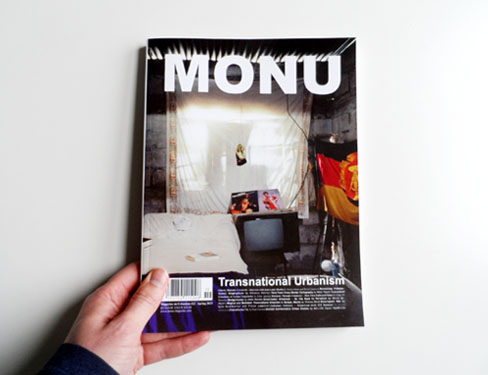
NARRATIVES AND ENVIRONMENTS - A REVIEW OF MONU #37 BY REBECCA BILLI
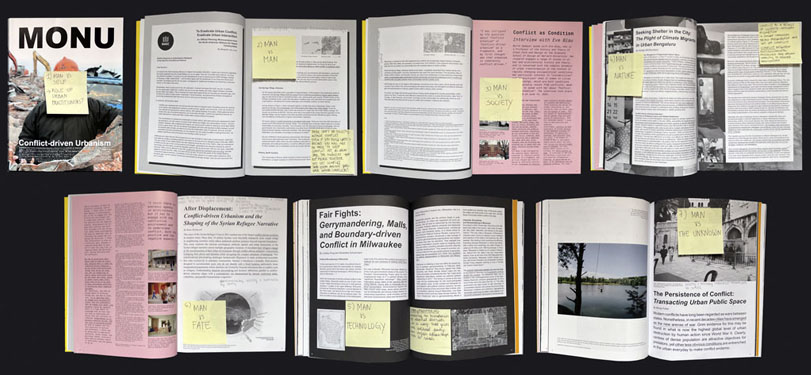
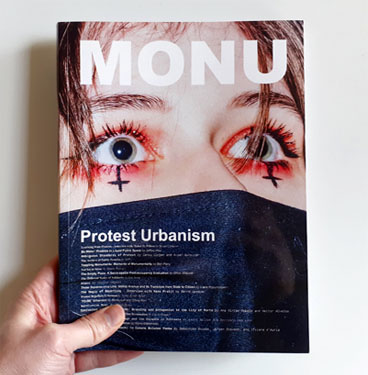
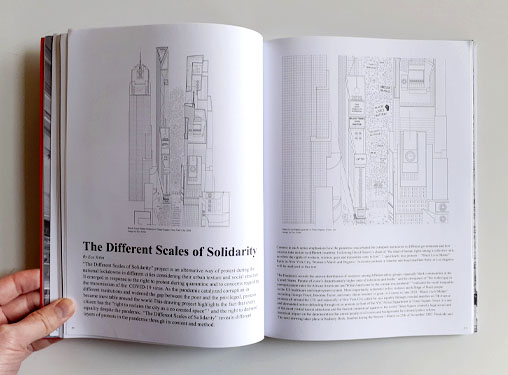
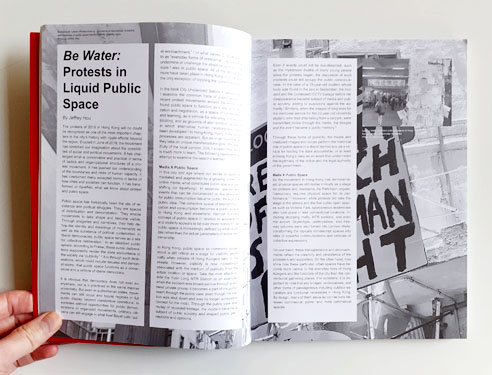
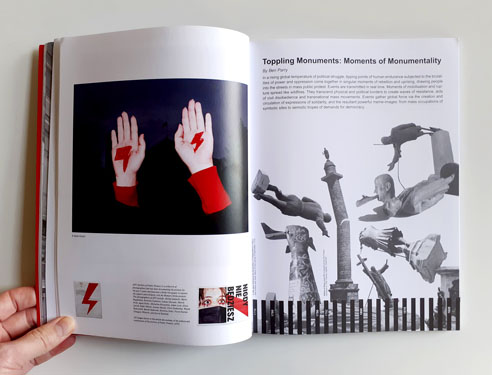
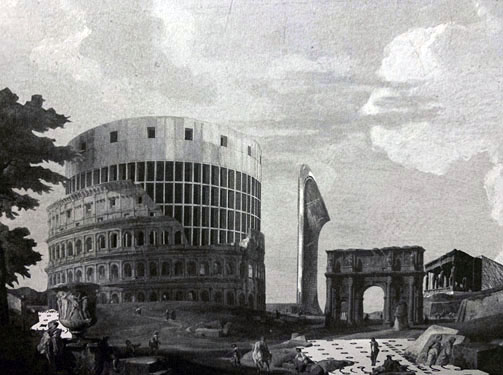
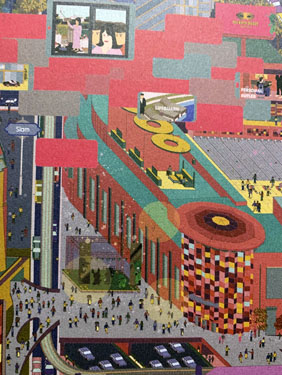
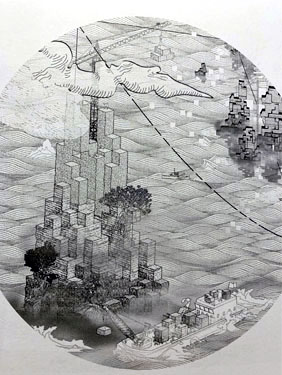
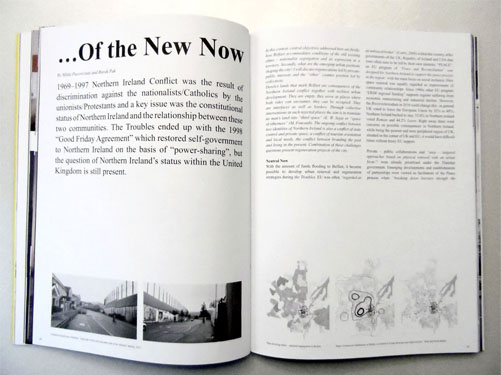
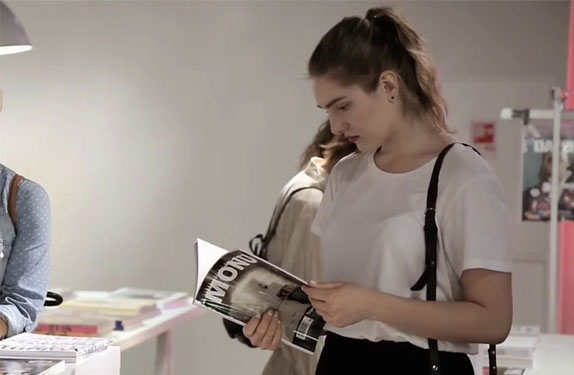
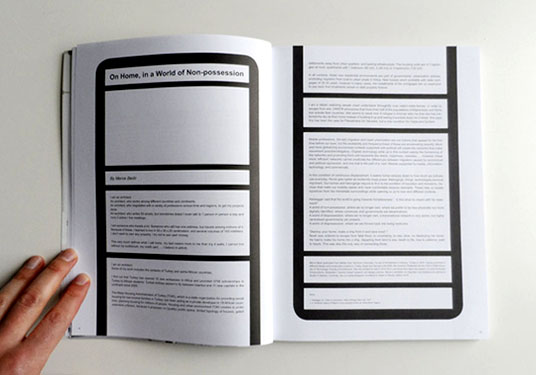
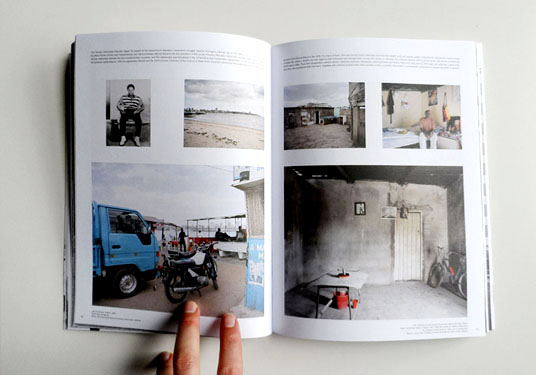
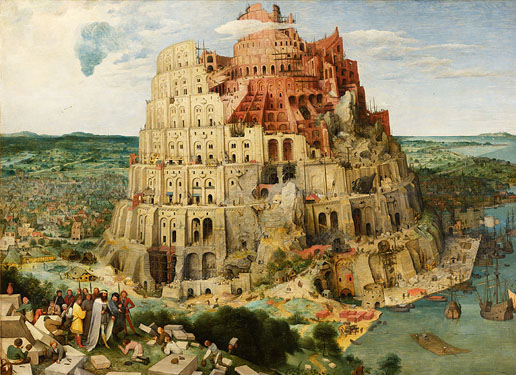
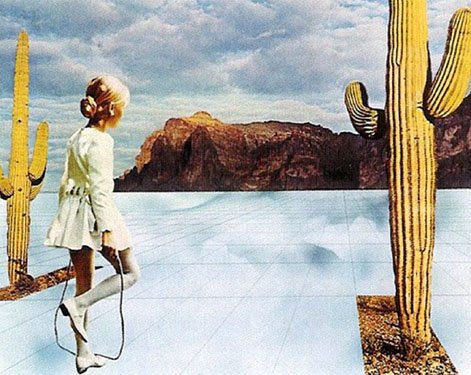
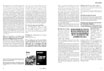
Digital Collage, MONU #37, Conflict-driven Urbanism, collage by author
When I was in high school and studying the classics, my professor highlighted
that, while the Odyssey is the epic of the journey, the Iliad is the poem of
conflict. As such, it is built on dichotomies. A dual-focused epic, its plot
and grammar structure are always bipartite. There are "a one" and
"an other." It is in this concept of "the other" that conflict
emerges. In literature, tensions have been acknowledged as instrumental to the
advancement of a plot. Analogously, in cities, conflict influences the present
and can catalyse new futures. It brings ahead both shortcomings and strengths
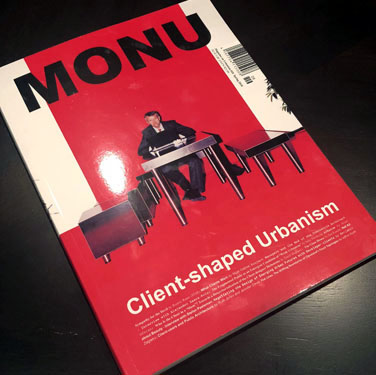
of contemporary society. The premise of MONU's
issue 37 supports the claim that conflict is a fundamental force shaping
urbanity. Cities are impacted by conflict, they are also made by it. As English
literature categorises conflicts into seven archetypal struggles, urban spaces
reflect tensions through spatial, social, and political structures as, unlike
literary production, the built environment is defined by a physical presence
impossible to ignore. Drawing comparisons between well-recognizable forms of
literary conflict and urban clashes can help understand the variety of tensions
that define urbanity and the resilient and creative potential that lies in the
response of cities and communities.
1) Man
vs Self
Even by oneself, human experience is defined by inner turmoil and strife. To
eradicate it, one would have to get rid of human beings altogether. The idea
that conflict is unavoidable, as it is embedded in the nature of men, was already
understood in ancient times, as proven by mythology and philosophical theories.
In the Phaedrus, Plato describes the soul as a chariot led by two horses of
opposing will, conducted by a charioteer who manages the conflict between them.
In cities, these inner struggles translate into societal dilemmas that have
urban manifestations. Throughout history, conflict and perceived tensions have
been instrumental and instrumentalised in shifting power dynamics and imposing
alternative forms of life. Urban practitioners have to take up the role of Plato's
charioteer, channeling and understanding the potential and limits of conflict.
2) Man vs Man
As gatherings of individuals, urban environments firstly represent a battleground
for interpersonal conflict. In his provocative fake manifesto speaking in lieu
of the made-up NAAGC (North American Alliance for Gated Communities), Benjamin
van Loon highlights the paradox of trying to avoid conflict in the urban
context through physical and policy gates. Building gates and fences to keep
more and more people away, will not keep conflict out as much as increment it
by widening disparity and encouraging tensions. Men are by nature social beings
and, as such, with a tendency to aggregate, yet they end up spending a lot of
time coming up with ways to avoid interaction and its outcomes. Another danger
of removing conflict from the urban context lies in the development of an inclination
to overlook issues and an incapability to stand for oneself when necessary.
Conrad Hamann, Ian Nazareth, and Graham Crist
paint a picture of conflict-free Australian cities. Here, confrontations are
displaced. Punishment, violence, and repression are removed from the urban context.
This creates an unrealistic and idealised image of the city as well as a biased
trust in the government, that becomes able to skew public opinion to its benefit.
Furthermore, it perpetuates conflict, as governments-tasked with addressing
societal needs-implicitly suppress their expression.
After a terrorist attack in 2020, St Mark's Square in Zagreb, Croatia, was closed
off as a security measure and then kept fenced off during COVID-19. In the aftermath
of the pandemic, the government refused to bring it back to its initial role
of public space and rather kept it as a convenient parking space. Representing
another instance of power using conflict to their advantage, Stephanie
Newcomb and Danijel Losic argue that this closure represents
an attempt to pursue personal interest without repercussion by promoting a fear-based
narrative and a negation of the identity of the space itself. What is overlooked
in this type of conflict-repressing approach is that confrontation can foster
solutions. Rebecca Smith's account of protestors' camps against
Cop City, close to Atlanta, shows how opposition becomes a form of resistance,
partaking in shaping urban landscapes. Resisting an urban vision based on control
and police-enforced order, the protestors established spaces for contestation
at various levels and across different media. Through different scales and configurations,
these became acts of creation of a different world.
3)
Man vs Society
As cities are physical manifestations of the society that built and inhabits
them, the built environment reflects societal conflicts, often becoming a stage
for contestation and transformation. As such, conflict can be highly instrumental
in driving change. Eve Blau's example of the early 1900s experimental
project "Red Vienna" shows that challenging dominant ideologies via
architectural design can be done subtly and through more subdued forms. Creating
conflict from within was key to the success of Vienna's social housing. Maintaining
their traditional appearance ensured the implementation of their more transformative
approach. The architecture of Red Vienna was highly charged politically. In
this instance, conflict was understood and, rather than resolved, used to foster
urban transformation. Similarly, Christina Schraml explores the
increasing appearance of prohibition signs in the public areas of Vienna's social
housing complexes. An advocate of human interaction and neighbourly conflict,
she claims segregation is unnatural to the essence of urbanity. Pledging it
as a citizens' right, Schraml suggests institutionalising conflict
to sustain its productive potential. When conflict is not suppressed but encouraged,
it fosters engagement in the co-creation of dynamic and adaptable living surroundings.
Promoting exchange and inclusivity becomes key to overcoming urban conflicts.
Zoë Ritts, Nikita Dhawan, and María
Castro Varela highlight how the idea of closed-off borders is neither
sustainable nor justifiable in contemporary society. While interactions potentially
produce both understandings and misunderstandings, it is the potential for interconnection
presented by conflict that should be supported when dealing with urban spaces.
Dichotomies of private vs public are dated and too often informed by a patriarchal
system. Furthermore, potentially negative conflict emerges even more in the
shortcomings of standing societal systems. It manifests through their cracks
and gaps through positive creativity but also blind opposition. Diambra
Mariani wonders if the increased desire for self-justice expressed by
Italians, and sustained by the growth in the purchase of arms for self-defence,
is but a result of their distrust in the legal system. An opposition, again,
to the system and an attempt to fix what they perceive as a government shortcoming
in ensuring safety and justice. Sometimes, the conflict emerges in the very
attempt to fix it. Carolina Tobler reiterates the socio-political
relevance of architectural competitions examining how the 1972 call to reimagine
Santiago do Chile's center reflected its urban tensions and vulnerabilities.
Dwelling shortage, complex private/public dynamics in the context of housing
and territorial ownership defined both the competition and the international
response. Yet, solutions to these acknowledged issues were searched through
the same large projects considered to be the cause of tensions and shortcomings.
4)
Man vs Nature
Urban conflicts are exacerbated by the environmental crisis the contemporary
world is living. Kshitija Mruthyunjaya shifts the attention to
all those imbalances that sharp changes bring. Natural disasters push migration
and displacement the same way armed conflicts do. When said movement is oriented
towards existing cities, shortcomings emerge due to the latter's inability to
absorb newcomers. The lack of space and resources to accommodate migrants leads
to the vilification of the guest community. This catalyses spacial and infrastructural
conflicts, linguistic and occupational ones, and legal, administrative, and
economic conflicts which all bring about their architectural manifestations,
creating marginalised and segregated areas within the urban fabric. Yet the
urban future lies in these conflicts, in harnessing the creative potential that
comes out of an inclusive environment. Similarly, Lukas Großmann
explores how shelters, originally conceived as emergency responses, challenged
housing norms and influenced urban legislation, becoming the most impactful
form of purpose-built architecture for our times. Their introduction in the
San Francisco area in the early 1900s not only served as a response to the humanitarian
crisis but to a societal one too. They allowed low-income families to become
homeowners, which they would never have been able to afford otherwise. Crisis,
like conflict, gives way to a reshaping of the built environment by prompting
a reevaluation of legislation and standards through a resilient and responsive
urbanism.
5) Man vs Technology Lindsey Krug and Samantha Schuermann analyse the
implementation of gerrymandering in Wisconsin. Here, the conflict between urban
and non-urban areas is pronounced. Through data-driven strategies, the practice
of gerrymandering manipulates the boundaries of the districts in a way that
gives advantage to a certain political party. It is a violent act intended to
negate the inconvenient presence of the urbanised Milwaukee in an otherwise
controlled landscape. Data and census-based analysis are weaponised over urbanistic
standards reinforcing inequalities.
6)
Man vs Fate
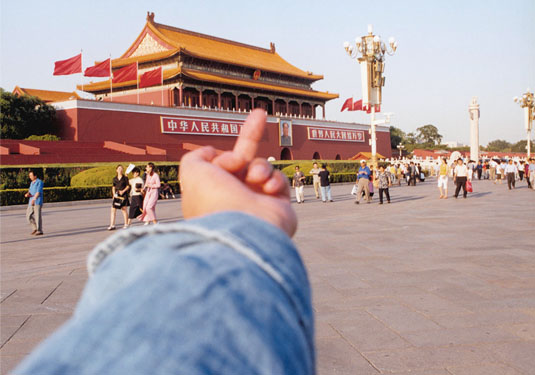
Conflict often occupies a grey area. Ai Weiwei - a famous son
of conflict himself - sees the dilemma of whether conflict is good or bad as
an inevitable aspect of human development. Ever since a young age he has felt
a call to confrontation, to ward off being absorbed by a system he held no respect
for. He notices how his own experience with conflict is born out of the cultural
cleansing of diverse opinions and the repression of dissent. A right to conflict
is inherently inscribed in human nature, yet its size and outcomes can often
exceed human control and ethics. Conflict-driven urbanism also emerges from
uncontrollable consequences of unregulated confrontation, such as war and forced
displacement. Rana Abudayyeh explores identity in refugee urbanism
and the reconstruction of urban environments in the wake of conflict-driven
exoduses. Displaced communities are forced in unfamiliar landscapes. They inform
a dislocated urbanism, built upon a shared baggage of experiences and losses.
Personal and cultural urban symbols re-emerge in temporary settlements. Hybrid
and translocational, defined by an adaptive and informal nature, refugee camps
are urban entities that escape convention, expanding the boundaries of urban
anthropology. More often than not, dealing with (armed) conflict is not a choice.
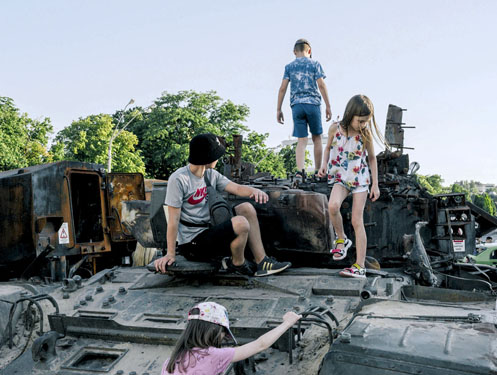
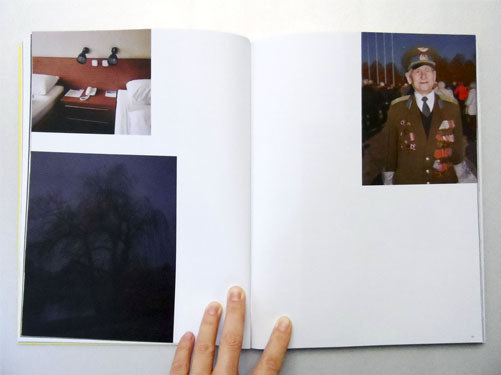
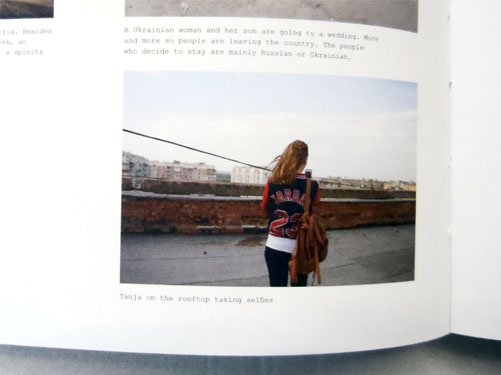
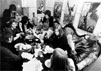
In the wake of the siege of Kyiv, through pictures of their games and gatherings,
Fabian Ritter wonders how one grows in wartime. Being a youth
implies dealing with a whole lot of internal and external conflict to begin
with, how do you express it freely when your environment is under attack?
7) Man vs the Unknown
From resistance to immigration to the militarization of urban spaces, the concept
of "otherness" as "diverse and unknown" drives many tensions
and causes violence and segregation. Nishi Shah explores the effect
of conflict on architecture in the area of Kashmir, disputed for years between
Pakistan, India, and China. With civic spaces becoming stages of protests, the
loss of the built environment has been bypassed as collateral damage. However,
destroying a public space or residential area negatively impacts citizens too
deeply to be cast off as a side outcome. The loss of a recognizable urban context
brings displacement and leads to disorientation, stripping architecture of significance
and making communities impermanent. Shah invites practitioners
to look for new spatial forms in conflict-impacted areas. Reversing the paradigm
of decay and destruction to create an architecture of peace.
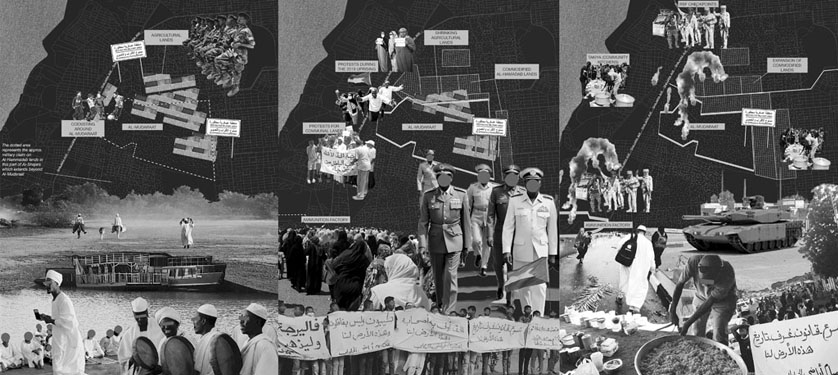
Breaking away from unjust traditions becomes even more relevant where militarisation
has become a constant and defining urban character. This is the case of the
Sudanese areas presented by Niema Alhessen and Khalda El
Jack. Here, the presence of armed forces has become institutionalised
within the city system. It is a violent infiltration, as when militarisation
is interwoven and inseparable from urbanisation it implicitly suggests that
no alternative exists. Imagining different futures becomes rebellion in itself
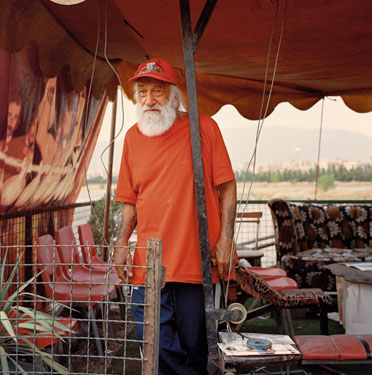
and showing that a different life is possible is a form of resilience. Such
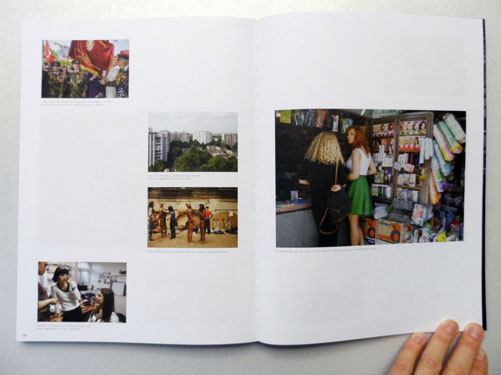
resilience is the one Johanna-Maria Fritz presents in her photographs.
Depicting the absurdity of war, she shows how locals have found forms of escapism
in traditional circus culture. They oppose the status quo and a seemingly unavoidable
life route. Yet in the urban context, conflict does not end with truces but
it persists more or less openly. Wendy Pullan explores how divisions
outlive hostilities in the every day of cities. She pledges the need to develop
new customs and conventions to allow social transactions, and these need physical
contexts to develop. Investing in public space becomes all the more relevant
as it is key to urban relations and life in a diverse city. Unsurprisingly,
she points out, public space is not only the first and most impacted area in
times of war and armed conflict but also the hardest space to bring back to
life.
The collection of voices in MONU
#37 suggests that conflict, rather than being eradicated, should be
delved into and understood as an inherent aspect of urbanism. As even the most
harmonious community will present some sort of conflict, letting its creative
potential emerge is more important than shaping a clash-free society. The root
of conflict is interaction, but that doesn't make it a bad thing, as confrontation
is inherently democratic. There is a right to certain forms of healthy conflict
and, as urban practitioners, we have a duty to make sure that it can take place
and that it might happen in physical spaces interwoven in the fabric of a diverse
city.
Rebecca
Billi studied architecture between London and Lisbon and earned a Master’s
in Museum Studies from Leiden University. Her work explores museums and cities,
exhibition formats, and the manifestation of cultural encounters in urban contextst.
She’s a PhD candidate at Universidade Autonoma de Lisboa and founder of
the multidisciplinary design and research platform Cosebelle.
The latest issue of MONU Magazine, entitled "Conflict-driven
Urbanism", offers an exploration of how conflicts have historically
shaped, currently influence, and may continue to impact cities in the future.
Through its thoughtful curation, the issue takes readers on a global journey
to uncover how diverse conflicts emerge and transform urban environments. From
Vienna's conflict-avoiding signage to the fences, surveillance, and enhanced
police presence in Las Vegas, and even the parking space in Zagreb's St. Mark's
Square, the magazine reveals how efforts to manage or avoid human interaction
often reflect underlying tensions. By examining such examples, alongside refugee
camps, gated communities, and circuses, the issue sheds light on the complex
ways crisis responses can reshape urban spaces. It reflects upon Europe's contemporary
borders, raising questions about the role of architects, urban planners, and
designers in addressing the issues. Each case underscores the unavoidable nature
of conflict in urban life, illustrating how diversity and communication inevitably
bring tension yet remain integral to the vitality of cities. This narrative
invites readers to consider how conflict not only disrupts but also redefines
the urban fabric.
We are constantly
overwhelmed by endless news of negative events, from the devastating forest
fires in Los Angeles to Donald Trump's bold remarks and the tragic stories from
the war in Ukraine. These narratives often highlight only the negative side
of conflict, making it easier to see the glass as perpetually half empty. Despite
the persistence of negative headlines related to conflict, this issue offers
a refreshing perspective on the potential positive outcomes of a crisis.
Lukas Großmann takes us back to 1906 to the massive earthquake
and fires that destroyed 80% of San Francisco and marked a tragic chapter in
the city's history. However, the city's innovative response - constructing emergency
shelters in the form of portable wooden huts - offered housing to those affected
but also those who previously were unable to afford it. This effort not only
addressed the immediate need for shelter but also catalyzed a reimagining of
the urban landscape, tailoring it to better meet the needs of its residents.
When it
is not natural disasters displacing countless individuals, it is often human-made
struggles that uproot lives. For some time now, Europe has been contending with
the arrival of refugees seeking safety and a brighter future. While building
camps and providing shelter is achievable, negative perceptions of refugees
persist. Several pieces in this magazine emphasize the urgent need for a shift
in perceptions of refugees. In her article "After Displacement: Conflict-driven
Urbanism and the Shaping of the Syrian Refugee Narrative", Rana
Abudayyeh sheds light on the Al-Zaatari Camp, located in northern Jordan
near the Syrian border. She highlights the remarkable resilience and innovation
within the camp, showcasing how migrants actively shape their environment to
meet evolving needs. This process has transformed temporary refugee shelters
into dense, vibrant urban clusters. While this case illustrates how, in desperate
circumstances, people can actively contribute to creating their own communities,
it also underscores a critical challenge: the external perceptions of refugees
has evolved into a bigger obstacle to their progress of recovery and integration.
The perception of refugees as "a threat" or "a drain on the system"
is critically examined in the conversation "Migration, Crisis, and City-shaping
Forces" between Zoë Ritts, Nikita Dhawan
and María Castro Varela. Here, they reflect on the resurgence
of anti-immigration sentiment during the recent European Parliament elections,
exploring how Europe's borders often become starkly higher when individuals
deemed undesirable, such as refugees, attempt to cross them. They also delve
into the often-overlooked factor of trauma, which subtly manifests in spatial
decisions and reflects societal attitudes. In Germany, for instance, refugee
camps are frequently located on the outskirts of cities or in rural areas, with
limited mobility, highlighting a lack of willingness - or perhaps understanding
- of what it means to integrate these individuals into neighborhoods, cities,
and broader society.
Alongside
this interview, the magazine also features conversations with Eve
Blau and Ai
Weiwei offering perspectives on the future of our urbanism as a
profession. Ai Weiwei reflects on the distinctions between urbanism
and art, while Eve Blau states: "The role of architects,
urban designers, and planners in conflicts is not one of conflict resolution".
This view resonates with the overarching themes of the magazine and aligns closely
with my own conclusions about the evolving role of our profession. As designers,
we often hasten to deliver immediate solutions to pressing problems. When someone
loses their home, we build a shelter. While this is undoubtedly a step, we often
stop there, congratulating ourselves and moving on, leaving many post-conflict
challenges unresolved. In some cases, such as San Francisco's wooden huts, this
initial response may prove sufficient. However, in today's context, perhaps
our role must extend beyond addressing tangible needs to encompass the intangible
- acknowledging and addressing the psychological burdens and deeper complexities
that crises leave in their wake. Eve Blau hints that our field
may be shifting and emphasizes the importance of listening, understanding, and
conducting thorough research before proposing interventions. I wholeheartedly
agree and believe it is essential to step beyond the confines of our screens
and collaborate with other disciplines.
As an urbanist who has spent the past year examining how the soviet occupation
and its aftermath has shaped the mindset of the Lithuanian population and limited
the potential for public spaces in micro-districts to evolve beyond their original
purpose, I found this issue to be a profound reminder of the complexities of
current global conflicts. During my research on the intersection of psychology
and urbanism, I developed a dialogue tool designed to help residents of micro-districts
discuss trauma in relation to space. Although the tool underwent testing and
co-development with the community, it was ultimately dismissed by top-down decision-makers
with claims that the population was not ready - despite a year of conversations
with the residents. It underscored a notable disconnect between top-down decision-makers
and local residents. While success in our profession often hinges on being in
the right place at the right time, I believe we need to bring greater attention
to how our field can contribute to long-term solutions for these conflicts.
This issue of MONU provides a great start for a discussion about the
future and how we can help ease the psychological burdens faced by communities.
Greta
Samulionyte is an urbanist, architect and researcher passionate about trauma-informed
placemaking and inclusive urban design. Her work focuses on creating spaces
that support vulnerable groups by fostering engagement, belonging, and resilience
through innovative tools and collaborative processes. In her recent research;
"Fostering trauma recovery through citizen participation", she explored
Lithuania's collective trauma. She developed and tested a new engagement strategy
and dialogue tool to ease psychological burdens, strengthen community ties,
and promote social cohesion.
11-12-24 // NEW
CALL FOR SUBMISSIONS FOR MONU #38 - INCLUSIVE URBANISM
Inclusive
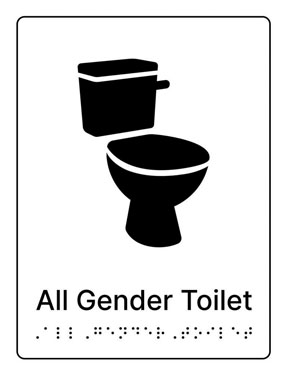
graphic signage by Motionspot The attempts
in many cities over recent years to make public toilets gender-neutral and thus
more inclusive - an approach that can theoretically only be appreciated - have
made it obvious why they were created in a "segregated" way to begin
with. On the one hand, standard toilets are used as urinals that raise issues
of cleanliness making them rather unsuitable for seated use, and on the other
hand, urinals are part of restrooms used by women, confronting them with men
with their pants down...
continue
reading inSubmit.
14-10-24
// MONU #37 ON CONFLICT-DRIVEN URBANISM RELEASED
“To Eradicate Urban Conflict, Eradicate Urban Interaction” as
Benjamin van Loon states in his satirical article that is structured
as a memo to the members of a fictitious association: the North American Alliance
for Gated Communities. Because urbanism is inherently conflict-driven as Eve
Blau points out in our interview with her entitled “Conflict
as Condition”. According to her, processes of urbanization involve
a certain amount of violence and destruction as cities are places of power,
representation, and contestation, which she thinks is both positive and negative...
continue reading in Issuesand
get a printed copy here.
26-08-24 // NEW? SOCIAL? URBANISM? BY BASTIAN BENTRUP
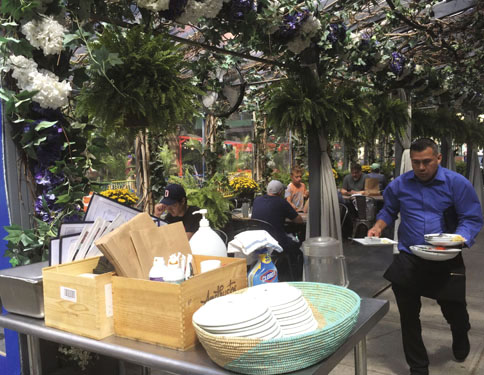
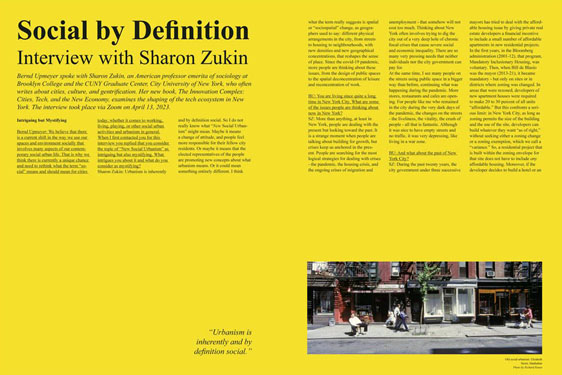
Left: New social urbanism: Outdoor dining, University Place, Manhattan, 2021,
photo by Sharon Zukin, from interview "Social by Definition", page
19.
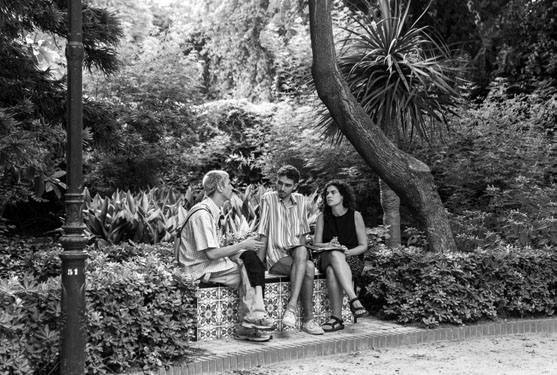
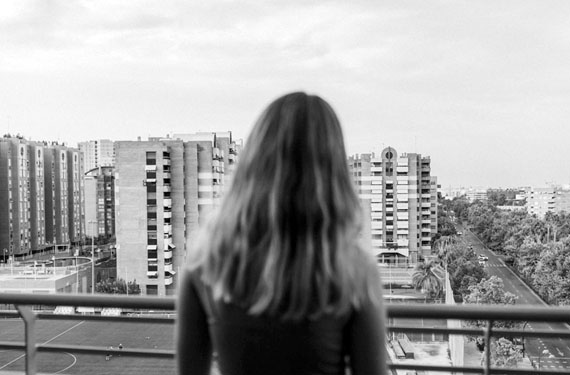
Right: Crearqció members Júlia and Pau interviewing Álex,
a resident of València, in La Creu del Grau neighborhood. August 2022,
photo by Maria Blau, from article "New Rights, New Needs, New Rules"
by Nuria Ribas Costa, pages 48-49.
Throughout the past pandemic years most people would argue that our social life
has not only changed, but a new understanding developed of how important our
social fabric actually is. Some municipalities realised that our cities need
to adapt to be able to foster a socially sustainable environment for city dwellers.
A lot of small urban interventions were realised throughout the world, improving
the living conditions, parklet by parklet. But is this enough to constitute
a "New Social Urbanism"? Is it possible to make the good
life accessible to everyone?
Issue
#36 of MONU looks at this post-pandemic environment and asks whether
the term "social" needs a new definition and is looking for a New
Social Urbanism. The contributors are interrogating their findings to discuss
this hypothesis in the forms of articles, photo essays and interviews. The contributions
made for this issue either question whether there is a New Social Urbanism
arising and show examples of what could be described as a New Social Urbanism.
In "Free
Floating Fascism and Religious Revanchism is the New Neoliberalism"
Mark Gottdiener describes a situation that could not be further away
from social urbanism. By drawing comparison to the beginning of the 19th century,
Gottdiener shows how late capitalism is producing the same inhumane
living conditions as his industrial predecessor. Gottdiener cites
Engels, who argues, that the profit-driven real estate market
will not be able to solve the housing crisis since developers would never supply
adequate affordable shelter. He points out that most of the contemporary urban
developments are lead by neoliberal capitalist accumulation logics and therefore
the "public interest […] was replaced by a privatized supply solution
to societal demands". Gottdiener's account of what is currently
happening in the US does not leave much room for a New Social Urbanism.
Especially when recognizing the ongoing war against LGBTQ+ communities waged
by church officials in many American cities.
A similar
point is made by Sharon Zukin in her interview"Social
by Definition". She argues that urbanism by definition is social
but a lot of American politicians - especially the Republicans - do not want
to be associated with socialism. Policies that are on the verge of socialism
do not have that much of a future in the US. Not least, because there is simply
no money for it. Accordingly, she does not seem to be convinced: "I am
quite pessimistic about whether a New Social Urbanism is arising."
And I tend to agree here. To establish a truly New Social Urbanism, one
would have to overthrow the current system. Meaning: abolish late capitalism
and replace it with a more humane way to organize the world. Is that something
that is happening any time soon?
In her piece "Do Nothing for as Long as Possible"Tatjana
Schneider challenges the status-quo of the current environmental situation,
arguing that architecture is still one of the biggest contributors to the world's
CO2-emissions. Nonetheless, most of us keep calm and carry on, like the good
citizens we are. "Pacified by cappuccino", city dwellers do not seem
to notice that we are still victims of "the relentless commodification
of our cities". Furthermore, the general idea that our ways of consumption
should change, trickles into the contemporary architecture imagery: "happy
worlds with happy people". But how do we actually escape this situation?
We would need a better way to sculpt our urban environment, to involve more
people and have them participate on multiple dimensions. In the current system
nonetheless, that is very hard to do.
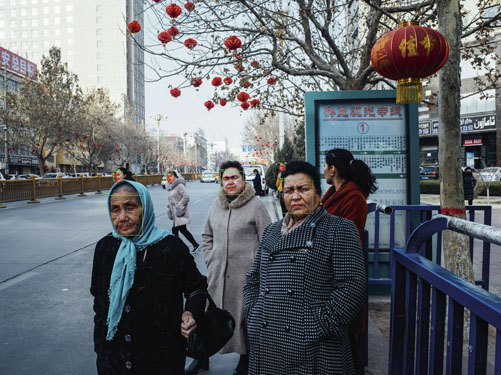
Left: Photo by Maxime Matthys, from article "2091: The Ministry of Privacy",
page 81.
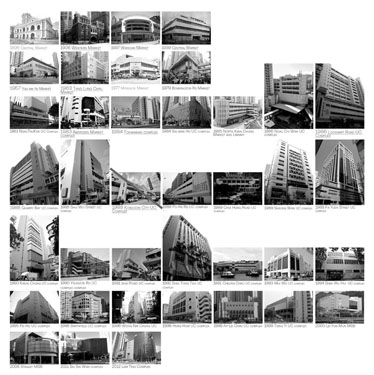
Right: A Timeline of the Hong Kong's Municipal Services Buildings' development,
graphic by Ying Zhou, from article "The Municipal Services Buildings of
Hong Kong" by Ying Zhou, page 116.
Some
voices in this edition of MONU offer new solutions showing inspiring
ways to go about a new social. When talking about new ways to govern
the city and its inhabitants, it does not take long until someone points towards
commoning as a citizen-empowering governance practice. Moving away from the
logics of a capitalist society, commons might have the power to build a social
fabric that is not reliant on capitalist accumulation practices but encourages
a less hierarchical approach to governing cities. Spain has always been on the
forefront of implementing commons. In "New Rights, New Needs, New Rules"Nuria Ribas Costa argues that Valencia is one of the Spanish cities
that are seeing an "undeniable sprouting of new needs of its inhabitants".
To meet these new needs, Costa introduces the Court of the City project,
which "proposes four theoretical axes to bring the idea of a 'city as a
commons' from theory to practice". Furthermore she discusses tools for
a New Social Urbanism, which she developed along the lines of David
Harvey's "right to change ourselves by changing the city"
- including notions of collectivity and the concept of the right to the city.
I think
concepts that question the current state of power relations suggesting how to
challenge them are most important in figuring out what a New Social Urbanism
could look like. This issue of MONU focuses our attention on some ideas
on how to move forward, but also gives good-practice examples like Ying
Zhou's historic recapitulation of "The Municipal Services Buildings
of Hong Kong". In her article she is characterizing this typology as
dense social hubs that are used in multiple ways: from eating, reading, to working
out, and reposing. But since the city of Hong Kong is closing them down one
by one, Zhou is reminiscing about the effect these multi-program
buildings have and had on the inhabitants and the local social fabric.
What Zhou
is describing in her contribution shows how a former system of socialism is
being swapped out for a surveillance-capitalist system that is stomping the
social needs of its inhabitants. In conjunction with the photo series of Maxime
Matthys these two contributions describe a shift in the urban fabric
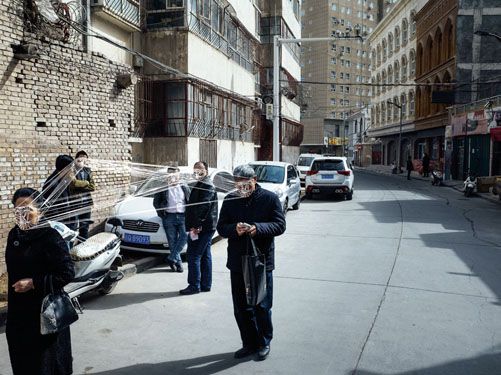
of Chinese cities. For his piece "2091: The Ministry of Privacy"Matthys traveled to the city of Kashgar in Xinjiang and photographed
one of the last remaining bastions of Uyghur culture in China. Uploaded into
a facial recognition software similar to that employed by the state, the results
render the respective biometric data in form of landmarks or as Delaunay diagrams
onto the subjects' face. By using these software-produced overlays, he not only
documents the daily lives of a dwindling population in China, but uncovers the
oppressiveness of a totalitarian system by making the invisible visible.
This issue
of MONU shows several established positions on the subject of social
urbanism and points at new possible directions for a New Social Urbanism.
Even though most of the articles regarding the New Social Urbanism are
inspiring, I cannot help but share the same point of view as Gottdiener:
as long as we live in a system of capitalist accumulation, there is no room
for a real new and social urbanism. Only if we leave late capitalism
behind us, there will be a better life possible. Maybe even the good life
for everyone.
Bastian Bentrup is an Urban Studies student at Bauhaus-University Weimar.
His research interests include marginalized groups in the built environment
and the impact data-extracting and surveillance-capitalist entities have on
cities.
12-06-24 // DIGGING DEEPER INTO THE LAYERS OF “NEW SOCIAL URBANISM”
BY MALEEN RÜTHERS
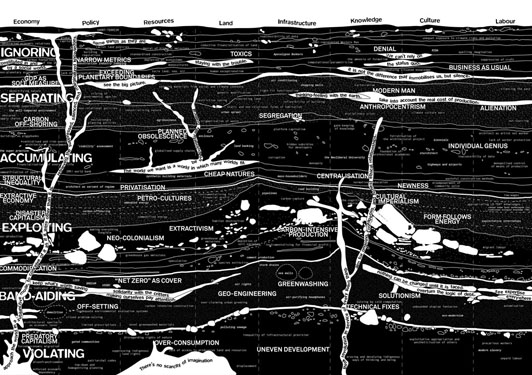
Left: The architecture of the modern project relied on extractive and combustive
processes to such an extent that fuel has come to dictate form. Shown here as
sedimentary layers are
the forces that have accelerated the production of CO2 in relation to the production
of the built environment. From article “Do Nothing for as Long as Possible”
by Tatjana Schneider, page 27.
Illustration: MOULD – Sarah Bovelett, Anthony Powis, Tatjana Schneider,
Christina Serifi, Jeremy Till, and Becca Voelcker, “Architecture is Climate,”
2023. Published on e-flux Architecture,
commissioned by the Jencks Foundation in the series ‚Chronograms of Architecture‘.
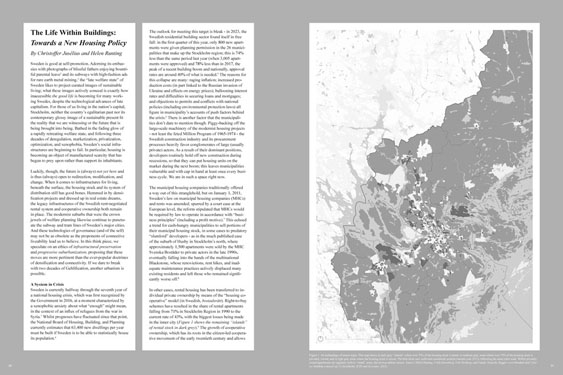
Right: The Life Within Buildings: Towards a New Housing Policy by Christoffer
Jusélius and Helen Runting, pages 30-31.
In issue
#36 of MONU "New Social Urbanism", twenty contributors paint
a broader picture of what the changes of the social urban realm are actually
about: concerns of responsibility and honesty, confronting facing facts of injustice
and exploitation, issues of affordability and exclusion, questions of governance
and organization, challenges of polarization and alienation, influences of digitality
and virtuality, but also chances of new structures and discoveries to develop.
Reviewing
the 36th issue of MONU from a perspective of an Urban Geographer, with
a background in Earth- and Environmental Sciences, my attention got caught by
an illustration resembling a lithospheric diagram featured in Tatjana
Schneider's contribution "Do Nothing for as Long as Possible",
created by MOULD - a group of architects and academics working at the intersection
of spatial practice and climate emergency. On the first view, the illustration
depicts a cross-section of sedimentary layers, representing the mineral and
fossil resources accumulated over billions of years beneath our feet. The depiction
reminds me of a semester of my studies during which I made efforts to memorize
all different kinds of geo-resources, their appearances, occurrences, and compositions.
I walked through the city of Freiburg, photographing and investigating house
facades, paving stones or stone bridges and observed rockslides through the
lens of a microscope.
Social
Responsibility and Issues of Exploitation The diagram shown in Tatjana Schneider's article is different
than the figures and cross sections I know from University. There is a double
meaning: instead of naming the geological components of the soil, extracted
for constructing and sustaining human environments, the illustration names socially
and environmentally disastrous forces and practices associated with the built
environment. The diagram by MOULD was created in collaboration with e-flux Architecture
and the Jencks Foundations and is a reference to famous diagrams by the 20th-century
architect, writer, and critic Charles Jencks.
It's literally a somewhat muddy chaos, to picture the underlying forces and
human practices that shaped our cities. Yet, Tatjana Schneider's
argument is clear: she advocates for radical honesty in examining practices
of a New Social Urbanism. While the endless call for action to finally
do things differently is an "old hat", way too often, existing hegemonies
are still reproduced. Few are willing to delve into this metaphorical dirt.
However, Schneider insists that only by confronting the dark,
unpleasant, and ugly facts that have led to the development of exclusionary
cities, can real change occur. A New Social Urbanism must be more than
allowing for some edgy creative spaces and innovative public-private alliances;
it requires digging deeper, uncovering and addressing those underlying layers
- colonialism, exploitation, violation of power, denial, and the privatization
of common resources and spaces, just to name a few.
But not
only Schneider makes this seemingly obvious but often forgotten
or ignored argument. The challenge of overcoming hypocrisy and addressing past
mistakes when it comes to new urban approaches deemed to be social, is also
addressed in the interview
with Sharon Zukin"Social by Definition"
or the article "The Life Within Buildings: Towards a New Housing Policy"
by Christoffer Jusélius and Helen Runting.
Urban Affordability and Exclusion Reflecting on New York City as an example, Zukin is quite
critical of whether a New Social Urbanism, understood in a positive sense,
even has a chance to arise under conditions where the distribution and design
of urban spaces are primarily dictated by the monetarization of their prospective
usage. Although this issue of MONU magazine is not intended to be an
extended version of issue #32
on Affordable Urbanism,
when reading the interview with Sharon Zukin or Christoffer
Jusélius' and Helen Runting's article, it becomes
evident that questioning or shaping a New Social Urbanism is indispensably
linked to the topic of affordability.
Jusélius
and Runting critizize Sweden's paternalistic failures in effectively
addressing urban socioeconomic segregation, occurring after decades of deregulation
and privatization of public housing. By viewing the map of the distribution
of Stockholm's private and public housing stock, the critique of an overly deregulated
housing development becomes spatially imaginable. The
authors hereafter argue that rather than approaching underlying causes of availability
and equitable distribution of affordable housing, planners, scholars, and authorities
have disproportionally focused on infrastructural connectivity as the primary
issue for overcoming social issues in geographically segregated neighborhoods.
Additionally, labelling the suburbs of the postwar era as dysfunctional by their
design and location does not help in combatting exclusionary cities. On the
contrary, Jusélius and Runting argue that it reproduces stigmatizations
and circumvents the necessary debate on spatial and housing injustice.
But it's
not all painted black in this issue of MONU magazine. Looking back at
the lithospheric diagram mentioned earlier, there are indeed some bright layers
and promising veins visible such as: "nothing can be changed until it is
faced", "see expertise everywhere" or "staying with the
trouble"; some of which also reappear in other contributions. For the reviewed
approaches of a New Social Urbanism, an enhanced recognition of community
and collectivity plays an essential role.
Left: Sant Llorenç, València. August 2022, Photo by Maria Blau,
from article “New Rights, New Needs, New Rules” by Nuria Ribas Costa,
page 48.
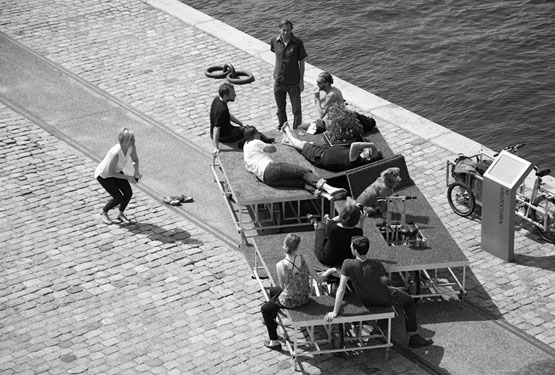
Right: Parkcycle Swarm, Copenhagen 2013, from article “Spatial Reappropriation
through Transformative Practices” by Valentina Rizzi, page 54.
Commoning, Collective Governance and Spatial Reappropriation The
article "New Rights, New Needs, New Rules - Commoning as a Way to Reclaim
Collective Governance of Cities" by Nuria Ribas Costa,
for instance, reports about a renewed assertion of the needs of inhabitants
in Spanish cities. Emerging grassroots initiatives are challenging traditional
centralized power structures and establish collective governance and decision
making. Ribas Costa sheds light on the work and experiences of
the initiative 'the Court of the City' in Valencia, emphasizing that "social
life is not only about coexistence but also about collective ownership".
Perhaps
Jusélius and Runting would agree that it
is time to dismantle paternalistic modes of governance and restore autonomy
to local communities. Yet, I assume that Zukin as well as
Jusélius and Runting would raise questions about
the challenge of asserting claims for 'the Right to the City' amidst existing
structures of ownership and power. I'd say that collective governance and collective
ownership are two different issues and present different types of challenges.
However,
upon a second look, Ribas Costa seems to be aware of such concerns.
She argues that there is no way to regain municipal administration's capacity
to deliver public services and secure people's rights and needs: "traditional
forms of governance must be obsolete, unable to process, absorb and respond
to the (new) needs of citizens" (page 45). Authorities that agree
to step back from monopolizing the management of public interests leave space
for alternative, collective and shared modes of governance to develop. Certainly,
there must be some rules and conditions to bring this theory into practice,
which can be read in detail in Nubia RibasCosta's
article. In conclusion, a New Social Urbanism must necessarily involve
new governmental structures that are yet to reassembled and establish.
Let's delve
further into a different approach on collectivity and spatial reappropriation
of the urban public approached by Valentina Rizzi in her article
"Spatial Reappropriation through Transformative Practices".
When discussing spatial reappropriation, I must admit that performative and
visual arts as transformative tools would not have been my first proposal. After
reading, Rizzi's contribution, I was reminded of the power of
artistic practices as responses to the hostility of certain urban environments.
As urban landscapes become increasingly uniform and public space exclusionary,
performative approaches to urban design hold the capacity to open new realms
of imagination, challenge existing norms, facilitate unconventional encounters
and mobilize efforts to redefine our notion of community and social identity.
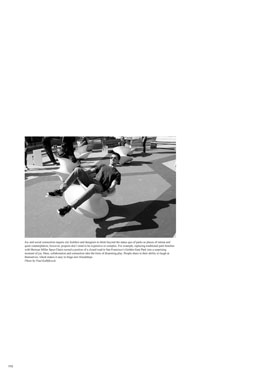
Left: Post Disaster Rooftops, Taranto 2022, from article “Spatial Reappropriation
through Transformative Practices” by Valentina Rizzi, page 52
Right: Post-Public Space by Francisco Silva, pages 65- 67.
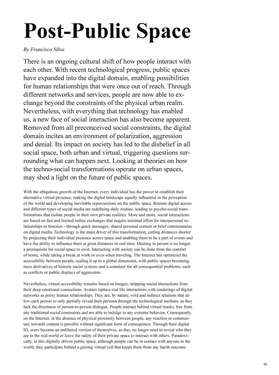
Influence of the Virtual and the Digital But
"what can happen next?" to public spaces when their social qualities
decline and change? In one of my favorite articles "Post-Public Space",
Francisco Silva raises this question and makes theoretical speculations
about the future of a public social sphere that merges with virtuality. Therefore,
he draws analogies to writings on socio-technical transformations of the two
authors, the architectural historian Anthony Vidler and the philosopher Jean
Beaudrillard.
Silva
starts by reflecting on the status quo of public space: at a time when the social
sphere suffers from polarization and exclusion, making unconventional and non-commercial
encounters increasingly difficult, the digital domain opens up social space
to a new dimension of global connection and communication. Meeting in person
is no longer necessary to socialize, and distance no longer an obstacle for
social interaction as the digital domain merges with the physical. While the
remoteness of online social interaction increases the access to social space
for all different types of actors and behaviors, brevity and anonymity also
allow for decreased social control and constraints. New extremes of barbarism,
disrespect, harassment, and even criminality emerge and collide.
Then, the article takes an interesting turn when Silva argues
that despite, and precisely due to, the social space being at the peak of moral
decay, there emerges a change for a new identity and quality of the social to
develop. Amid the shattered structures of what we understand as social space,
a new and increased concern for inclusion, respect, truth, meaningful encounters,
and understanding for complex human interaction emerges. Public
space might reestablish as something no longer defined by conventional understandings
of the physical urban social space. How exactly that will look like is a matter
of discovery and further investigations by the readers, researchers and practitioners
interested in New Social Urbanism.
After reading
through New Social Urbanism, I find myself in fact re-evaluating an initially
somewhat pessimistic "disbelief in all social space both urban and virtual",
as Francisco Silva frames a general societal sentiment. Resuming,
this issue of MONU is also a call to take part in shaping the New
Social Urbanism reassessing the emerging qualities and fallacies about the
properties we consider defining an (Anti-) Social Urbanism.
Maleen Paula Rüthers (she/her) is an urban geographer and a postgraduate
at the HU Berlin holding a Bachelor of Science in Liberal Arts and Sciences,
with a major in Earth and Environmental Sciences from the University of Freiburg,
Germany. She also pursued studies in Valencia and Lisbon at the faculties for
Geography and Spatial Planning. Currently based in Berlin, Maleen is engaged
in studying and working in the field of urbanism, with special attention to
regenerative architecture, urban green infrastructure, critical cartography
and transdisciplinary formats for collaborative discourse and practice. This
review of MONU
#36 was first published by Berlin-based Urbanophil
on June 3, 2024.
12-04-24
// MEDIATING SOCIAL CONNECTIONS IN THE NEW AGE OF URBANISMBY CHIARA
CATALINI
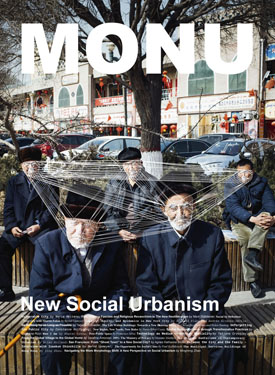
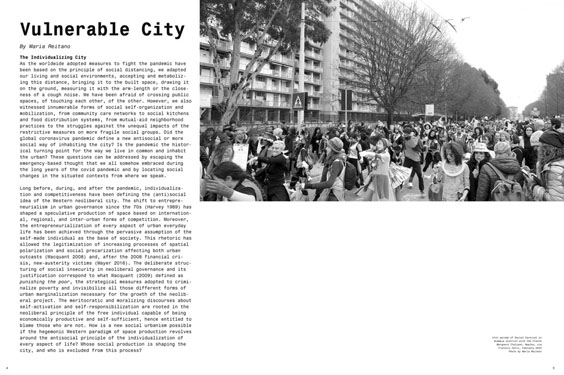
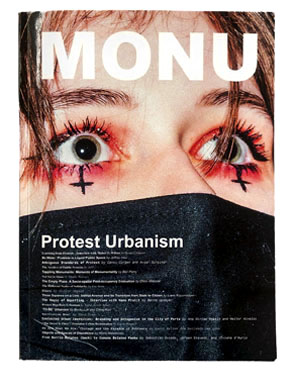
Left: Cover of MONU #36: New Social Urbanism.
Right: The beautiful concept of "vulnerability", introduced by Maria
Reitano in her article "Vulnerable City", pages 4-5.
The latest issue of MONU
explores the current challenges and opportunities of urban planning, by offering
critical perspectives that cover various levels of discussion. One of the central
themes of this issue is the role of urban planning in the post-pandemic era.
It calls for a rethinking of traditional notions of physical space creation
and emphasizes important design issues related to social dynamics.
Sociologist Sharon Zukin discusses the impact of "New
Social Urbanism" on cities, which has been accelerated by the COVID-19
pandemic. The crisis has highlighted issues in urban planning and architecture
related to social dynamics. The forced isolation has prompted a deeper reflection
on the role of urbanism and challenged the individualism typical of neo-liberal
cities, leading to new perspectives. Zukin emphasizes the importance
of the sense of proximity usually found in neighborhoods and how the disappearance
of these urban clusters threatens the connection between people and the sense
of intimacy. The latest global health crisis has revealed new ways of being
close, suggesting new social opportunities of living in the city and advocating
for social urbanism based on the awareness of our mutual vulnerability. This
beautiful concept of "vulnerability", introduced in her article by
Maria Reitano, invites us to reflect on new ways of producing
space based on an awareness of fragility and interconnections among individuals
in society and the resilience this awareness can generate.
The analysis
goes beyond the physical realm and explores the increasing significance of virtual
spaces in the New Social Urbanism. The COVID-19 pandemic has demystified
the belief that online interactions are inherently antisocial, as detailed in
Tatjana Crossley's article "Technology as Medium to Rethink
Spatiality". This transformation has blurred the line between the real
and the virtual, opening up new opportunities of connection. In her article,
Serafina Amoroso discusses the role of the virtual in the New
Social Urbanism, specifically the move from the Global Village to the Global
Home. The article examines themes such as the accessibility of spaces through
augmented reality but raises critical questions about its relationship with
the physical world. Is the virtual merely an escape from the issues we face
in the real world? The article leaves us with an open conclusion.
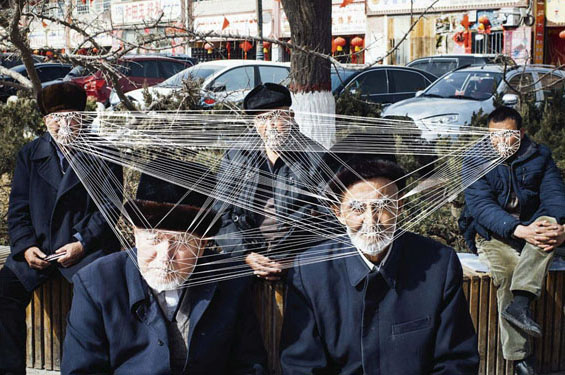
The cover
of this issue showcases an image from the photographic project "2091:
The Ministry of Privacy" by Maxime Matthys. The photo
depicts a public space in Kashgar where a group of people is connected by a
virtual mesh created by a facial recognition algorithm. The lines in the image
create an intricate web of connections, suggesting a complex and layered network
of relationships that go beyond the visible. The image invites us to reflect
on the nature of our interconnectedness and how it is mediated by technology.
It raises important questions about how digital and physical structures shape
our experience of the urban landscape, and how they impact our sense of privacy
and agency. The image is a powerful representation that challenges us to think
critically about the structures we build and the systems we use to navigate
our world.
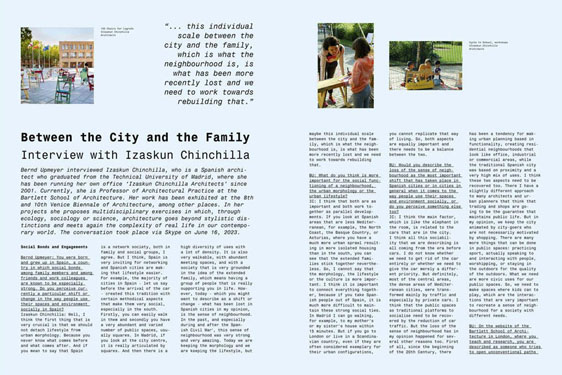
Left: The photos of Maxime Matthys invite us to reflect on the nature of
our interconnectedness and how it is mediated by technology, page 82.
Right: Interview
with Izaskun Chinchilla by Bernd Upmeyer, page 107.
After thoroughly reading MONU #36, it is clear that interviews and essays
all agree on the importance of meaningful connections in design thinking. This
agreement requires a radical rethinking of social dynamics, emphasizing the
need to build emotional bonds that can truly reconnect people on a deep level,
creating a genuine sense of 'neighborhood'. This concept is the theme around
which the entire discourse revolves.
I believe that the interview
with architect Izaskun Chinchilla is central in understanding
the concept of "New Social Urbanism". Chinchilla
critiques urban planning that prioritizes work functionality, arguing that it
turns cities into fragmented spaces that undermine social cohesion. She suggests
the urgency to revise urban planning by considering it
not only as a practical act but also as an empathetic and participatory one.
Chinchilla's perspective transforms the architect's role from
a creator of physical forms to a "social mediator," highlighting the
importance of managing social relationships within urban communities. This shift
marks a turning point in the perception of architecture, now intrinsically linked
to the construction and management of social relationships within urban communities.
Chinchilla's perspective paves the way for a more humane and
interconnected vision of architecture that aligns with the growing awareness
of a new social era taking shape in our cities. In this context, urban design
becomes an act of social construction, reflecting the necessary evolution in
contemporary urban dynamics and laying the foundations for a more cohesive and
supportive community.
In conclusion, aligning myself with Zukin's perspective, I believe
that the term 'urbanism' inherently has a social meaning. However, it is fundamental
for urban planners and designers to explore the evolution of the term 'social'
in the context of contemporary society, recognizing its dynamic nature shaped
by historical events. This requires a critical examination of what 'new' entails
in today's urban landscape and this issue of MONU offers the reader a
number of valuable resources to address this query.
Therefore
New Social Urbanism represents a necessary departure from the ancient
dichotomy of function vs. aesthetics. Rather than continuing this longstanding
dilemma, it emphasizes the importance of adopting a holistic approach to urban
planning that transcends mere utilitarian concerns. This shift challenges urban
planners to prioritize the well-being and the social cohesion of the communities
they serve. By doing so, we can aspire to realize what Paul Kalbfleisch
has described as a 'Joyful city’.
Chiara Catalini is a designer and photographer originally from Italy. She
moved to the Netherlands to further her education in Product Design with a Master's
Degree in Interior Architecture and Research at the Piet Zwart Institute of
Rotterdam. Currently, she works independently as a freelancer through her own
practice, Chiaramente Studio, specializing in interior and product design as
well as photography.
16-02-24
// OPTIMISM ABOUT THE FUTURE OF URBANISM BY NISHI SHAH
Left: Maxime Matthys's image on the cover of MONU #36: New Social Urbanism
captures the emergence of an omnipresent techno-centric urban future.
Centre: 'Piggybacking'-showcasing how undercapitalized ventures intertwine with
established developments, disrupting the monotony of today's urban planning
landscape."The Strange Bedfellows of Contemporary Urbanism" by Brian
Holland, p. 92.
Right: Sociologist Sharon Zukin, in an interview with MONU editor in chief Bernd
Upmeyer, is rather pessimistic about whether a “new social urbanism”
is rising, p. 13-14.
Ever since the genesis of city planning, the concept of "social" urbanism
has permeated the lexicon of every architect and planner. Yet, the pandemic
has thrust "new" urbanism into the limelight, highlighting the sheer
mess, fractured deficits, and anti-sociability inherent within spatial design.
BOARD's annual journal,MONU
- Magazine on Urbanism, Issue #36, accentuates the imperative for a
nuanced comprehension of New Social Urbanism. This edition resonates
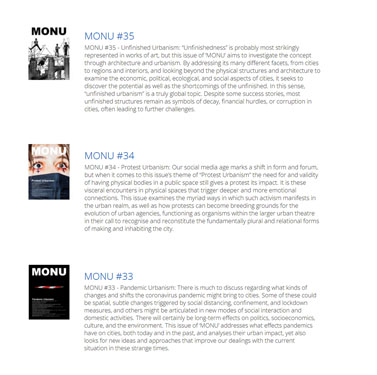
with its prior issues, notably MONU
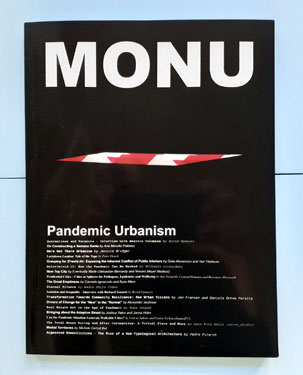
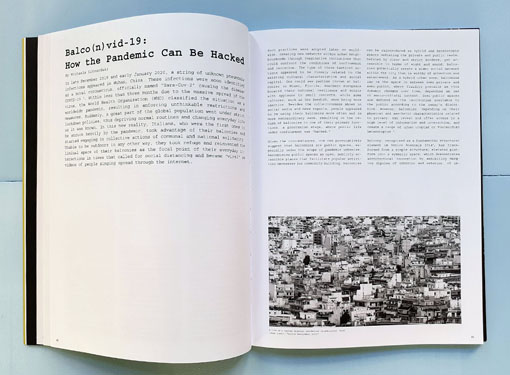
#35: Unfinished Urbanism and MONU
#33: Pandemic Urbanism. These issues explored themes such as unpredictable
transactions and enormous economic inequity amid the pandemic. Expanding on
that, understanding New Social Urbanism now demands a broader perspective.
It must transcend the conventional 'social' definitions and grapple with the
multifaceted conflicts faced in a post-pandemic, rapidly-digitizing society
to reconceptualize the foundational tenets of 'sociability.'
MONU #36 endeavors to address a harmonious equilibrium between the public
and private realms, real and virtual worlds, and collective versus governmental
responsibilities to foster inclusive sociability within radically different
urban structures. The issue, rich with interviews,
articles, photographs, and essays by experts operating at the nexus of urbanism
and social science, spans global contexts, from the bustling megacities like
New York City and Hong Kong to the localized perspectives of Valencia and Librino.
Though featuring twenty distinct contributions, the issue coherently articulates
overarching themes on New Social Urbanism: ramifications of COVID-19,
evolving urban strategies, the rise of communal spaces, and the evolution towards
immersive cities.
An in-depth
examination of the root causes of resource exploitation and the contemporary
missteps of urbanism unfolds in this issue. In her essay, Tatjana Schneider
foregrounds structures of unsustainability, "gas-guzzling"
infrastructure, climate crisis, and critical global analysis. Similarly, Paul
Kalbfleisch dissects the implications of zoning laws and a car-centric
culture, highlighting social segregation and the eventual 2020 'Social Recession.'
This pervasive lack of human interaction and social coldness has become particularly
pronounced in New York City where socio-economic disparities-aggravated by the
pandemic-exacerbate challenges in managing extreme density with little-to-none
affordable and hygienic housing, as explained by Richard Plunz
and Andrés Álvarez-Dávila as well as in Bernd
Upmeyer's
interview with Sharon Zukin. Urbanistic oddities manifest
more starkly in some cities where planning mistakes have rendered ghost towns,
as in Agnes Katharina Müller's portrayal of San Francisco,
or ordered public neighborhoods that paradoxically reveal the absence of liveability,
as detailed by Constanze Wolfgring.
Left: In the wake of San Francisco's post-pandemic shift into a ghost town,
this contribution examines inclusive strategies, aiming to revitalize the city's
downtown into a vibrant "social hub." "San Francisco: From 'Ghost
Town' to a New Social City?" by Agnes Katharina Müller, p. 98.
Centre: Architect Izaskun Chinchilla, in another interview with Upmeyer, believes
we are heading toward a hybrid situation in which we will socialize both physically
and digitally, multiplying the spectrum of the ways of meeting and socializing,
p. 101-102.
Right: Reimagining our social priorities towards joy and playfulness, this image
underscores cities as the true home for the human spirit. "The Opportunity
for Joyful Cities' by Paul Kalbfleisch, p. 110.
Yet, amidst these looming challenges, MONU
#36 illuminates pathways of redeeming neighborhoods by emphasizing innovative
housing and urban policies as catalysts for social revitalization. While not
entirely groundbreaking, these policies employ straightforward yet impactful
social space-making approaches ranging from citywide initiatives to individual
housing units, addressing the intersections of work, private life, public engagement,
and communal activities for all inhabitants. From Paul Kalbfleisch's
advocacy of prioritizing joy through playgrounds for the "human spirit"
to Valentina Rizzi's transformative reappropriation through performative
arts, embracing "marginalized spaces as generative grounds for collective
reclamation," the issue offers tangible solutions to restore a sense of
neighborhood familiarity and rejuvenate public spaces as traditional arenas
for social interaction. Brian Holland's piece on 'piggybacking'
discusses a space-sharing practice that posits marginal activities alongside
popular developments to form multi-use structures. This strategy challenges
the disconnectedness and homogeneity often associated with modernist planning
while fostering a vision of diverse, resilient collectivity. Several articles
within the issue resonate with the central theme of collectivity by suggesting
refined real estate policies, advocating for collective ownership, emphasizing
the right to the city, adopting the city as a commons, and exploring social
capital. These discussions suggest that prioritizing social design, placemaking,
and communal sharing of urban resources-rather than solely focusing on privatization
and commercialization-will inherently lead to financial gains and environmental
consciousness facilitated by increased public engagement and active utilization.
Most importantly,
MONU
#36 confronts the predominant and inevitable shift towards the post-public,
digitally-immersed, tetra-dimensional cities. The magazine's cover unequivocally
underscores that envisioning New Social Urbanism for the 21st century
necessitates acknowledging and naturalizing this densely layered digital urban
environment. Maxime Matthys' cover photograph, sourced from his
project, "2091: The Ministry of Privacy," compellingly unveils the
omnipresent yet often "seemingly-invisible technology" that overlays
our urban experiences. Tatjana Crossley references the insights
of contemporary philosopher David Chalmers, who asserts that
"virtual reality is genuine reality," especially given how augmented
reality has manifested in alternative urbanities through video games, art exhibitions,
and advertising. We're on the cusp of "techno-social transformations,"
as exemplified by Francisco Silva. The appropriation of space
into a "tetra-dimensional urbanism," as Serafina Amoroso
aptly suggests, by equipping our media houses and urban realm with digital screens,
AR technologies, and hybrid spaces, emphasizes that architecture integrates
virtual realms. As physical presence is no longer a prerequisite and social
interactions distill to their core essence of connection, emotion, and communication,
the multiplying spectrum of socializing by merging realities heralds a promising
horizon for architects, planners, and social scientists. Design-now-transcends
traditional territories, ushering in a new era of four-dimensional social landscapes
in a merger of body, technology, and structures.
Being a
reader from an Asian nation where social interdependence has historically influenced
architectural ethos, the global implications of this theme captivate my attention.
Yet, upon reflection, the limited analysis from the Eastern perspectives stands
out, especially considering the region's rich tapestry of interconnected atmospheres,
collective harmony, familial ties, and stronger social bonds. It would be particularly
enlightening to explore the implications of social distancing in these inherently
communal societies and contemplate the potential manifestations of New Social
Urbanism within such unique and dense cultural landscapes. Nevertheless,
this latest issue of MONU
#36 - in its signature aesthetic format with unique layouts per contribution
- deserves all the superlatives for its wealth of ideas. It stands as a compelling
read, initiating vital dialogues on the power of sociability and liveability
of cities, envisioning cities as socio-technological ecosystems, and undoubtedly
eliciting optimistic trajectories for the future of urbanism.
Nishi Shah is an alumna of The Berlage Center for Advanced Studies in Architecture
and Urban Design. Currently living in the Netherlands, she is employed as an
architect, working as a freelance writer, and serving as a co-curator for VOLUME's
biweekly newsletter. With a close affinity towards research and critical thinking,
Nishi attempts to explore new methodologies of approaching design-as a creative
artist and an analytical theorist-to foster interdisciplinary dialogues within
the design discourse. This review of MONU
#36 was first published on World-Architects
on February 13, 2024.
11-12-23 // NEW
CALL FOR SUBMISSIONS FOR MONU #37 - CONFLICT-DRIVEN URBANISM
Study
of Perspective, Tiananmen Square, 1998, Ai Weiwei
When
recently we initiated a debate on the consequences of the coronavirus pandemic
on cities that led to MONU's issue #33, we had the hope that the crisis
would make people and governments cooperate more strongly with each other and
thus enable them to tackle major problems of all sorts making our cities more
habitable and affordable than ever...
continue
reading inSubmit.
16-10-23
// MONU #36 ON NEW SOCIAL URBANISM RELEASED
How is a “New Social Urbanism” possible if the hegemonic
Western paradigm of space production revolves around the antisocial principle
of the individualization of every aspect of life? asks Maria Reitano
in her piece “Vulnerable City”. According to her, long before,
during, and after the pandemic, individualization and competitiveness define
the (anti)social consistence of the Western neoliberal city... continue
reading in Issuesand get a
printed copy here.
Left:
Cover of #35
Centre: Editorial
Right: Table
of contents
It never
occurred to me to look and question the urban realities surrounding me in their
degree of finishedness. Growing up in a city that is constantly
reinventing itself on a base of complex and very much opposing histories, there
was always some sort of structure, building, or place that consists of, and
in most cases thrived of, (being) unfinished. Having Berlin as
my 'default' image of a city, unfinishedness is inherent to my
understanding of urban realities. As such, I never fully engaged with any deeper
or increasingly complex conceptualisations of unfinishedness,
beyond the binary it implies and what's visually evident in Berlin's urban landscape.
MONU
magazine is picking up on what they coined 'Unfinished Urbanism'
to explore current urban realities, defined by flaws, imperfections, and failures.
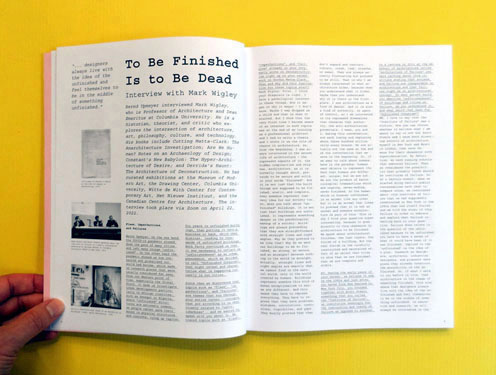
Opening the discussion is an interview with Mark Wigley, paving
the way for the issue's discussion on unfinishedness, its great
potential and possible shortcomings, embedded with a wide range of case study
articles, representing stories, narratives, and examples beyond the dominating
Eurocentric urban sphere. Critically reflecting on the static notion of architecture,
Wigley is advocating against a reality that is defined through
stability and completeness. His interest is precisely in unfinished realities,
as they are opening up a space for creativity and flexibility to respond and
accommodate the ever-changing nature of cities and contemporary urban realities.
This understanding of unfinishednessas a necessity
to respond to contemporary urban challenges runs as a read thread throughout
the magazine. Unfinishedness is understood as crucial, as seemingly
the only way to deal with the unpredictable nature that cities are facing today
and surely will face in the future.
Situated
within the intersection of theoretical discussion and direct case study examples,
the issue is addressing Unfinished Urbanism from a primarily architectural
framework, offering insights into the consequences of over-design and rigid
top-down urban planning approaches. Ranging from unfinished nuclear power
plants in the Crimea region to counteracting strategies and playful
resistance, the issue manages to include a differentiated and increasingly representative
collection of stories and narratives, exceeding the boundaries of the urban
North West. Opening up the space of elaborating the risk of over-fetishisation
of unfinished urban structures allows for a critical discussion
of the underlying structures that are causing these realities. As most of the
unfinishedness of buildings, especially in the Global South,
is due to unforeseen economic crises, corruption, or the withdrawal of investors,
the discussion could extend to generally questioning the systemic structures
that unfinishedness is resulting from.
Generally,
the issue is offering a differentiated and comprehensive overview of Unfinished
Urbanism. MONU offers a variety of case studies that are all
characterised through, or are dealing with, unfinishedness, while
being embedded in an approachable and extensive theoretical discussion on the
subject matter in a predominantly optimistic manner. As much as we need urbanism
to remain open and adjustable to concurrent and upcoming realities, so do we
need to stay open within this discussion to foster an increasingly inclusive,
horizontal, and fair debate. As such, this issue is as much unfinished
as our cities, which is a great starting point.
Pauline
Werner recently graduated in Urban Studies and is now studying Heritage &
Design at TU Delft.
She is interested in contemporary urbanism and the intersection of art, politics,
and resistance within the urban environment.
As of today MONU is collaborating with the Dutch subscription agency
Abonnementenland
that is going to handle the subscriptions and the shipment of MONU Magazine
in the years to come. Single
copies of MONU and back-issues can be ordered at Abonnementenland
too.
Our previous subscription agency Bruil & Van De Staaij stopped its
services and closed the company.
11-04-23
// A RESOURCE FOR A YOUNG URBAN DESIGNER, MONU #35 ON THE UNFINISHED BY
ARIELLE STEERE
Left:
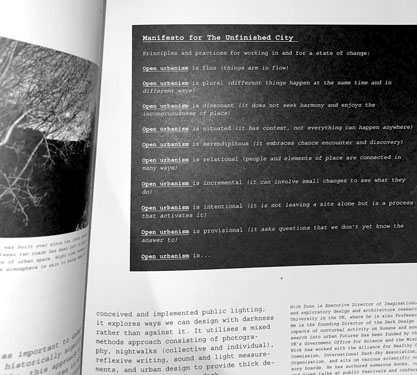
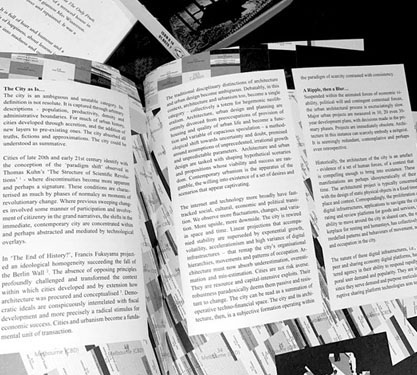
The Unfinished City: Approaches for Embracing an Open Urbanism by Nick Dunn
and Dan Dubowitz, p. 28-29
Right: The Temporal City by Ian Nazareth and David Schwarzman, p. 114-115
This
issue is a call to observation made up of a breadth of contributors; a look
into the wealth of possibility in leaving something unfinished. Between the
two covers is a significant imagination of what happens in an unfinished city,
acknowledging all the complexity inherent to urban environments in their movement
through time. Being an architecture student, I am always told to submit a finished
product. Ideas bookended by deadline and notions of completion - crisp, clean
and uncomplex. Plans of public spaces, community centers, and housing meant
to be wrapped in a bow and left unchanged, summed into one final CAD and a few
sentences. But here, in MONU
#35, the reader delves into possibilities of expansion and growth in
an urban environment, acknowledging intricacies. The beauty of this magazine
is the synthesis of different lenses into the world of "Unfinished Urbanism":
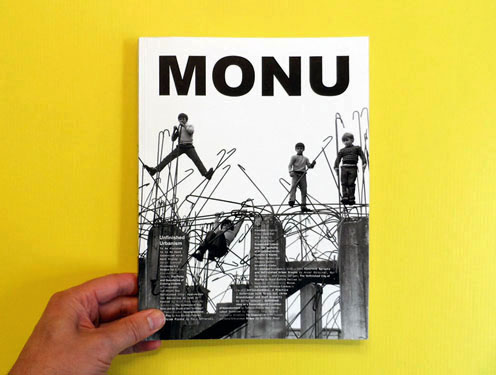
ruins, policies, playgrounds, and nuclear plants. There is whimsy and imagination
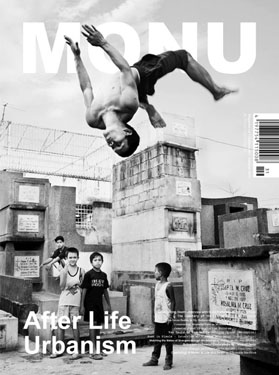
in the incomplete, only hinted to with the children balanced on the cover page.
This issue, through its contributors, is a brilliant exploration of time. The
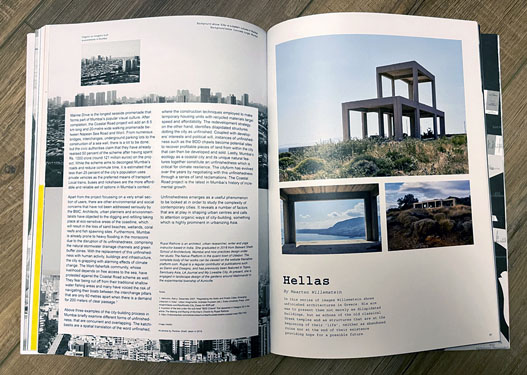
First there is the more obvious, Maarten Willemstein "Hellas":
Greek ruins suspended in time, the inclinings of something to be renewed.
Tiphaine Abenia discusses the nature of ruins, not as romanticized and
embedded in their history but as a possibility for reiteration and growth. This
idea of renewal is discussed again by Marco Enia and Flavio
Martella right off the bat, equating a city to an organism, something
dynamic, alive, always readjusting, which expanded upon with this notion of
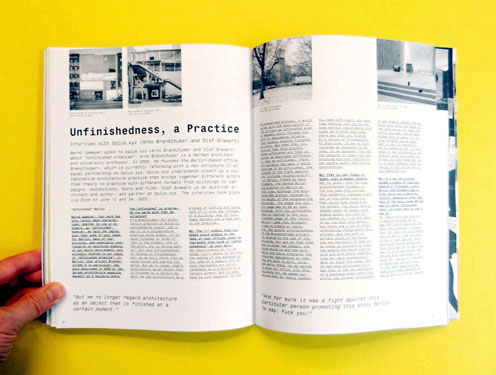
"intelligent ruins," a wonderful oxymoron from "Unfinishedness,
a Practice", the second interview. There is also talk of the "death
of the architect", by Wijdane Esseffah, which puts into question
the whole status of a definitive author as a work of architecture progresses
through time.
For me as a student, time is considered stagnant, meant
to be built and then left, sturdy and unchanged. The breaking of these rules
explored through these pieces beckons the reader to question how the possibility
of change can be built into a city. This brilliant selection of works is incredibly
inspiring as a student, serving as an exploration of approaches outside of traditional
teaching.
MONU #35 also gets concrete in its assessment of space, strategically
including pieces that discuss policy. After all, how does a system that allows
for the unfinished come to be? "The Unfinished City: Approaches for
Embracing an Open Urbanism", gives good insight into how cities are
shaped by policies enforcing permanence. It is an "urgent" call to
action that is much needed. How do we combat, and challenge policy? One of my
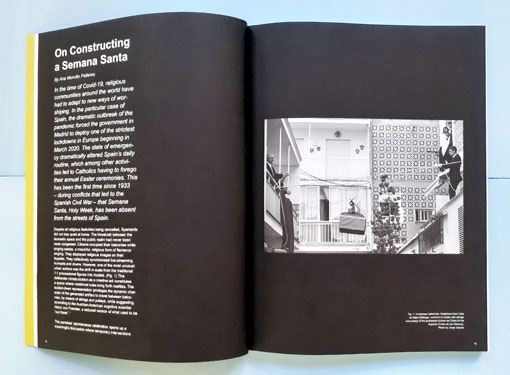
favorite pieces in the issue, Ana Morcillo Pallares'"Incompleteness
and Play" shows how designers have created temporary installations
where 20th-century plans and policy have fallen short, beautifully approached
through the assessment of various playgrounds. A piece showing the joy and play
that should always be imagined in urban design.
To explore the progress borne out of the unfinished, it is important to also
assess the issues, and MONU does not shy from the intricacy of outcomes.
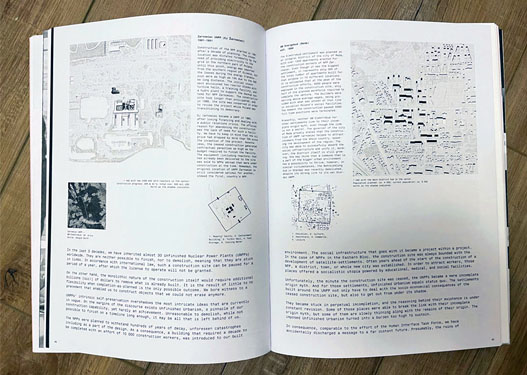
In "Roadside Picnic - Remote Detour around the World's Unfinished Nuclear
Power Plants" the reader is shown the vast, immovable footprints of
the world's abandoned nuclear plants. Leaving something unfinished leads to
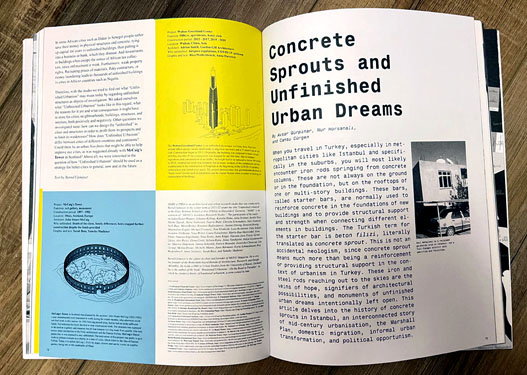
renewal and development, which causes displacement, so effectively shown in
Isabelle Pateer's photo-essay: "Unsettled".
MONU
#35 approaches many ideas, tackling the complications of the incomplete
with a global narrative. It could be too much: past and future artifacts, shaped
by time, policy, and social fabric. How do we create possibilities? Where can
the unfinished be helpful? Unhelpful? But MONU #35 is overwhelming in
the best way because it has to be. Through these narratives and discussions,
the reader understands that to approach a city is to enter a labyrinth of causes
and effects.
I have followed MONU magazine for years. In high school, I was given
new issues for Christmas. My ideas of urban design have grown through the two
covers of this magazine. As a student it is wonderful to have this as a tangible
resource to return to and enjoy. Both interesting as a reader and significant
as a young designer, this issue weaves together these notions of time, layered
and messy, giving a very full picture to approaching the future of urban design.
Arielle
Steere is a 2nd year student at UC Berkeley's Center for Environmental Design
studying Landscape Architecture. She runs CED's urban design zine: "Oddyard"
which does work considering the intersection between youth and temporary installations
of urban design and is on the Board of "Room One Thousand", the graduate
architectural journal.
13-02-23
// DIMENSIONS OF THE INCOMPLETE - A MONU #35 REVIEW BY TATIANA CHARUSHNIKOVA
Unsettled
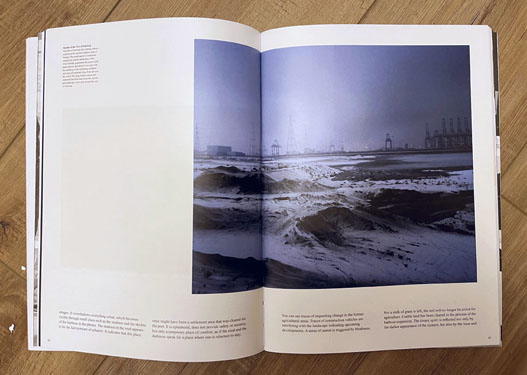
by Isabelle Pateer, p. 50-51 Unfinished
cities and unfinished buildings are something we witness daily in every city
people live in: the construction site left abandoned years ago, road and station
repairs, and planned masterplans for redeveloping particular areas. We often
view these "unfinished" spaces as eyesores, failures, and needing
renovation. Governments often demolish these spaces and seek funding to rebuild
them with wide public support. Otherwise, we see unfinished as a "failure,"
a place for crime and abandonment. But is it actually something so damaging
to our cities and neighborhoods? Is the concept of a "finished" city
a valid one, and if so, what are the dimensions of "finished" and
"unfinished" in urbanism and architecture? MONU
#35magazine examines these questions, exploring the relationship between
political values, society, and the physical appearance of cities. What is particularly
compelling about this issue is how the magazine investigates the complex dimensions
and nuances of unfinished urbanism through a diverse array of academic articles,
interviews, and artistic projects.
The underlying
theme in this issue is the relationship between political values in the government
and society and the physical appearance of the cities. In the interview with
Mark
Wigley, a professor of Architecture and Dean Emeritus at Columbia
University, he claims that contemporary architecture aims to represent stability,
completeness, and authority over nature, which is deeply intertwined with the
psychological makeup of society. The same issues are discussed in the conversation
with Akoaki, Sirota, and Farges. They
emphasize how capitalism in the US, with the lacking or weak municipal support,
shifts public functions to philanthropy projects, which still construct their
own ideologies that rarely meet the needs of residents of a particular city.
Capitalism "clearly maps its destructive capacities and debunks its progressive
myths." Wigley supports this view, stating that "to
be liberated from the capitalist system would be to liberate the unconscious
with everybody becoming an artist and the only form of art that really matters
is urbanism and to endlessly remake the city that you share with others."
These scholars and architects, as well as some other authors from this issue,
clearly see "unfinishedness," as liberation and form of claiming something
that has been taken from the citizens in the modern political urban system.
The shapes of reclaiming vary from physically unfinished buildings, abandoned
spaces given to the public to rethink their use, or more political and social
acts, such as squatting that declares the right of every person to housing.
Other projects
presented in this issue beautifully illustrate and complete previous takes on
the destructiveness and dire consequences of "finished" in neoliberal
urban areas. The desire for profit and rapid economic growth often backfires
or evicts those for whom this land held a special meaning transmitted through
generations, economically or spiritually. In the project "Unsettled"
by Isabelle Pateer, the cold unsettlement of construction sights
of the expanding harbor in Antwerp explores those dimensions of economic thrive
in the city and the quiet displacement of local residents. Will this eviction
profit the overall population through a more globalized economy? Will new natural
areas be built as compensation for the expansion of the port? Is the change
and unfinishedness of these former agricultural areas bringing hope or destruction?
There is definitely more depth to a conversation on unfinished rather than seeing
it as a form of rebellion against capitalism and authority imposed over citizens
and their right to occupy and rebuild urban space to their needs and desires.
Left:
Roadside Picnic - Remote Detour around the World’s Unfinished Nuclear Power
Plants by Paul Cetnarski, p. 44-45
Right: Stranded in Limbo: 25 Unfinished Structures by MARS at PBSA, p. 72-73
What is exceptionally remarkable about this issue is the questioning of the
Western approach to unfinished urban practices, where poverty and economic instability
in South Asia and African countries are seen as a form of resistance and art
we can learn from rather than a form of dehumanization and the past of colonialism
in these areas. Acknowledgment of the privilege Northen and Western countries
have when illustrating unfinished and constantly changing urban structures as
a revolutionary approach to contemporary urban planning and architecture is
an important aspect that is, in my opinion, not discussed enough among academic
scholars and artists. Analyzing the unfinished urban space in Mumbai, Rupal
Rathore's article presents informal settlements as climate resilience
coupled with high maintenance prices in the new affordable self-owned apartments
for workers migrating for rural areas rather than the intentional desire of
the citizens to reclaim urban areas in the city.
Leafing
through the magazine, we dive into different countries and conditions under
which buildings or even entire cities ended up in limbo status. Similar cases
have diverse effects on society and the economy, leaving various imprints in
the place where a grand project has been abandoned or never came to life. The
restrained, almost black-and-white layout with colorful accent inserts masterly
manipulates our attention and perspective on unfinishedness. Some pages bring
us hope among the ruins, but sometimes we get lost in deserted places that breathe
with shattered hopes and a bygone time that never came. As shown in the
Paul Cetnarski article "Roadside Picnic - Remote Detour around
the World's Unfinished Nuclear Power Plants", incomplete satellite-cities
in the Soviet Union have remained an unfinished myth, leaving the residents
in the shadow of grand plans for economically prosperous communities. Unfinishedness
became a burden that was too difficult to
Left:
Incompleteness and Play by Ana Morcillo Pallares, p. 40-41
Right: Hellas by Maarten Willemstein, p. 80-81
Thus, through these diverse approaches to, as many would think, very straightforward
terms, the issue examines the complexity and depth of Unfinished Urbanism, depending
on the cultural, economic, and geographical context. Unfinished can be seen
as hope, a way to fight, rethink, and rebel, but also might be a sign of great
historical failure that neither government nor citizens can conquer. The magazine
presents a unique and thought-provoking view on the subject, challenging the
traditional Western view of unfinished urbanism as a way to conceptually rethink
our urban living, inspired by the example of less wealthy countries, and shifting
focus to more complex and nuanced perspective on abandoned or unfinished urbanism.
Tatiana Charushnikova studies Urban Studies and is a part of the Association
for Students of Urban Studies (ASTUS) at Leiden University. She is intersted
in how governance, design, and urbanism impact and shape our cities. Currently
living in the Hague, she is investigating these topics and their interrelation
at the University and through various art projects.
05-12-22 // NEW CALL FOR SUBMISSIONS FORMONU #36-
NEW SOCIAL URBANISM
Jean-Paul Sartre and Simone de Beauvoir, 1946
Photo by David E. Scherman
Although
the French existentialist philosopher and writer Jean-Paul Sartre
could have easily worked from his home or from one of the hotels in which he
lived most of his life, he famously did most of his writing in cafés.
He evidently preferred the social life of coffeehouses despite its drawbacks
due to the noise and other distractions....continue
reading inSubmit.
17-10-22
// MONU #35 ON UNFINISHED URBANISM RELEASED
“To Be Finished Is to Be Dead” claims
Mark Wigley in our interview with him. Because only an unfinished
city is a city that is open to unknown and unpredictable transactions and that
is what cities are for. To him, urbanism is only urbanism to the extent that
it is unfinished and “Unfinished Urbanism” an urgent call in
an age of a pandemic and of predictability, both of which are killing us...
continue reading in Issuesand
get a printed copy here.
(Cover: Image is part of Ana Morcillo Pallares’s
contribution “Incompleteness and Play” on page 39. Photograph
by Riccardo Dalisi (Courtesy of Archivio Dalisi / Napoli, Italy)
Music: Limahl - Never Ending Story, Video editing: Danae Zachariaki)
Left:
Cover of the reprinted issue #24
Centre: The Home as Political Arena - Interview with Andrés Jaque, p.
4-5
Right: The Interior of the Metropolis by STAR strategies + architecture including
the centrefold “Section of a Metropolitan « Grande Maison »”,
p. 118-119
Due to the enormous interest in our sold out issue #24 on Domestic
Urbanism, we started researching into possibilities in reprinting a
smaller edition. Although it looked pretty impossible and completely unaffordable
at the beginning, we nevertheless managed to bring MONU #24 back in stock.
Get a copy of the reprint here.
07-06-22 // SPACES AND METHODS OF PROTEST -REVIEW OF MONU #34
BY JAWAAD ISSOOP
Left: Table
of contents of MONU #34
Centre: Learning from Protests - Interview with Mabel O. Wilson, p. 4-5
Right: The Archive of Public Protests by APP, p. 30-31
Forum
has changed. A major part of its intercommunication is virtual. Yet the main
democratic terrain for its holistic manifestation remains the urban public space.
Within the social, economic, and political climate that we face today across
all its scales,MONU
#34places us on a critically important oblique. One that explores the
temporality of humanity while investigating power structures, as well as their
evolution and establishment within contemporary societies.
Highlighting
a balanced approach towards our political urban infrastructures, this edition
sheds light upon the intricacies and dependencies of a world living in the overlap
of the physical and the virtual. Central to the protest debate within our urban
forms lies the phenomenon of democracy decay. Evidently, a considerable share
of global politics is transitioning towards an aggressive centre or right wing
and its impacts have resulted in the polarization of information and communication.
The content puts forward the importance of urban spaces in their contemporary
plurality as barriers to social muting and inequality and exemplifies the design
of successful spaces and methods of protests.
Left:
The Empty Plaza: A Socio-spatial Post-occupancy Evaluation by Dillon Webster,
p. 44-45
Centre: Revolution Now! by Bing Guan, p. 90-91
Right: We Are What We Are: Chicago and the Paradox of Protests by Aaron Kalfen
and Benjamin van Loon, p. 108-109
Highly conceptual in nature, democracy has needed throughout time channels to
manifest itself in the public realm. Our visual sense being the one that allows
us to generate relationships with our surroundings and generate meaning, has
played a key role in the histories of protests. From monuments to objects, we
are showcased a panoply of markers that allow us to assess modes of communication
and reaction towards socio-political stasis.
In times
where anti-epistemological approaches leading to social tear and wounding are
widespread, MONU #34 is a must-read as it sensitively reminds us of bottom-up
processes and the importance of citizen agency. Exhibiting the balance between
the codified nature of protest and its organic characteristics, this edition
investigates the role of the people, their fora, and their fate.
Jawaad
Issoop is an architect, who graduated recently from the Middle East Technical
University (METU) in Ankara. He is interested in architectural production in
the form of writing and believes that this is of utmost importance in the current
post truth-era.
11-04-22
// MEANING, POWER AND THE BUILT ENVIRONMENT: RECLAIMING PUBLIC SPACEBY ALONA ALBRECHT-LAZO
Left:
Cover of MONU #34 Right:
Editorial,
p. 1-2
MONU #34 Protest Urbanism reminds us of the political nature of our urban
and public spaces in the cities we inhabit. It unmasks the power that lies within
the design and the governance of the built environment to influence how we live
our lives as well as how we see and relate to the world and others. Most importantly,
it makes us remember the right we have to the city, and how we, as its inhabitants,
possess the ability to reclaim, rethink and remake the environments we share.
Beginning the edition with
an interview by Bernd Upmeyer with Mabel O. Wilson,
a transdisciplinary researcher and practitioner exploring the diverse facets
and expressions of anti-black racism in American urban spaces, it immediately
becomes clear that the topic at hand is inherently a question of power as it
folds into issues of collective visibility, representation and decision-making.
This conversation instantly makes the reader feel part of this dialogue. A sense
of openness to listen and to learn emerges, setting the tone for the engagement
with the material to follow.
With the global proliferation of social media platforms and the inseparability
of increased mediatization and digitalization from our daily individual and
collective lives, MONU isn't afraid to tackle the underlying, more fundamental
questions. What is the importance of physical presence in space, and what makes
the urban and public space political? It becomes clear early on, that it is
'the actions of the citizens that enable the public space to take on a political
role' (p.15), as Jeffrey Hou states in his contribution 'Be
Water: Protests in Liquid Public Space'.
In MONU #34 Protest Urbanism the object of study is explored and presented
through a variety of print mediums such as interviews, articles and photography
series. Theories, concepts and ideas are always unveiled through and not in
isolation of moments of social struggle and upheaval of our times. The diverse
forms and forums of protest urbanism are explored in the context of for instance
the 2020 Black Lives Matter (BLM) Protests in Chicago , the abortion protests
in Poland of 2016, the Yellow Vest movement in France and the 2019 Protests
of Hong Kong, which generates a sense of relevance and urgency in the tackling
of the questions at hand. With
its array of contributions, this publication formidably succeeds in educating
and forming the reader into an independently critical thinking mind, and in
deeply including him/her/them into the conversation. The applied case studies
serve to present various possible forms and expressions of protest urbanism,
as well as their very origins in versatility, spontaneity and creativity. The
analyses informed by thorough research and backed up conceptual and theoretical
argumentations, additionally display the different ways of seeing and understanding
the inherent political nature of urban processes, enabling them to question
issues of similar nature beyond the pages of this magazine.
Overall, the reader gains
a broad understanding of the inherently political nature of the urban and the
public space, displaying the interwoven relationship between the design of the
built environment, and the governance of its use through laws and policies.
It displays how the built environment is never neutral, but instead exists in
accordance to a particular way of seeing the world and the self as a society.
What is built changes 'as society revises the way it sees itself' (p.39),
as Maddy Weavers for instance writes in 'Not Set in Stone'.
In her analysis of the expression of institutional racism in the American built
public space, we learn how monuments contribute to determining the collective
memory of society, by choosing to tell one story and actively silencing another.
Without letting the
reader fall into a state of despair, MONU succeeds instead in planting
a seed of hopefulness, by showing that the power which lies in the hands of
who controls the design and the legal management of the public space, is never
absolute. In fact one is always reminded that every person has the ability to
claim visibility in the occupation of public space and the capacity to renegotiate
the laws according to which one is in turn governed. By rearticulating the meanings
and values we attach to what exists around us, we as the makers of the urban
sphere, have the ability to create modes of collective living that are socially
and environmentally just. What
subtly underlies and is briefly hinted at in the information provided in this
magazine, as for instance in Mario Mataromos' article 'Objects
and Spaces of Dissidence', is the idea that the urban landscape and the
political nature of public space has been significantly altered with the governance
of the neoliberal capitalist system. Today, the sphere of public governance
and policy making is no longer separable from the reign of the neoliberal free-market
economy in the private sector. It is increasingly important to ask the questions
of how specifically, this shift in dynamics of power has and is impacting the
design and governance of the cities and its urban spaces?
Khaos by Ulrich Lebeuf, p. 60-61 of MONU #34 - Protest Urbanism
According to what values and whose interests is the design process and policy-drafting
conducted, and how does this express itself in the design and management of
the built environment? How does this ultimately lead to a reproduction of a
certain neolyberal system of visibility and invisibility in society? While it
is by reading this magazine that these questions arose, I wish that they would
have been tackled in a critical and more in-depth manner. Understanding the
impact of the shifts towards privatization, dispersion and isolation is crucial
in my opinion, in order to grasp how this alters what constitutes a site of
political contestation and negotiation, and thus, what does and could be considered
protest urbanism.
Taking this perspective
into consideration might change and expand the scope of what constitutes influential
political action in the urban realm, as it might include agencies that differ
in a certain way or another from the stereotypical idea of what a protest is,
e.g. as involving a group of people gathering in a public square demanding awareness
or change. Do practices of place making, of urban acupuncture, of property sharing,
of local public gardening initiatives, and of grassroots initiatives of democratic
decision-making for instance not too, have the ability to generate immediate
impacts on local communities and use of spaces? While these do not cause the
disruption of society's everyday functioning, their situatedness and collective
agency within the here and now do have the potential to generate sites of rearticulation
towards a politics of care.
Overall, MONU #34 Protest
Urbanism constitutes an immensely relevant piece of work, which covers the
many facets Protest Urbanism can take within the context of current social
and environmental struggles in the urban environments of the present. It comprises
articles that are extremely rich in information, ideas and theories always unfolded
through the exploration of the very material practices of protest urbanism throughout
history and the present. Reading this edition of MONU magazine will leave
you educated on the complexities of contemporary societal issues, and it certainly
raises many questions about the life taking place before one's own doorstep.
The diverse formats of interviews,
articles, photographic series, and timelines personally made the read exciting,
refreshing and accessible. I am impressed that it covered a diverse variety
of different social struggles and protests happening around the world. It is
inspiring to see that the topic was tackled from the perspective of people that
all have incredibly different academic and personal backgrounds, with different
areas of expertise and perspectives.
I appreciate that this edition
of the MONU magazine constitutes an archive of information that any person
can read and relate to in one way or another. It gathers every reader into a
mutual space of solidarity in a world of separation and isolation; reminding
everyone of their belonging to a larger urban whole, and of our collective capacity
to make our urban environment a better and more liveable place for all.
Alona Albrecht-Lazo studied
Liberal Arts and Sciences from Erasmus University Rotterdam, with a focus on
political philosophy, critical theory and international law. She is an interdisciplinary
and critical thinker interested in understanding the complex socio-political,
economic and cultural processes taking place in contemporary urban environments.
14-02-22 // FIGHTING FOR THE RIGHT TO PARTICIPATE - REVIEW OF MONU #34
BY RUPAL RATHORE
Left: Cover
of MONU #34
Centre: The Different Scales of Solidarity by Ece Yetim, p. 50-51
Right: Be Water: Protests in Liquid Public Space by Jeffrey Hou, p. 12-13
Working
as a volunteer in Himalayan villages, I came across the term dhandak
which is the traditional form of protest in the hills; an accepted practice
in the pre-democracy era to expose unjust or corrupt law-enforcers and bring
to the king's notice local grievances. That gets me thinking whether urban protests
in contemporary India can be viewed as a phenomenon in public space that accelerates
communication between citizens and the state and demands acknowledgement of
pressing issues that would otherwise move at the lethargic pace of bureaucratic
procedures. The current atmosphere of political tension and polarized opinions
renders the scene, especially in prominent cities, unpredictably complex and
volatile. Consequently, active spatial engagement, collective sentiment and
the sheer force of gathered numbers has made apparent newer forms of Protest
Urbanism; the urgent theme that MONU
34 begins to address. This issue is a curation of interviews and articles
that analyze 'visibility' in the public sphere during an event or movement,
adopted methods of protest and the role of design (or lack of) in aiding (or
disrupting) public dissidence. The photo archives are a set of evocative images
that themselves become powerful tools of protest urbanism when circulated or
displayed. In "The Different Scales of Solidarity", drawing
is used as an effective visual technique to document the layers of protest by
zooming-in on the city, the neighborhood and the street to capture dissent and
the demand to 'reclaim the city as a co-created space'.
What is visible in the public realm can be extended beyond the physicality of
space into conversations and discussions that 'occupy public consciousness'
as proposed by Jeffery Hou, as well as the digital expanse where
'media is a vehicle to hold the state accountable'. Sometimes, protests can
condense into 'moments of monumentality' that linger on in public memory and
continue to be associated with the place where they occurred, often shaping
human relationship with that space and 'conjuring shared sentiment'. While "Toppling
Monuments: Moments of Monumentality" lets the listing of such 'moments
of mobilization, artistic interventions and creative acts of resistance' tell
a story of its own, "Not Set in Stone" asserts that 'violent
action against the past (by heaving colonial statues to the ground) is a sign
of ideological revolution'. A symbolic attack on racist histories and figures
of violence is one way of declaring what is no longer to be tolerated, among
other strategies that are employed to make an impact.
Left:
Toppling Monuments: Moments of Monumentality by Ben Parry,
p. 32-33
Centre: Not Set in Stone by Maddy Weavers, p. 38-39
Right: Ambiguous Standards of Protest by Cansu Cürgen and Avsar Gürpinar,
p. 18-19
"Ambiguous Standards of Protest" elaborates on how ordinary objects
like cloth hanger, bra, house keys and others are 'recontextualized' to acquire
new meanings when multiplied in large gatherings to convey a message quite literal
or be used as a shield like the yellow umbrella in Hong Kong. Blocking the streets
and hijacking logistics is perhaps found to be the quickest way to grab the
attention of authorities, put forth demands for the most basic requirements
like public transport or affordable health care and force decisions that prioritize
the community over tourists. Negotiating the city that is designed with the
male end-user in mind, "The Street is Ours" challenges the
insensitivity and incidents of harassment with a more visual, yet physical method
of protest; coller, which is a political act performed by women to 'reclaim
a place that has been confiscated'. Alternatively seeking direct action, Hans
Pruijt states in his interview that squatting results in
immediate benefits that solve the problem of not finding a house to stay, and
in the process, organically forms committees that are inclined to urban activism.
This brings us to the question of whether public spaces can be designed to serve
as ideal protest grounds or will that become 'a catalyst for rejection since
adhering to appropriate use goes against the notions of strategic disruption
required for gaining political attention' as argued in "The Empty Plaza"?
Nurul Azreen Azlan highlights the reverse to be true where design
can repel protesters, like the 'big boulevards in Paris cutting through the
medieval urban fabric, making it difficult to build barricades and easier for
the police to disperse crowds'. "TO-BE' Urbanism" draws
some interesting inferences from a series of significant protest movements that
have been initiated in Hong Kong since 1997, each of them triggering 'urban
agencies to emerge, evolve and continue the protest energies on a renewed dimension'.
It is then these episodes themselves that give the design impetus for future
struggles, like the 2019 protests introducing digital technology to empower
the movement with real-time tracking apps that helped dodge police suppression
and reinforced the 'be-water' strategy.
Left:
The Magic
of Squatting - Interview with Hans Pruijt by Bernd Upmeyer, p.
70-71
Centre: Protest Repellant Urbanism by Nurul Azreen Azlan, p. 78-79
Right: 'TO-BE' Urbanism by Becky Luk and Ching Kan, p.
82-83
MONU 34 is a valuable record of the current efforts for more inclusivity,
viewed through an urban lens, capable of evoking public reaction and activating
a balanced discourse around the subject that is highly relevant to us all. Like
the people of Porto reacting to the re-branding of their city that failed to
represent its social heterogeneity, most aspire to be identified in the
'contested urban space' and fight for the right to participate in creating the
world they wish to inhabit. The reader of this issue can't help drawing parallels
with the contextual realities and experiences of one's own country, city and
locality.
Rupal
Rathore is an architect, urban researcher and writer based in India. She practices
design under her studio The Native Platform, in the quaint city of Udaipur.
This review of MONU
#34 was first published on The
Native Platform on December 23, 2021.
09-12-21
// NEW CALL FOR SUBMISSIONS FORMONU #35- UNFINISHED URBANISM
La Pensée
by Auguste Rodin, ca. 1895
"Unfinishedness"
is probably most strikingly represented in works of art. Just think of the Non
finito-sculptures of Michelangelo made in the Renaissance-period
that paid tribute to the theory of Plato that no work of art might
ever completely resemble its heavenly counterpart. Michelangelo's sculptures
inspired the Non finitos of Rodin and his vague figures that appear to
be struggling to emerge from masses of marble such as his La Pensée
sculpture from the late 19th Century. Or picture the projects that were intentionally
left unfinished such as the follies of the late 16th to 18th Centuries - such
as the temple of philosophy at Ermenonville, symbolising that knowledge would
never be complete - or imagine art movements such as Fluxus that during the
1960s engaged in experimental art performances which emphasised the artistic
process over the finished product. Other artists that considered the process
of creating more important than the finished work were creatives such as the
American composer and music theorist John Cage who emphasised
that one should embark on an artwork without any conception of its end. When
thinking about contemporary expressions of unfinished creative work one might
consider the designer Martin Margiela and his deliberately unfinished
trousers and tops from his game-changing fashion show of 1989.
As rich and broad "unfinishedness" is applied and discussed in the
world of art, music, and fashion, with this new issue of MONU we aim
to investigate "unfinishedness" in architecture and urbanism....
continue reading inSubmit.
18-10-21 // MONU #34 ON PROTEST URBANISMRELEASED
Even though our social media age marks a shift in form and forum, when it comes
to "Protest Urbanism" there still seems to be a need for -
and validity of - having physical bodies in a public space in order for a protest
to have an effect, as Mabel O. Wilson argues in our interview
"Learning from Protests". Bodies occupying large spaces or
marching through different types of arteries, be it streets or freeways, still
appear to be central tactics for people engaging in political protest. It is
the visceral encounters in physical spaces that trigger deeper and more emotional
connections... continue
reading in Issuesand get a
printed copy here.
24-02-21
// URBANISM IN PANDEMIC BY KSHITIJ DHYANI
Left: Cover of MONU #33
Centre: Balco(n)vid-19: How the Pandemic Can Be Hacked by Michaela Litsardaki,
p. 40-41
Right: On Constructing a Semana Santa by Ana Morcillo Pallares, p. 14-15
When I think
of Covid-19, the first thing that comes to my mind is the lockdown, bunking
inside my house (which turned into a temporary sanatorium as well as my working
and recreational space), as well as the human and economic loss, on both personal
and national level. But the time of crisis is also the time for the persuasion
of theory. This is the spirit with which I received the current 33rd edition
of MONU Magazine. The pandemic is still an ongoing shared experience,
and hence, this edition of the magazine seemed too close to be purely objective
about it. Firstly, according to some estimates, despite the new vaccines, any
emergent health or financial distresses may last, at least until 2022. Secondly,
the scientists are still trying to understand the long-term mental and physical
health effects of the pandemic. In contrast, urban design and urban planning
are slow moving fields, in which observation, theorization, and then execution
often takes decades. Hence, any current analysis of the situation from an urbanist's
perspective is bold if not hasty. In
the first lockdown of India, during the migration of the labour from the cities,
the things were planned catastrophically poor. In one of the reports, a pregnant
woman who was forced to walk miles to her home-town, gave birth on the road
and then continued walking. When our infrastructure and cities offer such inhuman
experience to the people, it is hard to read a poetically written piece on urban
scapes, which ignores the hostility of the lived human experience of it.
The magazine
sets the tone at the beginning with Beatriz
Colomina's interview by Bernd Upmeyer. The interviewee's
knowledge of not just the history of architecture, but also the architects,
made this a perfect opener. Beatriz also presented us with an understanding
of various human struggles of our times and how they relate to the space around
us. While, in "Lockdown London: Tale of the Tape", the photographer
Peter Dench brought us a haunting, cold, and dystopian view of
London during the lockdown, Nadia Shira Cohen's view of Rome in
"Eternal Silence" is more endearing, heart-warming, and gives
us hope in the strength and survival of humanity during the times of crisis.
On
micro issues, "On Constructing a Semana Santa" (Anna
Morcillo Pallares), "Balco(n)vid-19: How the Pandemic Can Be
Hacked" (Michaela Litsardaki), and "New Top City"
(Eventually Made), gave us interesting insights into how, during
the lockdown, in various cities, our pre-existing spaces were used in unconventional
ways. The nature of intrinsic human creativity while interacting with spaces
was further explained in "Augmented Domesticities - The Rise of Non-Typological
Architecture" (Pedro Pitarch) and discussed as a catalyst
for a new post-Covid-19 mix-typological space design. In "Here Not There
Urbanism"Jessica Bridger explained how contemporary
technology helps us creating a sense of global space over the local space, and
how it frees us to create a rather fluid lifestyle based on physical mobility
while being connected globally.
Left: The Great Emptiness by Carmelo Ignaccolo and Ayan Meer, p. 60- 61
Centre: Drivers of Change for the "New" in the "Normal"
by Alexander Jachnow, p. 82-83
Right: Real Estate Art in the Age of Pandemic by Kuba Snopek, p. 88-89
Dalia
Munenzon and Yair Titelboim explained the historical relationship
between indoor air-treatment and public health in their article. This idea was
further explored at city level in the article by Ian Nazareth,
Conrad Hamann, and Rosemary Heyworth, where they
explained how the cities have always been associated with sickness and epidemics.
A practical confirmation of the theory from this can be seen in the research
piece by Carmelo Ignaccolo and Ayan Meer on tourism
in Italy, where one sees how the pandemic pushed the tourists and people outside
of the main tourist spots, and the city. And even though the tourism affects
the local housing market adversely for the residents, the empty rooms of the
pandemic-hit cities could not be filled with the locals, who are still shifting
out. The interview
with Richard Sennett was one of my favourite pieces from the edition,
where the deep knowledge of the interviewee in the field of public health and
its impact on the cities, historically, can be read in the most pragmatic way.
However, the most realistic and practical piece was "Drivers of Change
for the "New" in the "Normal"" by Alexander
Jachnow, where the author presents us a much needed and healthy scepticism
of many ideas presented in the magazine itself, while summing up the major Covid-19-related
urban issues well. Kuba Snopek's eye opening piece of urban art
was another honest and practical look at the condition of people and art. I
found some pieces to be too poetic, wordy, impractical, and focussing on the
wrong issues while the fascist states and bourgeois forces are ruthlessly viewing
the current crisis as an opportunity to reap the last bits of benefit out of
the people through oppression and corporate brute. When people are torn apart
between health and financial crisis, it is unforgivable for the theoreticians
to engage in intellectual gymnastics. On the other hand, some authors presented
us with mundane, run of the mill, and predictable pieces, and they may not count
themselves as any superior than the former for the sake of their virtue signalling.
Overall, the publication is well curated with a mix of both basic and applied
research pieces, interviews with experts, and discussions of art and photography.
The publication is informative and many articles give in-depth history and current-analysis
of how people and cities interact during times of crisis, and how they change
each other. Visually, the graphics were pleasing and adventurous, and went with
the theme of Covid-19. The magazine focussed on many micro-issues of how we
should expect our cities to evolve and change in the coming years, and how some
of those ideas have been floating around since a while. In my opinion, the magazine
needed to bring more focus on the people, as the cities don't exist without
people. The empty, alienated, concrete cities might look poetic and stunning,
but their physical implications are intense and, in some cases, lethal. In countries
like India, cities are battlegrounds of economic and political power to the
extent that a live massacre of one class, caste, or religion can go on while
the other can live in peace and ignorance of the underbelly that sustains them.
Today urbanists need to focus not only on sustaining what we have, but also
heal what we have done. And with this thought, I persuade people to pick up
the latest edition of MONU, and engage with some of the most interesting
takes and insights on contemporary social-urban issues, and a visual treat of
graphics and photography.
Kshitij Dhyani is a Delhi-based Architect and Researcher. He did his under-graduation
from SPA, Delhi, and studied architectural research at Sir JJ College of Architecture,
Mumbai. He runs his independent firm and has previously taught in various Architecture
and Design Colleges. This review
of MONU #33
was first published on The
Conjuncture on January 27, 2021.
18-01-21
// TRANSFORMATIONS IN THE DELICATE RELATIONSHIPS BETWEEN THE PUBLIC AND PRIVATE
- REVIEW OF MONU #33 BY DAMIANO MESAGLIO
Vider Paris, 1999-2001, by Nicolas Moulin
Deserted streets, lack of traffic, rows of closed shutters that transform
the ground floor into a continuous walled curtain, the silence emerging from
the picture, road signs on the asphalt bearing witness to a population that
used to live there, and which can no longer be spotted. It seems that Nicolas
Moulin'sVider Paris dystopic vision has come true: a biological
entity, invisible to the human sight, has emptied the city's lymphatic channels.
Only one thing is missing in Moulin's premonition: the homeless, the only ones
who "wander the city desperately looking for help in a city void of any
life" (Nadia Shira Cohen, Eternal Silence).
The forced isolation imposed by the critical health crisis we are experiencing
has stripped away our cities of that contradictory complexity which determines
their very urban character: the ground floor. Suddenly deprived of it, shipwrecked
in the labyrinth of our private kingdoms, we desperately tried to witness our
existence and role by inhabiting that dichotomous plan that both separates and
connects those two worlds, the concave, public and external on one hand and
the convex, private and internal on the other: the façade. The social
interaction desire that used to make the city as its most fertile ground, has
now attempted to unleash those extensions of private space suspended over the
public one - usually known as balconies - stating "[the return]
to one of their primary functions, a proscenium stage" (M. Litsardaki,
Balco(n)vid-19: How the Pandemic Can Be Hacked). Otherwise it encouraged
the conquest of the furthest urban stratum from the one which usually welcomes
our public life, the roof: "an add-on territory for citizens; as an outlet
for what won't fit downstairs" (Sebastian Bernardy and Vincent
Meyer Madaus, New Top City). Like birds constrained in a birdcage
that spend their miserable existence verifying whether new holes had opened
up towards the freedom, we have rediscovered new potentials of our architectures'
envelopes, bringing new hopes and social rituals' nostalgic echoes (Ana
Morcillo Pallares, On Constructing a Semana Santa).
The home has always been perceived as the place where we feel sheltered, a place
where we can nurture our private domain, a fortress against the overbearing
advance of the public in our day lives. Now that work has fully entered our
shelters, shall the city not react by providing places where it is once again
possible to exercise the full rights of our hard-won privacy? Or should we get
used to and resign ourselves to the idea that in order to survive we will have
to keep on making our homes into spaces where anyone can - virtually - enter?
Right now, that - thanks to man-made weather - contemporary life had just realised
the dream of the "desirable and necessary" separation of the outdoors
from the indoors. In other words, between the private and the public (Dalia
Munenzon and Yair Titelboim, Grasping for (Fresh) Air:
Exposing the Inherent Conflict of Public Interiors). And even if those little
bubbles devoted to the respite from urban chaos - a park bench, a telephone
booth, etc. - are now made inaccessible by the same red tapes (photographed
by Peter Dench and collected in Lockdown London: Tale of the
Tape) our imagery usually traces back to the circumscription of a crime
scene, should we be convinced that our attitude is criminal? Should we bring
our cities back to a model based on micro-neighbourhoods and home-shops? Would
we really be able to crumble the compactness of our monocentric metropolises
into polycentric city cities, or - according to Richard Sennett
into "15-minutes cities", a multitude of small and autonomous urban
units? (Richard Sennett, Isolation and Inequality). But then,
as Beatriz Colomina asks herself "what is going to happen
with all the empty office buildings?" (Beatriz Colomina,
Quarantines and Paranoia). And, finally, would we really be willing to
accept a city that is built on two economic models - the traditional modern
one and the one that is spreading right now - so diametrically opposed and,
therefore, so divisive and discriminatory?
Thinking about the enclosed society's behaviour with regard to the architecture
and the city during the lockdown, the last issue of MONUtries to answer some questions. By investigating the impact of the current
health, social and economic crisis on all scales - from the territorial to the
domestic, and passing through the urban - the magazine verifies the transformations
in the delicate relationships between the public and private dimensions. The
articles and arguments follow one another without any apparent order or scalar
logic, reflecting in an interesting way the equivalence of the different problems
of inhabiting, as this pandemic has highlighted. Thus, in a surreal situation
imposed by stay-at-home orders, from a socio-psychological point of view, the
consequences of the lack of balconies in a city centre skyscraper do not seem
to be less serious than living in a suburb lacking in proximity services. In
a way, this crisis has led us to question the hierarchy of problems, rethinking
our criteria for defining the democracy of inhabiting. And it has confirmed
the absolute urgency to leave behind a design and decision strategy that is
based on mono-scale as pre-determined and rigid. Instead we should promote an
ambiguous, indeterminate and, therefore, adaptive action.
Damiano
Mesaglio is an architect who graduated from the Architecture Faculty at the
University of Udine (Italy). In 2020 he published an urban theory research about
the city of Buenos Aires, where he spent six months in 2019 (Buenos Aires. Una
teoria sulla forma urbana, Mimesis Editore, Milan). After a first professional
experience in Italy and Spain, he now lives and works in Paris.
18-12-20
// EXPERIENCING THE CITY IN TOTALLY NEW WAYS BY TUDOR ELIAN
Left: Quarantines and Paranoia - Interview with Beatriz Colomina by Bernd
Upmeyer, p. 4- 5
Centre: Grasping for (Fresh) Air: Exposing the Inherent Conflict of Public Interiors
by Dalia Munenzon and Yair Titelboim, p. 32-33
Right: Can the Pandemic Situation Generate Walkable Cities? by Leticia Sabino
and Louise Uchôa (SampaPé!), p. 102-103
For almost a year now, life has been on hold. The whole world has shared in
uncertainty, fear and hardship as the Covid-19 pandemic has caused isolation,
scarcity, loneliness and loss. For the more fortunate, it has also meant more
time: for rest, for thought, sometimes for involvement. Certainly the past months
have raised important political, health, social and spatial issues, which experts,
professionals and citizens alike have tried to reconsider. So it has been for
urban design and architecture as well. The current issue of MONU Magazine,
entitled"Pandemic
urbanism", is a significant collection of discourses analysing
the coronavirus in the urban environment as well as post-pandemic scenarios.
Its principal merit is of assembling a record of the present and of the way
professionals are (re)conceiving the urban today. In this way, I believe it
to be a valuable memento for the future. The magazine's current issue comprises
articles which may be grouped in three categories.
Firstly, documentary essays about Covid-19 landscapes and alternative pandemic
practices, such as the adaptation of public religious celebrations in times
of lockdown, the great emptiness of tourism-reliant city centres or the new
uses of domestic spaces as public interfaces in times of isolation. Throughout,
an evident and inevitable informal spirit is present, as most of us have experienced
the city in totally new ways. As we have dealt with the urban mostly on a local
scale, concentrated around the home, the familiar has been transformed by the
current conditions, rediscovered or reinvented through a myriad of small gestures.
As Beatriz Colomina puts it, "[the pandemic] has made
the invisible city visible". In other words, distancing has brought about
a concentrated gaze on the world at hand and has produced a specific urbanity,
defined by desertion and caution, re-appropriation and adaptation, as illustrated
in this issue of MONU.
Secondly, the magazine showcases a series of more theoretically minded articles,
dealing with the potentialities or predicaments of interior everyday spaces.
Of these, the most provoking deals, surprisingly, with interior large-scale
air conditioning or "man-made weather", as Dalia Munenzon and
Yair Titelboim refer to it. The article follows the historical
evolution of interior artificially maintained environments, showing how the
"[Covid-19] pathogen has shattered the modern illusion of safety
created by indoor air-generating machinery" and interpreting a necessary
renewed connection to the outside as a renewal in both spatial and social order.
Thirdly, in-between the two previous approaches, the current issue of MONU
considers a number of post-pandemic "reparational" measures - walkable
cities, adaptive streets, "15-minute-cities", "superblocks",
urban resilience (in contrast to urban competitiveness) - infused by the spirit
of local governance and tactical urbanism. These affirm the faith in rather
small-scale interventions and visions with potentially substantial cumulative
effects. Although urbanism as a modern discipline has developed in light of
major urban health threats, against which improved infrastructure has played
a major role, the current pandemic raises somewhat different problems. While
waterborne diseases, such as cholera were eliminated by covering sewage networks
or legislating the urban layout, airborne epidemics have not had the same impact
on the profession or the city in the past. In fact, nor do they on the present
or envisioned future, as the post-pandemic "new normal" only seems
to churn and (hopefully) expedite already existing or burgeoning concepts, albeit
progressive ones. This may disappoint some, but I would argue that systematically
waiting for massive priority changes in the wake of crisis, irrespective of
its causes or nature, might be the reckless approach in this case. Instead,
a better understanding of existing issues that the coronavirus has helped bring
to light to the broad public (social tensions, inequality in the face of such
crisis etc.) could lead to actual solutions, and this issue evokes some examples
in this sense.
It just might be that unwavering priorities, met with somewhat modest, but creative
and considerate measures, are a sign of badly needed stability.
Tudor Elian is a Romanian architect, researcher and academic, with a PHD
focussed on informal spatial practices in the city of Bucharest. He is a Teaching
Assistant at the "Ion Mincu" University of Architecture and Urbanism
as well as Curator of the Image Archive of the National Museum of the Romanian
Peasant, in Bucharest. He is interested in alternative ways of communicating
and practicing architecture, through the interaction with the building material
and with everyday urban life.
14-12-20 // NEW CALL FOR SUBMISSIONS FORMONU
#34-
PROTEST URBANISM
A woman marches to the White House at the head of a group of members
and allies of the LGBTQ community
as part of the Pride and Black Lives Matter movements on June 13, 2020, in Washington.
While
urban protests featured in both of our last two MONU issues -#32
on more affordable cities and #33on the consequences of the coronavirus pandemic for cities - merely as a
side topic, with this new issue of MONU we would like to focus entirely
on protests as an urban phenomenon, as they appear to be used as an urban approach
for change frequently and intensely these days. In a time when most activism
is expected to take place in the digital realm and via social media - not only
because of the coronavirus pandemic - such numerous mass-events in the physical
spaces of our cities might come as a surprise, which intrigued us to such an
extent that we decided to study them further. For they have become indicators
and symptoms of what is wrong in our world and our cities in multiple respects...
continue reading inSubmit.
07-12-20 // MIGHT COVID-19 HELP US FINDING THE CITIES WE DESIRE? - REVIEW
OF MONU #33 BY EMILIE STECHER
In March 2020 our perception of the urban was suddenly limited to the square
meters of our flats. Working, learning, meeting friends, or going to a concert
— everything took place within our four walls. Finally, during the summer,
after months of isolation, we slowly made our way back into the city, craving
social contact. Now we are watching, in real-time, our metropolises being transformed.
Bike lanes pop up on the surface, restaurants expand onto the pavement and play-streets
find their way into our new perception of the urban area. If illnesses like
tuberculosis were "house problems," Covid-19 is a "city
problem," as Beatriz Colomina describes in her interview
in MONU #33. Will this pandemic be a revolution for the city of the future?
The latest issue of MONU, Pandemic Urbanism, gets the discussion
started. With distinct views from different perspectives, artists, urbanists,
researchers and sociologists offer an insight into their field. They show what
they have experienced during the last months and analyze what they think the
future might hold. To get a good basis for discussion, the issue provides knowledge
about the historical influences of illnesses on cities and the previous drivers
for change. Furthermore, it presents documentations and changes that the urban
environment experienced during the last months and includes visions for the
future.
With these
diverse perspectives, the issue tries to figure out what urbanism was, is, and
will be. A reoccurring theme is the relation between the private and public.
The reader can dive into a vivid description of the religious Easter ritual
of Semana Santa, the holy week, which took place on a balcony in Spain. In a
research study about the use of balconies during the lockdown, one can get lost
in the imagination of non-balcony owners. The revival of rooftops in New York
is presented by a fascinating illustration showing imaginative uses for the
"new top city," offering new discoveries again and again. Through
new uses implemented into the domestic space, Pedro Pitarch calls
for the end of the Architectural Typology, which ought to replace programs with
architectural performances. Bedrooms are no longer only used for sleeping and
kitchens for more than cooking. This thought continues in the project of the
"total house" of Anna Rita Emili, where
space is created through laser projections. She sees a decrease in distance
between the private and public and as a result the home transforms into a multifunctional
space where all life takes place. Through smart working there is more time dedicated
to recreation and hobbies and furthermore to fall in line with our biorhythms.
Working from home and homeschooling let this usual border between the private
and public disappear. In the interview Beatriz Colomina says that
the seemingly small-scale impact of working from home can have a huge impact
on the shaping of cities. With all the empty office buildings in the center,
we would have to rethink the city itself.
Left: Isolation and Inequality – Interview with Richard Sennett by Bernd
Upmeyer, p. 74-75
Right: Balco(n)vid-19: How the Pandemic Can Be Hacked by Michaela Litsardaki,
p. 42-43
Colomina is not alone in rethinking urban space. With absent tourists, a lot
of Italian city centers were abandoned and showed their urgency in designing
for residents and not for tourists. The silence in Rome is beautifully captured
in a photo essay. A dancing couple shows the freedom that lies within the new
vacancy. I assume the article by Jessica Bridger, which is about
urbanism being here and not there, to be central. Since many people were leaving
their city lives behind and went back to the rural areas of their hometowns,
they took urbanity with them and shifted the perception of it. Commuting is
unnecessary after all, and suddenly urban doesn’t mean density anymore.
Concerts and exhibitions happen online, and the new media territory emerges,
as described in-depth in another article. How we put this into form is not decided
yet, but it is our chance to combine Covid-19 with the "urgently
needed response to the coming climate crisis, a crisis to end all crises,"
suggests Bridger, "[what] will be the foundation for
a new kind of shining, silver city upon a hill." It’s these
pieces of hope and vision that are spread all through the issue and waken the
feeling of wanting to get up and be part of this wind of change.
As so in
the second interview where Richard Sennett demands to rethink
20th-century urbanism and mentions, among other things, the Open City which
is also, like the Pocket City or the 15-Minute City, a reappearing topic. For
these theories the pandemic acted as a catalyst which gave them the chance to
be tested in bottom-up projects, often with way less or even no bureaucracy.
The barely new approaches gained a lot of new reasoning since many people were
not allowed to go out or were restricted to certain areas of their cities. Suddenly
walkability was a necessity. As shown in a South American based article there
are huge inequities in the possibility of implementing these concepts, especially
in numerous low-income areas where unwalkability became visible. Through highly
diverse approaches, the issue questions and discusses new and old urban approaches
and the way we live. It gives opportunities to fight climate change and talks
about social issues that gained visibility like unequal access to basic needs,
education, and health care. Most of all, like the coronavirus itself, it makes
the invisible visible.
Seeing the
magazine’s cover, it seems as if there is nothing left but the restriction
tape. But by opening it, one can see all the possibilities, visions and opportunities
of the future. MONU #33 doesn’t try to analyze everything or provide
finished answers; rather it can be seen as a starting point for future discussions
about how Covid-19 reshapes and transforms cities and our living environment.
Change is coming. Whether it is only climate change or also the way we shape
our surroundings will remain open. What Pandemic Urbanism does is get
us excited about it and provide an insight into the possibilities, so we can
"find our way back into the kind of city we desire," as
contributor Alexander Jachnow suggests.
Emilie Stecher studied Architecture at the University of Liechtenstein. She’s
interested in how we can connect people through architecture and urbanism. Currently
living in Rotterdam, she’s gaining knowledge about sustainable design and
planning and the Dutch approach to urbanism. This review of MONU
#33 was first published on A
Daily Dose of Architecture Books on December 4, 2020.
One of the most important influences of the current global coronavirus pandemic
on cities might be the fact that it has made the invisible city visible: the
enormous economic inequities and unequal access to healthcare and to education,
as Beatriz Colomina points out in our conversation with her on
“Quarantines and Paranoia”. She further states that the pandemic
surely influenced our perception of cities, especially when during the lockdown
there was less traffic and the urban background became much more visible which
allowed the buildings to appear in a completely new way, beautifully and with
so much previously unnoticed details... continue
reading in Issuesand get a
printed copy here.
01-10-20
//“AFFORDABLE URBANISM” THROUGH THE PRISM OF A VARIETY OF
CONTRIBUTORS - INTERVIEW WITH BERND UPMEYER
Pages 48-49 of Totally Dublin #189
Michael McDermott from the Irish magazine “Totally
Dublin” interviewed Bernd Upmeyer for their 189th issue.
[…]
Michael McDermott: The current edition looks at “affordable urbanism”
through the prism of a variety of contributors. Was your thinking about the
subject affected by the submissions you received and commissioned?
Bernd Upmeyer: Usually the contributions, and especially the interviews that
I usually do, to every new MONU issue affect my thinking about each newly
chosen subject. That is a great thing, because my own perception is unavoidably
limited to a certain extent, as is the perception of everybody, especially as
we are diving into new subjects all the time. Therefore, my thinking with regard
to the topic of our current MONU
issue #32: “Affordable Urbanism”, was affected during the
creation of it too. When I created, for example, the open “call
for submissions” text for issue #32, at the beginning of November last
year, I pointed out some obvious solutions to generate more affordable housing,
which are often sought in the construction of more units, the provision of subsidies,
or the implementation of rent-controls. However, by that time I was not yet
that familiar with the strategy to create more inclusive and affordable cities
by allowing people to become only the owner of the bricks and mortar but not
of the plot - meaning of the building, but not of the land - referring to countries
such as Switzerland, the UK, and the Netherlands, where such a system exists,
as was pointed out by Christopher de Vries and Anne Mie
Depuydt, two of the contributors to MONU #32.
[…]
MM: We
have recently had a new coalition government formed in Ireland with the Green
Party being the glue between two establishment parties. What, in your opinion,
are the mistakes Greens make when approaching urbanism and what advise should
they heed?
BU: Many countries, especially in the Western World, are trying increasingly
to make their cities more environmentally sustainable, which is certainly a
great thing. However, more environmentally sustainable buildings or neighbourhoods
are usually more expensive to build than less sustainable ones, which challenges
therefore the creation of more affordable cities in the future. So, being too
idealistic in relation to environmental sustainability can easily lead to a
conflict of objectives, a challenge that Jörn Walter, the
former Chief Planning Officer of the city of Hamburg, pointed out in an interview
entitled "Redefining a Radical Social Market Economy" that
was published in our current MONU issue #32 on "Affordable Urbanism".
He stressed the fact that cities need to create comprehensive sustainability
concepts that take ecological objectives just as seriously as social and economic
ones... read
the entire interview here (page 48-49)
25-09-20 // HOW TO BUILD CITIES THAT ARE FAIR - REVIEW OF MONU #32 BY
MARIA HEINRICH
Pages 45-45 (Fair Game by Ellen Donnelly and Marc Maxey)
and 52-53 (Affordable Housing in New York by David Schalliol) of MONU #32
The 32nd issue of MONU, "Affordable Urbanism," was published
in April, when the Covid-19 crisis was already showing us the aftermath of deficient
social housing. In some cities, it is made agonizingly clear how bad housing
conditions are directly linked to high infection and mortality rates. One of
the contributors, Sasha Plotnikova, makes this strikingly clear:"Like an epidemic, LA’s eviction crisis hits the most vulnerable
the hardest".
Next to Plotnikova,
the other contributions in the magazine offer a varied account on affordable
housing that ranges from theoretical framework to implementations that are already
in place, and in some cases are even under the threat of extinction. Privatization
of land and gentrification are making ground and construction value soar while
there is a polarization into a richer middle class and a poorer working class.
This is causing an accelerating need for affordable housing all around the world.
Solutions for these problems can be found in both top-down and bottom-up measures.
These top-down measures
can include policy renewals such as in Paris, Hamburg, or Zurich, where around
one-quarter to one-third of newly built rental housing has to be affordable.
Scott Lloyd, Alexis Kalagas, and Nemanja
Zimonjic illustrate how in Zurich the involvement of housing cooperatives
is decisive to achieve this goal. As the offer of large building sites is decreasing
steadily, they propose a "distributed cooperative" that is
built on dispersed plots. Other solutions that are implemented by cities are
hereditary or emphyteutic leases where buildings are in private possession but
the land underneath belongs to the city. This way the municipality has the authority
to mandate the ratio of social housing on this "private property".
Bottom-up efforts include
land occupations, flexible DIY-spaces and informal business solutions. Melbourne-based
architects John Doyle and Graham Christ point out
that East Asian cities offer a wide portfolio of what they call "tight
architecture". These buildings stand on small pieces of residual land
and thereby adopt the whole of the city and make land cheaper because a dense
city is an affordable city. This can happen by bottom-up appropriation or top-down
planning.
While many answers are given
to how housing can be made affordable, other integral aspects of urbanism are
left unsolved. Are there ways to apply these measures to public space, transportation
and infrastructure in an attempt to create an affordable city? Two articles,
one on the Green belt of Cologne and the other on informal kiosk culture in
Ghana’s harbor town of Tema take the aspect of affordability into the public
realm. Apart from that, Richard Florida’s contribution, "Urbanism
for All", is a call for politicians to care more about urban policy,
including infrastructure. Whereas these features shed some light on what affordable
urbanism could mean, a bigger variety of urban cases would have been instructive.
After reading the magazine,
one is closer to understanding how to build cities that are fair because they
offer affordable space to citizens of all backgrounds. While no article serves
as a solution for all cases, the different contributions form a set of tools
that can be applied by citizens, planners, and politicians. The varieties of
precedents from neighborhoods and cities that are mentioned make it clear that
the most resilient solutions are community-driven and are facilitated by local
policy-makers. Because of current discussions, it will be interesting to see
if affordability will play a role in the next issue of MONU, "Pandemic
Urbanism" that is expected this fall.
Maria Heinrich
is a master student in Architecture at the Technical University Delft.This
review of MONU
#32 was first published on A
Daily Dose of Architecture Books on September 11, 2020.
05-05-20 // NEW CALL FOR SUBMISSIONS FORMONU
#33-
PANDEMIC URBANISM
Above left: Brian May's micro concerts on his Instagram page
Above right: Great Orme Kashmiri goats on the streets of Llandudno, Wales
Below left: Pizza delivery with toilet paper, Rotterdam, Netherlands
Below right: Two men jam out on the guitar and flute on a balcony in Turin,
Italy
When in 2009 Jacob Ross Boswell, in
his article "Dystopic Verdure" in MONU #11 on "Clean
Urbanism", introduced the topic of diseases, such as malaria, cholera,
tuberculosis, yellow fever, and typhus etc, and how they had impacted urban
landscapes and the shape of cities in the past, we were very intrigued and considered
dedicating an entire issue on this topic. Particularly fascinating were his
elaborations on how, by the second half of the 19th Century, urban designers
and landscape architects such as Daniel Burnham, Frederick
Law Olmsted, and a host of other architects, planners, and landscape
architects collaborated with medical colleagues like Chicago's John Rauch
in reshaping American cities: broadening streets and boulevards to allow for
more sanitary air flow, moving pestilential cemeteries and dumps to the fringes
of the city, carving out, reclaiming, or simply seizing land for America's first
great urban parks, such as New York's Central Park. However, in the end we abandoned
the idea to create an entire MONU issue on the relation between diseases
and cities, since it seemed to us as something that belonged to the past only.
However,
since the recent outbreak of the global coronavirus pandemic with which the
entire world struggles currently, there does not seem to be a theme that is
more present than discussing the consequences of diseases - and in particular
infectious and contagious diseases - for cities. Thus, we deem it necessary,
important, and urgently relevant to initiate a reflection on "Pandemic
Urbanism"...
continue reading inSubmit.
20-04-20
// MONU #32 ON AFFORDABLE URBANISM RELEASED
The creation of affordable urban spaces - whether for housing, work spaces,
public spaces, urban infrastructure, or other functions - is a complex issue,
as cost considerations must be balanced with other important objectives such
as social usability, environmental sustainability, beauty, etc. Because, as
the former Chief Planning Officer of the city of Hamburg, Jörn Walter,
argues in our interview “Redefining a Radical Social Market Economy”:
none of this is worth anything if people cannot pay for it... continue
reading in Issuesand get a
printed copy here.
09-04-20
// MAKING THE INVISIBLE VISIBLE - REVIEW OF MONU #31 BY JAWAAD ISSOOP
Left: Omar Kassab and Mostafa Youssef argue in their piece “With
Seven Bodies in My Backyard” that the idea of the cemetery as an apparatus
of isolating death,
as a form of escapism from the reality of our own mortality, is deemed obsolete
and propose to eradicate the cemetery as a territorial land-use entirely,
dispersing it throughout the city leading to a dissolving of the cemetery, pages
20- 21 Centre: David Charles Sloane suggests in his piece “Constructing
Memorial Poles as Monuments” to use poles, trees, and fences as “Everyday
memorials” in the public realm, pages 28- 29 Right: Carlton Basmajian and Christopher Coutts see human burial, with
an emphasis on natural burial instead of cremation
and the burying of embalmed bodies, as a vehicle for long-term land conservation
and restoration, and for an emotional reconnection to the eternal rhythms of
life, death, and remembrance,
as they put it in their article “Death and Burial: In the Past Lies the
Future”, pages 40- 41
Attempting
to de-sanitize and reframe death within our urbanscape, MONU #31 sheds
light on a seemingly elusive topic. While comfortably binding us to the finality
of life, the articles urge us to contemplate the role of interment spaces which
have for too long been shoved out of our cities, through an astute unfolding
of contemporary behaviors towards death. This edition not only unfreezes the
traditional and now obsolete cemetery, but also addresses memorialization across
different scales, media, and political stances. Filled with hot off press examples
of how cemeteries and spaces akin can act in our urban centers, readers get
a refreshing perspective on what is today popularly considered as antagonistic
urban space. Exhibiting the heterogeneous relationships that humankind has with
the dead across time, After Life Urbanism makes the invisible visible.
Left:
In “You Could Be Compost” Katrina Spade offers trailblazing burial
and cremation alternatives having developed a system that transforms a body
into soil in approximately one month, pages 64- 65 Right: When dealing with “After Life Urbanism” a sense of humour
can never harm, since “it’s tough dying these days” particularly
as burials in an urban area are often very expensive, as Anya Domlesky points
it out in “Claim Domain: An Urban Case for Burial”, pages 104- 105
Jawaad
Issoop is an architecture student at METU in Ankara. He is interested in architectural
production in the form of writing and believes that this is of utmost importance
in the current post truth-era.
Left: Democratizing Death - Interview
with Karla Rothstein, pages 4- 5
Right: "Burning Desire" in Ghost Life Urbanism by Jérémie
Dussault-Lefebvre and Sébastien Roy, pages 38 - 39
This
issue of MONU lays emphasis on the architecture of the funerary industry
and the "lesser talked about aspects" of the after life. Death is
just as inevitable and natural as life and yet it is not given as much attention
and concern as it deserves in context of the planned infrastructures, its impact
on the urban settlement and its adverse effects on the environment. It is one
of those notions which people are very sensitive and mostly orthodox about,
thus to propose a change in this tangent is not only challenging yet bold but
also very much empirical.
Carrying
out the last rites of your close ones is a form of respect that you pay to them
and thus generally people incline towards more traditional and religious methods
of performing the rituals. To being able to get flexible with these methods
for the greater good of the environment is not an easy shift that we are expecting
but is definitely pragmatic as per the need of the hour. Especially in a country
like ours where esotericism and religiosity still prevails very strongly, ideas
like these are hard to accept and follow. In fact even the crematoriums or the
burial grounds here are considered auspicious and holy, thus to coin the idea
to have multi functionality in such a space is almost inadmissible.
Left: Rest in Pixels - Interview
with James Norris, pages 76- 77
Right: Set in Stone: Humans and Barre Granite by Monica Hutton, pages 100- 101
For
example, in Hinduism, the dead body is burnt with ritualistic methods because
fire is considered to be a purifying element and the ashes are then laid in
a holy river which is believed to be the path to the heaven. Both these activities
do produce pollution but the common folk still believes in these methods. This
thus becomes like a karmatic limbo. To choose between the religious obligations
and responsibility towards the environment is what a country like ours gets
stagnant at. So as I went through this issue and fell upon these ideas and philosophies
which are definitely intriguing and alarming, it was a little difficult to relate
it to my local context.
Having been
said that, the depth of seriousness of the issue of after life urbanism is very
well addressed and openly talked about, which is commendable. Be it Karla
Rothstein's detailed understanding about this aspect or James
Norris' idea of preserving the words of the dead, the fact that death
is addressed as simply as life is in itself very moving. Each and every column
unfolds a different angle of this multifaceted dilemma and makes us wonder about
new underlying alterations needed in our society. To have realized the need
of addressing it is just the start of the ripple of change that needs to be
brought upon to break the stereotypical mindset of people. And to press upon
the fact that environmental needs are of utmost priority in these times of urgency.
Prakruti
Desai is an architect and urban designer at Aangan Architects and also a researcher
at AARI (Aangan Architects Research Initiative), Surat, Gujarat, India.
19-03-20
// IS THERE LIFE AFTER URBANISM? BY GIULIO GONELLA
Cover of MONU #31
On the cover of the latest issue of MONU, After Life Urbanism,
a black and white photograph shows a teenager boy performing a backflip jump.
Shirtless and barefoot, the picture catches the precise moment when his head
is perpendicular to the ground, his legs spread and his body perfectly balanced
to accomplish a safe landing. In the back, a few other kids look and gesture
at the camera and seem to not pay attention to him. The concrete box he jumped
from hosts an embossed tombstone: ‘RIP Agapita M. Cruz, Rosalina M. Cruz’;
below each name, the dates of birth and death. A pen-sketched graffiti flower
hides the cross carved on the left part of the plate. A number of cement bricks
and concrete-casted sarcophagi – each of them hosts a dirty headstone on
one side – piles up in the back, like containers ready to ship. The picture
is part of one of the most striking contributions of the issue. Miguel
Candela’s photographic essay, “The Cemetery of the Living”,
depicts the life conditions in the oldest cemetery of Metro Manila, Philippines.
As the capital city has endlessly experienced mass immigration since the end
of the Second World War, some families that cannot afford a house are making
the cemetery their home, while others live there to offer their services as
grave diggers.
How do the
living cope with the dead? MONU #31 aptly explores the relationships
between death, life and the built environment. It does so by collecting contributions
from researchers, designers and urban planners. Although it is rarely considered
as a vector of transformation, death informs the way spaces and cities are designed
and built. The discussion of death is often regarded as a taboo topic: it is
hardly addressed in the public sphere, as much as it is not considered as a
stimulating theme of design. Yet, as Karla Rothstein argues in
“Democratizing Death”, the interview that opens the issue,
interest in matters of death and the disposition of bodies has grown significantly
in the last twenty years. Rothstein indicates demographic changes
in societies in the global North among the factors prompting the exploration
of these topics in the world of design. Likewise, concerns over our ecological
footprint urge us to reconsider the practice of cremation as a way to deal with
corpses. The multiplication of spaces and rituals of mourning in our multicultural
metropolis also questions the political and legislative apparatuses of government.
To talk about death is not just to shed light on social changes, but to stimulate
thoughts on different aspects of the way we live together.
Throughout
modernity, death started to occupy specific places in the Western city. Hospitals,
crematoriums, and cemeteries were spaces built to host sick individuals and
dead bodies. In 2014, the exhibition Death in Venice at the Venice Biennale
dissected a selected number of these architectures, such as the Hospital of
the Innocent by Brunelleschi. According to the curator Alison
Killing, the exhibition’s aim was to question how, as a society,
we approached death. Killing argued that the design and construction of such
spaces produced a certain unfamiliarity between the individual and death. In
a similar way, the project for the city mirrored the same process on a wider
scale. Nineteenth-century Paris and London witnessed the rise of planned enclosed
spaces for the ones that were no more; despite these places occupying a relevant
position in the urban fabric, they were not considered an active part of urban
life. Even if they usually serve as parks or greens where people can walk and
relax, when we confront such spaces a nameless friction arises. As death is
considered the opposite of life, not as part of it, the same happens in the
city. Spaces of death are counterposed to spaces of life.
However,
as Sybil Tong argues in the article “Beyond the Grave:
Conscious Consumption in Life and Death”, graveyards and cemeteries
are first and foremost spaces for the living. In as much as they are commemorative
places, their function is to remember the dead. Therefore, a cemetery represents
“a politicized space of interpretation and collective memory.” The
current urban agenda for the dead seems to be primarily concerned with the good
management of corpses as part of a smooth administration of city life. Instead,
the possibility of a co-existence of the two worlds shows that it is not urban
planning for the disposal of dead bodies that is at stake. Less polluting alternatives
to common ways of disposition (such as cremation) can elicit a different relationship
to death. As Elissaaveta Marinova discusses in the issue, practices
like above ground decomposition question the way designers and planners think
about space, as the cemetery as we know it will “open for complete reinterpretation”.
After all, bodies are not objects to dispose of, to bury and quietly forget
about. Dead people are citizens even in the aftermath of their life.
We inhabit
a city even when our biological bodies do not wander around it anymore. As the
Metro Manila graveyard shows, other human beings live upon our rests. The marble
mattress they sleep on is the ceiling of our house for eternity. Our future
cities should therefore invent new social ecologies between humans, be them
dead or alive. There’s life after urbanism.
Giulio Gonella is an architect and researcher, who graduated at the Polytechnic
University of Turin. This review of MONU
#31 was first published on A
Daily Dose of Architecture Books on March 13, 2020.
04-11-19
// NEW CALL FOR SUBMISSIONS FORMONU
#32 – AFFORDABLE URBANISM
Banksy's artwork on Scott Street bridge in Kingston upon Hull, UK, 2018
One motivation for our previous issue #31 on "After Life Urbanism"
was based on an interest in finding innovative solutions for the creation of
affordable housing in spite of the increasing amount of city-space
that is covered by cemeteries. But the question how to generate affordable
urban spaces in general - whether for housing, work spaces, public spaces, urban
infrastructure or other spaces - has, as a matter of fact, been nagging us for
a very long time, if not since day one of the magazine around 15 years ago when
we started with MONU #1 on "Paid Urbanism". In that
first issue we demonstrated how subsidies and public spending shape our urban
spaces, supporting people to afford their urban lives and have access to urban
places and activities. Thus, this new topic of MONU has a lot to do with
Lefebvre's famous idea of the "right to the city", but projected onto
our contemporary world, and therefore also touches on themes such as accessibility
to urban life, inclusiveness, spatial inequality, liveability, social interaction,
collective life, co-creation, openness, and the re-thinking of capitalism when
it comes to the cities of today... continue
reading inSubmit.
14-10-19 // MONU #31 ON AFTER
LIFE URBANISM
RELEASED
To face
the urban challenges and phenomena that present themselves due to recent changes
in our society that are related to death, and its consequences for cities and
buildings, a topic that we call “After Life Urbanism”, “we
need to be simultaneously pragmatic and visionary” according to Karla
Rothstein in our interview with her entitled “Democratizing
Death”. She urges the re-engagement and coexistence with life and
death to explore what impacts all these transformations might have, encompassing
first of all spatial, but also cultural, social, environmental, technological,
and economic aspects. With his images of cemeteries of the city of Manila in
the Philippines, where families do not tread in fear of the “wrath”
of the dead but some found a place to call home among the crypts of the dead,
Miguel Candela depicts and symbolizes in his contribution “The
Cemetery of the Living” such coexistence of life and death...continue
reading in Issuesand get a
printed copy here.
18-07-19 //ON
THE FUTURE WE DON’T WANT TO KNOW ABOUT BY ULRIK MONTNEMERY
Left:
Sun City by Peter Granser, pages 16- 17
Right: Retirement Utopianism - Interview
with Deane Simpson, pages 6 - 7
I first came across MONU while searching for relevant literature
for my master’s thesis on participation in urban planning. Every issue
of the biannual magazine covers a unique topic and issue #30 is as the
title suggests, about urbanism in relation to our later years in life. The definition
of urbanism here is broad, and the magazine includes topics from anthropology
and art to architecture. These topics are presented through a curation of texts
and images, produced by a wide range of contributors and experts in the field.
This diversity is put together in a collage-like manner, where each part maintains
its own identity through a distinct typeface and graphical organization. The
risk of clutter is prevented, simply by keeping a coherency in page numbering
and margin size.
The opening text of the magazine is an interview by MONU founder Bernd
Upmeyer with professor Deane Alan Simpson, focusing on
his research of the "young-old". This is part of a classification
that appears throughout the issue and it separates seniors into two groups,
the young-old and the old-old. The first group includes those seniors who are
healthy and vigorous. Being past working age and liberated from their previous
obligations results in plenty of time to spend on leisure and social activities.
The seniors who no longer sustains a healthy body or mind falls into the latter
category of old-old. In some parts of the magazine, we are presented with statistics
of a growing population of seniors, with worldwide numbers of people over 60
reaching 1.5 billion by 2030. Despite this alarmingly large figure, we learn
that there seems to be a general lack of interest in addressing the topic within
the field of architecture. This problem is raised in the text "The Future
We Don't Want to Know About" by Anuschka Kutz. The focus
here is shifted more towards the old-old, with a criticism of the too often
simple and dull design and function of our care homes. With a growing older
population follows the risk of alienation and heterogeneity, as is shown in
the explorations of the young-old by several authors. Mixing and sharing is
a commonly suggested antidote throughout the magazine. It is advocated by various
authors in different situations, with the most concrete example shown in the
design of an intergenerational house by BETA. In the Dutch town
house, two families of different generations, occupy different floors of the
same building.
Left: The Future We Don't Want to Know About by Anuschka Kutz, pages 42-
43
Right: Intergenerational Living by BETA, pages 92 - 93
There is a general call to the readers to investigate typological and generational
hybrids like this, and to challenge how different age groups could mix as the
example above illustrates. This mixing of age groups is something I am personally
contributing to through my own living conditions. As a student residing in a
popular city with a lack of affordable housing, there are limited options available
to find a decent place to live for a reasonable price. The room which I rent
in a spacious and centrally located apartment, is shared with my landlady who
is in her mid seventies. She would fall into the category of the young-old despite
her not going on lengthy cruise trips nor moving around in an electric golf-car.
This highlights a potential risk by the use of the -old definitions in the magazine.
It often seems to come with an ironic undertone and absurd fascination of the
sometimes equally absurd lifestyles of some of the young-old seniors. Although
understandable, this steals some of the focus from the discussion of the "ordinary"
young-old: those who can't afford or have no interest in long-term cruises or
Disneyland-like isolated communities.
In conclusion, the magazine approaches a difficult topic, which is as relevant
as it is wide and it does it in a manner that offers insights from different
lenses and contexts: We learn about the symbiosis of UK high streets and seniors,
ageing in Chinese megacities and the history of Miami Beach. MONU manages
to address these topics and challenges in an informative yet intriguing manner
without losing itself in the sometimes demanding language and jargon one would
find in a journal. As a soon-to-be master of architecture, I will return to
MONU, not only as a springboard for academic literature, but more importantly
as a counterweight to the often fast and easily digestible blogs and lightweight
magazines we are presented with in our profession.
Ulrik Montnemery is a master student in Urbanism and Societal Change at the
Royal Academy of Fine Arts (KADK) in Copenhagen. This review of MONU
#30 was first published on Medium
on June 17, 2019.
07-06-19
//LATE LIFE URBANISM BY
APOORVA TADEPALLI
Left: The “Fountain of Youth” by Lucas Cranach the Elder, 1546
Right: Fountain
of youth in The Villages in Florida, photo by Deane Simpson
(Both images from article "Retirement
Utopianism - Interview with Deane Simpson", MONU #30, page 7)
There
is a life hack I learned in my early twenties and now see being used to full
effect all around me now in New York City: to pretend that old age does not
exist. Specifically, our own old age, but also, significantly, the old age of
others — people whom we would otherwise have to look at on the street,
to take care of with our taxes and our public property, and, generally, to wait
for. America, I learned upon moving here, is excellent at eternal debt accumulation,
debt that it will talk itself out of tomorrow, confident in the shiny-eyed bubbles
of tech and housing and youth. America is chronically young.
This aggressive
picture is, fortunately, being questioned in various ways politically, but it’s
worth continuing to try to re-center the elderly in our conversations about
the future, especially since aging populations around the world are rising.
This is the focus of the latest
issue of MONU, a Rotterdam-based publication about urbanism and the
future of cities, which looks at, among other things, the demographic of the
“young-old,” a relatively able-bodied and leisurely population. This
is the demographic that drives the “village movement,” which aims
to establish more stable environments for Boomers to “age in place,”
a movement around trying to prevent the elderly from being priced out of their
homes. Over 200 of these villages, which function somewhat like retirement communities,
now exist in the United States.
The largest
retirement community in the world, the Villages in Florida, is a settlement
of about 120,000 residents, consisting of a series of gated communities, or
“villages.” The Villages was designed by one of the architects of
Universal Studios; it has an eerie Disneyland aura (and is often called “the
Disneyland for the retired”), with a downtown that aspires to a Main Street
feel. The settlement is built around leisure rather than work. This shows in
the details of its design: golf cart lanes as general infrastructure for daily
use; entire strip-mall structures that consist solely of healthcare facilities.
It is one of the fastest growing metropolitan areas in the country. The Villages
is governed largely by private developers and has unique laws around development
because of its particular requirements. There are many of these self-contained
utopias in the US, which involve high membership fees to cover the costs of
caretaking staff and social events and facilities.
Main street in The Villages, Florida, photo by Rafael Luna (Image
from article "Traversing Heterotopias" by Rafael Luna, MONU #30, pages
70, 71)
But urban models based on isolation and self-containment are just that: models,
except in those instances where over two million dollars can be collectively
spent every month in dues. Frank Lloyd Wright, wholly taken with
the Valley, an idyllic green space in Wisconsin where he spent much of his childhood,
carried into his designs for cities an obsession with proper spacing, with some
image of an isolated utopia. Broadacre City, perhaps one of his most well-known
legacies, remained a model as well, for what would have been a highly exclusive
and unrealistic city-village.
The integration
of certain slices of the population into the larger urban design and narrative
is the opposite of self-containment, of segregation. Sustainable ways of adapting
to and normalizing the presence of more elderly people in cities cannot assume
that these elderly people are white and wealthy; the social norms and urban
design for the general populace needs to encompass the needs of old people,
just the way it needs to encompass the needs of children, or the unemployed,
or the homeless — all social groups that offend our wild, urgent need for
efficiency and productivity.
The true
test of a city’s design is how well it serves its least profitable users.
Designs for integrating old people into everyday city life — green spaces
and public spaces, benches and other places to sit, angled curbs that can accommodate
wheelchairs, longer traffic lights for vehicles to allow for easy road crossing,
wider footpaths, accessible and functioning public transport — are designs
that would largely help improve a city more generally as well.
View from the rooftop plaza of Seun SangGa, Seoul, looking West, photo by
Rafael Luna (Image
from article "Traversing Heterotopias" by Rafael Luna, MONU #30, pages
72, 73)
Hyper-dense cities are forced to be more creative in the way they integrate
the aging population into urban life; they do not have the luxury of being able
to create expansive, self-contained retirement enclaves. This issue of MONU
gives the example of Seoul, a potential “heterotopia” to contrast
with the homogenous utopia of The Villages. “We are in the epoch of juxtaposition:
the epoch of the near and far, of the side-be-side,” Michel Foucault
writes in his essay on heterotopias. Digitization creates multiple cities in
a single space; about 93 percent of the population of South Korea uses the internet,
making it one of the most connected countries in the world. Hyper-dense cities
like Seoul have to use their urban spaces, now increasingly digital, to juxtapose
their various populations and functions.
Historically,
Seoul’s infrastructure has relied on narrow alleys and informal spaces
for its economic activity; the lack of formal public squares or plazas, with
its underground markets and production spaces that opened with the subway system,
have made it a naturally integrative city, capable of catering to several demographics’
needs at once. These mixed-use spaces are essential for integrating the city’s
less “profitable” population: they are places of rest, recreation,
trade, production, and movement. By fulfilling many different functions, an
urban space becomes a potential home, temporarily, to many different kinds of
people.
England’s
High Streets offer a very similar variety of uses — these local environments
offer economic, social, and physical familiarity and comfort: a “combination
of public café, charity shop, children soft-play area, and a range of
spaces available for daily activities.” The local elderly population reported
that these streets are packed with small storefronts, with short distances between
each store and bus stop, that make them easier and more enjoyable to navigate.
The most
important thing about the High Streets, though, may be the fact that they are
seen by so many of their locals as almost an extension of home. The familiar
landscape encourages many old people in their neighborhoods to socialize, gives
them a space to meet the same people daily, and provides a repository of memories;
many reported being motivated daily to just get out and about. Especially for
a population whose social circles might be dwindling because of age, meaningful
social interactions are essential for urban life.
In the neighborhood
where I grew up, most of the residents are retired and have lived there for
decades and have vibrant social lives at almost every establishment in the area.
My mother, walking in the park or playing at the local bridge tournaments, routinely
meets ninety-somethings who can match her high energy and enthusiasm, who have
aged healthily and gracefully because, perhaps, they know they would be missed
when they die. They congregate in green spaces, at chai stalls, at street corners
where coconut water is being sold; they drop in on their neighbors unannounced
for tea and gossip. When I go home, there is a languor that I suddenly feel
I am allowed, in the middle of this enormous, hyper-dense city. The streets
leave room, in many areas of my city, not only for old people but for anyone
wanting to pause for a moment, to breathe, to waste time, to live for small
pleasures.
But in cities
like mine, as well as in Seoul, it has been a common practice for multiple generations
to live together, a tradition that is now receding as young people move away
from their parents to be closer to expanding work opportunities and cultures.
In Seoul this is leading to a relatively newly-alone elderly population that
suffers from anxiety and loneliness.
Meaningful place by social dimension, photo by Luca Brunelli (Image
from article "Ageing UK High Streets: Adding Life to Years" by Luca
Brunelli, MONU #30, page 63)
New
urban designs, from public spaces to housing for cohabitation, have the potential
and, perhaps, the responsibility to create this feeling of home in public spaces.
This is particularly important with the more vulnerable sections of a city’s
population, who are so often and so easily made invisible, for the crime of
not serving a particular purpose. But the truly successful city is a “heterotopia”
— it encompasses many worlds, many homes, many selves. It is equally real
in different ways for different people. The conversation around “aging
in place” is necessary but thoroughly incomplete, obscuring the point that
it is not just the elderly but all vulnerable groups that ought to be protected
to the fullest extent possible from gentrification. A city or a neighborhood
that fails to serve as a true home for old people, has failed in the same way
as a city that fails to serve as a true home for children, for poor people,
for people of color. We need age diversity in the same way we need racial and
class diversity in our public spaces to remind us that we do not live in a machine,
are not being made by a machine.
In 1920,
Walter Benjamin, mourning the effects of the war, wrote a meandering
essay about Nikolai Leskov and the act of storytelling. “Was
it not noticeable at the end of the war that men returned from the battlefield
grown silent, not richer, but poorer in communicable experience?” he implored.
“Experience which has passed on from mouth to mouth is the source from
which all storytellers have drawn. Experience has fallen in value.” A few
years later, Mary McCarthy would write her memoir, and note the
difficulty of “the task of recalling” for an orphan like herself.
“The chain of recollection — the collective memory of a family —
has been broken.”
Age is ugly;
it is, perhaps, particularly ugly in America — America the beautiful, the
playground of constant speculation. America’s future is bigger than its
past, but part of the project of normalizing aging is recognizing the importance
of the past, of memories; the value of experience that has been already had,
over experience that is yet to be had. A culture that desires rather than merely
tolerates its elders might be the one, then, with strong memories, with powerful
stories.
“Elderly
age, replaced first by public libraries and later by the Internet as a major
source of public knowledge, remains the greatest source of living experience,”
writes one contributor to this issue of MONU, “and the increase
of the mean age of the population is probably mankind’s greatest opportunity
to learn from experience.”
Has MONU gone mainstream with its 30th issue? With previous issues focused
on "Brutal Urbanism", "Border Urbanism", "Exotic
Urbanism", "Non-Urbanism", "Transnational
Urbanism", and other sometimes marginal or avant-garde approaches to
discussing cities, "Late
Life Urbanism" feels fairly tame and highly practical. What comes
to mind when thinking about urbanism for retirees and other people late in life?
For me, it's retirement communities such as The Villages, where my parents and
122,458 other seniors live. The place — studied by Deane Simpson
in one of my favorite books, Young-Old: Urban Utopias of an Aging Society
— is a cluster of gated "villages" oriented about dozens of golf
courses and anchored by a trio of "town centers." The town centers
are themed (Spanish, Seaside, Western) but pedestrian-oriented, while the villages
are sprawling, requiring a car or golf cart to get around. Outside of the miles
of golf cart paths, the most interesting aspect of The Villages, the place is
very conservative, bland. So how can late life urbanism move beyond conservative,
age-restrictive versions of the suburbs?
Left: Sun City by Peter Granser, pages 14- 15
Right: Home for the Elderly by Junya Ishigami, pages 96 - 97
Bernd
Upmeyer, editor in chief of MONU, begins the 30th issue with an interview
with Simpson, who describes Young-Old in depth and points out the
problematic issues of places like The Villages (exclusivity, segregation, etc.).
Later
he interviews Frits van Dongen, the former Chief Government
Architect of the Netherlands, about projects and urban situations that work
for old people but are not restricted to them. In essence, the Dutch model and
The Villages model are at either end of the late life urbanism spectrum, meaning
there's plenty to explore in between. Beyond those interviews, MONU #30
has sixteen contributions that range from essays (e.g., "Traversing
Heterotopias", in which Rafael Luna applies Michael Foucault's
notion to Seoul in the future) and projects (Junya Ishigami's
project for people with dementia that consists of old, familiar houses slated
for demolition but rebuilt together in one location) to photography (Peter
Granser's look at Sun City, Arizona, the USA's oldest adults-only
community. While there's nothing overtly avant-garde here, the work, ideas,
and research around design for aging — in a world that is getting increasingly
older — is too important to ignore.
John Hill is an architect, blogger, World-Architects editor, tour guide, and
author of a handful of books. Newest, NYC
Walks, was released in March this year. This review was first published
on A
Daily Dose of Architecture Books on May 24, 2019.
After having scrutinized thoroughly how architecture and cities are influenced
by societies that grow increasingly older due to declining fertility rates and
rising life expectancy, in our previous MONU #30 entitled "Late
Life Urbanism", we aim with the upcoming issue to move forward
in time to the "After Life" and investigate how mortality
impacts cities and buildings. In that sense, there is a certain connection and
continuation between this new issue and the last one. However, the new topic
- that we call "After Life Urbanism" - comprises many different
facets that need to be discussed which were not part of "Late Life Urbanism"
and are related to recent changes in our society that are related to death;
first of all spatial aspects, but cultural, social, environmental, technological
and last but not least economic ones too...
continue reading inSubmit.
15-04-19 // MONU #30 ON LATE
LIFE URBANISM
RELEASED
When debating how architecture and cities will be impacted in the future by
societies that become increasingly older due to declining fertility rates and
rising life expectancy, a topic that we call "Late Life Urbanism",
we have to consider the so-called "Young-Old", a new social group
that emerged after the mid-point of the twentieth century, as one of the driving
forces of the future, as Deane Simpson explains in an interview
entitled "Retirement Utopianism". To him this social group
is so important because the lifestyles of the people in this group - liberated
from the responsibilities of work and childcare, liberated from the responsibilities
of childhood, which involves education and socialization into society, and at
the same time largely free from rapid physical and mental decline - correspond
to a shift from an ethos of care to one of leisure and entertainment, producing
new forms of architecture and urbanism... continue
reading in Issuesand get a
printed copy here.
27-02-19 // MONU, WHERE THE FIRST ARTICLE IS THE MOST IMPORTANTBY
JOHN HILL
Elsewhere I've stated that the content of a book's midsection (e.g., a project
in the middle of an architectural monograph) is particularly important, providing
a crescendo to a book's narrative arc. This is not the case with magazines such
as MONU, where the first article is the most important, due to it being
the first piece readers confront. In turn it sets the tone for the rest of the
issue, even as its contributors, in the case of MONU
#29 for instance, are a diverse lot. First in this issue is MONU
editor Bernd
Upmeyer's interview with Cassim Shepard, who was the founding editor
of the Architectural League's Urban Omnibus and now teaches "Narrative
Urbanism: Strategic Storytelling for Designers and Planners" at Columbia
GSAPP. A statement of his I find particularly insightful has to do with the
goals of narrative urbanism being more about process ("the process of learning
how to observe urban dynamics...how to talk to people about what is special
or unique about a neighborhood") than product (moving images and sounds,
etc.). The interview frames narrative urbanism as exploration, thereby impacting
one's reading of the following contributions for the better.
Highlights
beyond Shepard's interview include a few illustrated pieces: MAP
Office's proposal for the addition of eight artificial islands in Hong
Kong, Alicia Lazzaroni and Antonio Bernacchi's colorful
isometric of a dense Bangkok scene, and Design Earth's illustration of "Geostories";
and essays by Phil Roberts and Benjamin van Loon
that close the issue and discuss, respectively, post-High Line elevated public
spaces and the role of narrative in four major developments reshaping Chicago.
The form that narrative urbanism takes is quite diverse too, be it Tiago
Torres-Campos's cartographic history of Manhattan, Amila Širbegovic's
"walking interviews," or Amelyn Ng's use of cartoons
for creating architectural narratives. Those interested in exploring cities
via narratives will find plenty to chew on in the pages of the latest MONU.
John Hill is an architect, blogger, World-Architects editor, tour guide, and
author of a handful of books. Newest, NYC
Walks, comes out March 12, 2019. This review was first published on A
Daily Dose of Architecture Books on February 22, 2019.
04-02-19
// NEW URBAN IMAGINARY AND PERFORMATIVE PRACTICE - REVIEW OF
MONU #29BY SAVERIO MASSARO
In
this time so influenced by impact evaluations, algorithms and dictatorship of
data, the issue states an urgent and relevant point: to promote value-based
narratives, processes and projects, letting emerge the immaterial factors
driving urban transformations. Thus, Narrative Urbanism is a contribution
through which to imagine a counterbalance, focusing on what can't be measured
but can be perceived, what can't be strictly evaluated but has a meaningful
value for living.
Through the different points of view and interpretations of what is "narrative
urbanism", it is possible to identify two main foci: the first
is about tracing a new urban imaginary expressed through a visual language.
A second focus concerns narrative urbanism as a performative practice.
In
the first case, there are six contributions. The first one is Narrative is
the new black, a reflection by Omar Kassab,
focused on the possibilities and limitations of contemporary language to imagine
a new visual order that goes beyond linguistic barriers. To support his argument,
Kassab cites an interesting reference: the "Place" experiment
carried out on the web platform Reddit in April 2017.
A second contribution that could be included in this category is Honk Kong
is land by MAP Office (Gutierrez and Portefaix), that proposes
a future in which 8 new islands were born in order to face the growth of Hong
Kong. The Island of Land, the Island of Sea, the Island of Self, the Island
of Resources, the Island of Possible Escape , the Island of Surplus, the Island
of Endemic Species and the Island of Memories are an attempt to reimagine the
whole Hong Kong territorial balances. These imagined new city-islands bring
to mind the Invisible Cities described in the eponymous book by the Italian
novelist Italo Calvino.
With captions the only text, the illustrated essay of Bangkok Domestic Tastes
by INDA, Lazzaroni and Bernacchi presents a very dense condominium
cosmogony of Bangkok, with delirious hyper-modern habits, that seems to evoke
the well known novel High Rise of James Ballard (1975). It leads to extreme
consequences and spatialises the most diffuse trends and behaviours influenced
by digital thinking in contemporary society. It is an action of unveiling that
emerges by zooming into the "big picture": it doesn't prettify but
criticizes and asks questions about the urban future of contemporary society.
Drawings are the medium chosen by Design Earth to propose, with
the essay Geostories, a critical and more effective way of representing
environmental issues and making them more understandable. The ground-related
and sectional approach of Design Earth tries to go beyond numbers,
infographics and the commodification of the Earth. Drawings have aesthetic and
political value: they create little worlds in order to reimagine the relations
and mutual influences between geology and architecture.
The photographic contribution Wild pigeon, made by Carolyn Drake,
talks about the Uyghur remote region in China, its transformations and tragedies.
In a place where politics don't allow conversations with foreigners, Drake employed
her printed photos as a canvas to let people reveal their stories. This overwriting
practice is an unconventional and silent methodology to listen to the local
community.
Bold collages are the tools used by WAI Architecture Think Tank
to accompany the ten points Manifesto for a Narrative Architecture in the essay
The rise of the Kynics. It's a subversive initiative aiming to activate
a discussion that moves critically between the modernist project and the hegemonic
discourse of Delirious New York.
Finally, the ironic way to talk about the image-based approach to architectural
narrative is embraced byAmelyn Ngwith her Notes on
the Architectural Cartoon. The architectural cartoon is here described as
a humorous tool for architecture, able to describe and suggest possibilities
instead of dictating rhetorical solutions conveyed through typical graphic tools
for architects.
Nick Dunn's nightwalking practice, pages 34 - 35
Some
other contributions lie within in a second category of narrative as a
performative practice, especially related to walking. In Talk on
the wild side: moving beyond storytelling in cities, Dunn and Dubowitz
lead us through the streets of Glasgow, where they conduct inscriptive practices,
defined as "nightwalking" and "wastelanding". Both practices
go beyond storytelling and urban marketing, by fostering collaborative urbanism
and a more inclusive way of city making.
A mix of walks and interviews is adopted by Amila Sirbegovic'sRight to narrative - walking interviews which explores how to discover
the influence of migration in cities like St. Louis and Vienna, by involving
planners and architects. Sirbegovic uses excerpts, frames of videos
and text from interviews, to articulate her research-based practice.
Lastly, the walking practice becomes emblematic for the renaissance trajectory
of a city, in the case of Detroit. Within the essay Detroit's Nain Rouge,
Kathleen Gmyrek presents similarities between Detroit and New Orleans,
showing other possibilities for Detroit in the way Mardi Gras took on a symbolic
meaning in New Orleans after Hurricane Katrina struck in 2005, on how the local
community has faced the disaster of Hurricane Katrina and has rebuilt a strong
identity. That's thanks to the Marche du Nain Rouge, a new tradition driven
by Detroiters reclaiming the myth of past with the hope for the future: it is
not just a way to rebuild civic identity and awareness, but also to "re-brand"
the city and to develop a new cultural infrastructure.
The aforementioned contributions and the remaining ones - here non mentioned
due to the lack of space - in this issue of MONU, create the feeling
of a journey across many different contexts and cities such as Hong Kong, Bangkok,
New York, Vienna, St. Louis, Uyghun (China), Detroit, Lima, Wuhan, Chicago,
Toronto and Montreal, and in so doing highlight the power of narratives
as tools, not just as "stories", and more appropriately
as processes for management and careful experimentation.
Saverio Massaro is an architect and civic designer. He obtained a Ph.D.
in Architecture Theories and Design at Sapienza University of Rome with the
dissertation "Integrated urban strategies to face the issue of urban waste
in contemporary city. New opportunities for a civic architecture" and is
currently Adjunct Professor at University of Basilicata (Italy). He is a partner
at deltastudio,
an architectural office based in Ronciglione (VT, Italy), and was a finalist
of the Young Architects Program MAXXI 2016. Massaro is editor of books, publications
and essays in the architecture field, and has been co-editor of the online magazine
On/Off Magazine. As a civic designer, he promotes and coordinates participatory
processes within non-profit associations Esperimenti Architettonici, Urban Experience
and CivicWise. Acknowledgment:
Thanks to Prof. Ph.D. Carolyn L. White (University of Nevada, Reno - USA) to
have been helpful with proofreading.
14-01-19
// URBAN DISCUSSIONS NEVER SLEEP: A CONVERSATION WITH BERND UPMEYER
Cover of MONU #23 on “Participatory Urbanism
The conversation is part of a collection of interviews by Archinect
with editors that make today’s most provocative architectural publications
come to life. While architecture is traditionally concerned with buildings,
materials, and scale, their importance and historical impact are recorded through
words, books, and images that are often organized, published, and disseminated.
Redlines seeks to understand the pedagogical and design frameworks that shape
this process.
[…]
Anthony
Morey: What
is the long-term goal of the publication?
Bernd Upmeyer: Our long-term goal for MONU is very similar to the goal we set
in the early years of the magazine, which is to scrutinize, criticize, and question
prevailing urban conditions in order to understand better how cities work, to
fuel the debates around them, and ultimately to improve our living conditions
within them. And as long as people are still motivated to contribute and we
are not getting tired of initiating new topics and investing time and energy
into something that will probably never have a secure and stable financial base,
we will continue this very unique project. For us, it also important that MONU
remains functioning as a platform for the exchange of ideas and for providing
a voice for many people in the field and especially for emerging professionals
who get a chance to be published and have their ideas presented in print format,
which will secure a certain freshness to the magazine.
AM: What
has been the most interesting issue in your eyes so far?
BU: Since we try to improve the magazine with every single issue with regard
to the diversity and quality of the contributions, the relevance of the articles
in general and in relation to the particular topic of the issue, the relevance
of each topic taken by itself, its appearance and layout, it can only be our
most recent issue on "Narrative Urbanism". But in the eyes of the
readers it might have been #23 on "Participatory Urbanism", as it
was one of the issues that sold out very fast. I want to believe that it had
to do with the topic itself that was important to investigate and not with that
fact that the issue sported a half naked Marina Abramovic on its cover. I myself
liked the topic of participation related to urbanism very much too, especially
as MONU itself is a very participatory project that tries to be as open as possible
to different people and viewpoints, recognizing that traditional journals struggle
to connect to today's informed audience.
AM: What
weaknesses does the publication have?
BU: One of MONU's weaknesses, which some might consider its strength, is its
focus on niche topics, instead of topics that are aimed at a broad demographic
such as politics, economics, or sports. We are of course interested in politics
and economics too, but only when related to cities and architecture. That positions
the magazine in a niche market, which puts it into a very fragile financial
situation limiting our way to operate and the time we can invest into it. More
supporters would certainly help. But we take this situation also as a chance
to make use of our independence and thus to try as much as we can to remain
critical, trying to enrich our society as a small press and to fill the niches
that larger publishers neglect or have to neglect for the sake of sales. Thus,
we will continue to take risks and flirt with failure in the future too.
AM: What
is the role of publications today?
BU: Publications, whether printed or digital, independent or "dependent",
as a means to make content available to a broader public are as important today
as they were in the past. If you refer with "publications" only to
printed matter, then we should discuss the role of printed publications in the
digital age. To this I would say that in the current "Trumpian" world
with all its fake news, half-truths, and manipulated information that is mainly
published digitally, printed publications play more than ever an important role
in our society. Not that everything that is printed is true, but it is shown
today - compared with digital information and everything that is on the internet
- to be much more reliable. That has a lot to do with the costly, complicated,
and time-consuming way in which printed publications are produced and distributed,
its permanence, and the mostly and hopefully trained professionally staff behind
them that controls, fact-checks, and usually improves the content...
... the
entire conversation can be read on Archinect
published on December 10, 2018.Anthony
Morey is a Los Angeles-based designer, writer, theorist and curator. Currently
he is the Executive Director & Chief Curator at a+d museum along with being
an editor-at-large of Archinect and a discussion moderator at Harvard University
Graduate School of Design.
10-12-18
//STORYTELLING: REVIEW OF MONU #29 -
"NARRATIVE URBANISM" BY ZOË RHINEHART
Image from Carolyn Drake's contribution `Wild Pigeon'`(p78)
In MONU #29 the word "storytelling" takes
on the grand connotations typically associated with architecture - futuristic
visions, imposing scale, immense risk - while continuing in the tradition of
gossip, morals and myths, performances and gestures. In this issue of MONU
these folkloric traits are traced in urban development and design processes,
physical explorations and creations; urban structures are built and sustained
by layered, conflicting stories and the bodies that live them, eternally (re)shaping
cities and histories. This "narrative urbanism" is a
patient, organic process revealing every construction site and street corner
as a haunted site with stories past and passing by.
This issue's contributors
encourage, with inventive narratives of their own, urban
narratives that saturate sidewalks, geographies, master plans, and cities'
strategies. They also dissect the (inter)action within and between cities worldwide
and promote an understanding of stories - both blueprinted and instinctive -
that flow between all members of the urban ecosystem. In narrative urbanism,
dormant stories are resurrected, imagined stories are drafted, and "every
space is special and worthy of care," sharing Donna Haraway's belief in
'being-with' one another and our Earth (Shepard, 6). Furthermore,
I appreciate that "Narrative Urbanism" and its writers aren't
reluctant to discuss the fact that formal plans are normally exclusive, taking
a conciliatory approach to the stakeholders at large. This is especially effective
following MONU #28 - an issue dedicated to the ins and outs of "Client-Shaped
Urbanism".
Early on in the issue, Omar
Kassab's"Narrative is the New Black" comes as a surprise,
happily upsetting our notions of narrative. Opening with a matter-of-fact
summary of the rapid decline of modern languages spoken and written today, the
piece prepares us for "an approaching all-out metamorphosis" of language
and narration that seems obviously bleak (Kassab, 13). He reviews
the ways in which language has been constrained, namely by our general focus
on the written word, marking its limitations and how thoughts and feelings can
be cut short on the page or when spoken. The conventional methods of expressing
ourselves taught to us by parents, textbooks, and teachers have never been all-embracing;
rather they've dampened our individual, inner-to-outer communications.
At the same time Kassab
outlines the rise of visual culture, the growing prevalence of visual tools
of communication, and the global expansion of the virtual field. Visuo-virtual
narratives, he argues, are more colloquial, easily disseminated, and
can express what spoken and written languages cannot on their own; they promote
well-rounded, globalized communication, contributing to an evolution in storytelling.
Though I felt that familiar, faux indifference when he mentioned emojis and
internet memes, by the end of "Narrative is the New Black" I
had to appreciate the engaging possibilities to be found in narrating language
itself. These visual mediums can be flighty and whimsical, but it is undeniable
that using such visually rooted languages alongside text and sound encourages
large-scale collaboration, "a wondrously complex amalgamation of a language"
(Kassab, 14).
Kassab points
out a simple, persistent fact that underlies each piece in MONU #29:
like words, urban narratives are generative, utilized best if
all stories - architects', artists', friends', neighbours' - are included to
construct our futures in cityscapes. On the other hand, urban narratives
are unlike words in the sense that they grapple directly with physical space,
bringing cities and citizens together, and touch all of our senses. This reminded
me of Ingold's concept of "languaging" found in artist Emma Smith's
Practice of Place, a similarly celebratory text I would consider MONU #29's
companion piece:
Far from serving as a
common currency for the exchange of otherwise private, mental representations,
language celebrates an embodied knowledge of the world that is already shared
thanks to people's mutual involvement in the task of habitation. It is not,
then, language per se that ensures the continuity of tradition. Rather it is
the tradition of living in the land that ensures the continuity of language.
(Smith, 153; Ingold, 147)
Left: Image from Cruz Garcia and Nathalie Frankowski (WAI Architecture Think
Tank)'s article "The Rise of the Kynics" (p91)
Right: Image from INDA, Alicia Lazzaroni and Antonio Bernacchi's contribution
"Bangkok Domestic Tastes" (p26)
"Narrative Urbanism" also examines a collection of visual
and physical narrative methods that alternate between subverting and
complementing those established when only professionals and moneyed influencers
hold sway over a building, district or project. Many of the articles take on
a propositional tone, determined to add oral histories, collective memories,
and archival materials to the canon of professional narratives
that include architectural renderings, staid agreements, and buzzword-y PowerPoints.
This method of legitimizing urban storytelling - by way of expanding,
compiling, and mobilizing an array of urban voices - is meticulous yet passionate.
My favourite
pieces demonstrate narrative urbanism as an everyday practice
- one that is clamorous and made up of countless, assorted bodies moving and
speaking at once. They also celebrate my favourite urban movement: walking.
"Talk on the Wild Side: Moving Beyond Storytelling in Cities" and
"Right to the Narrative - Walking Interviews" describe action-based
methods of collective walking and urban exploration that encourage communities
and residents to "co-author" underused and undeveloped urban spaces.
The authors of the respective articles offer fieldnotes and quotations that
are honest reflections from their participants. In an attempt to "both
inspire and provoke people to question the received narrative of their
city and embark on new ones that they can own and develop collectively,"
they take community members and urbanists on 'nightwalks' and invite them to
go 'wastelanding' i.e. observe abandoned or neglected spaces (37).
This urban
choreography, along with the accompanying images of deserted, concrete areas
in the article, reminded me of years spent purposefully loitering when I was
a teenager. I shuttled between New York and New Jersey, searching for ways to
hide in plain sight; sometimes my friends and I sought out blind spots, or unclaimed
land, in parking garages and suburban forests. I imagine what I would say to
those moving with me if I were to go on a collective walk through those dead
spaces again. I wonder what affect this method would have on my, and everyone
else's, everyday actions. Would my friends and I have continued killing time
in convenience stores, flipping through magazines, trying to look like we'd
just arrived or were just about to leave? Would we still hide from the cops
in public parks after dark, determined to conduct our late-night sports and
teen rituals in peace? Maybe we would have inhabited more (or less) conspicuous
spaces, or maybe our cities' parent-teacher associations, city council members,
business owners and the police officers would simply have a better understanding
of what we wanted, which was simple: ownership of public spaces, fewer spatial
regulations, and the right to lazily traverse cities, to ride to and from Manhattan
with ease and clear conscious. Though we definitely enjoyed carving out our
own spaces, making them simultaneously Other and ourselves. And I still wish
for the same; as a woman who loves cities' nightlife in particular, I want to
claim my movements and co-design urban spaces entirely. That being said, it
is clear, from my own experiences and the ones displayed in these articles,
that these desires aren't reserved for youth culture; I and many others haven't
abandoned our need to explore, dominate, and affect parts of our cities we crave
or already crawl all over and adore.
Image from MAP Office (Gutierrez and Portefaix)'s piece "Hong Kong Is
Land" (p21)
"Narrative Urbanism" also reminds us that stories are not only
told by bodies but are embedded in cities' foundations, continuously shaping
urban forms each day. "The Grid and the Bedrock", for example,
displays and explains literal (re)drawings of history via four consecutive maps
of Manhattan affected by ecological changes, advanced infrastructure, and wars.
"Geostories" and "The Rise of Kynics" feature
eerie, seemingly unnatural collages and diagrams influenced by the same urban
changes, though these images are completely sensible when viewed through the
lens of architectural history and the Anthropocene. Meanwhile, "Hong
Kong is Land" is a striking future narrative of Hong Kong;
the artists and architects of MAP Office have drawn mythological
maps of eight new islands to add to its surrounding landscape. Responding to
universal urban issues and wide-ranging narratives, the proposed
islands are delicately drawn fantasies with names such as "The Island
of Self", "The Island of Resources", and "The
Island of Possible Escape".
American
photographer Carolyn Drake also reflects on the temporal and imaginary
aspects of narrative through her co-created photographic images. Maybe
the most visceral pieces in "Narrative Urbanism", they are
manifestations of the tumultuous relationship between Uyghur people, based in
a remote province 2,000 miles from Beijing, and manipulations of their space
and culture. Both the government's development policies (which are aggressively
modernizing their villages and cities) and Drake's photographic
actions challenge the narratives they want to persist and the
truths they wish to speak in the face of oppressive authorities. The photographs
presented were supplied by Drake and collaged and sketched on by Uyghur citizens.
The images reveal tangible 'lines of desire' in the community, cut out, adhered,
and rearranged according to unique perspectives from the Xinjiang Uyghur Autonomous
Region. I think they signify strong environment 'reflextion' - a reflex to and
reflection on the environment and cultural and political situation. These cut-and-paste
photographs also seem to parallel the dense, carnival-coloured illustrations
in "Bangkok Domestic Tastes"; just as the collaborative artworks
seem to make Uyghur inclinations and emotions clear, the collage-like images
of Bangkok neighbourhoods curate the real estate market's strategies as abstract
spaces and shapes that align aspirational modes of urban living.
"Narrative
Urbanism" succeeds in "describing without dictating" in a
way that proves it to be an inclusive, communicative, and forthright addition
to urbanism methodologies (Ng, 110). As a method that is at once
unique and diverse, ever-changing and steadfast, it is indeed narrative
urbanism that excites city living, activates urban design, and gives
architecture its grand connotations.
Zoë Rhinehart is a New York-based writer and production manager. She recently
received her masters in Cultural Policy from Goldsmiths, University of London.
She celebrates third spaces and threshold awareness both in cities and on set.
When I was studying in the
late 1990s and early years of the new millennium, a very common task that was
set for us by our professors was to design a retirement home. Although I did
not take part in these projects at the time, I understood the necessity to prepare
students for a future in which our societies would become increasingly older
due to declining fertility rates and rising life expectancy through which the
number of people aged 60 years and over had multiplied since 1950, reaching
hundreds of millions worldwide. Accordingly, it was good that there was a growing
focus on people in their later life and their way of living, which
has ever since led to a lot of research, both practical and theoretical. However,
when I was recently confronted personally with the current state of care for
the elderly, I realized that there is still a lot to improve, invent, innovate,
and discuss when it comes to the way old people in the need of care live, particularly
in a society that is ever more individualized, lacking traditional family models
in which such care used to take place. That is why we want to dedicate an entire
new issue of MONU to a topic that we call "Late Life Urbanism"
and which we want to investigate on an architectural level, but on the level
of the city too...
continue reading inSubmit.
15-10-18
// MONU #29 ON NARRATIVE
URBANISM
RELEASED
To create a better general culture of understanding around architecture, urban
design and urban development issues, we need to use all of the narrative tools
that we have at our disposal, claims Cassim Shepard in the interview
we did with him entitled "Understanding Urban Narratives: What Cannot
be Measured" for this new issue of MONU, "Narrative
Urbanism". Being a filmmaker, he points out that moving images in this
day and age are particularly effective forms of communication as they have the
capacity to make people want to engage. For him, filmmaking is a very useful
process that taught him how to talk to people, how to listen to people, how
to observe spaces critically and with an open mind, in order to understand the
unique urban dynamics that make every space special and worthy of care... continue
reading in Issuesand get a
printed copy here.
09-07-18
//THE RELATIONSHIP UNTOLD - A REVIEW
OF MONU’S 28TH ISSUE, “CLIENT-SHAPED URBANISM” BY MEGAN MICHALSKI
Left: Cover of MONU #28
Right: "Arkanum" by Aras Gökten on page 33
As architects and architectural designers, a balanced relationship between client
and architect needs to be addressed. Being a fresh graduate and only being part
of the work force for collectively under a year, I've begun to understand that
these relationships must be tailored per architect, firm, client, project, etc.,
but that was the extent of my knowledge to this point. After reading MONU's
issue #28 "Client-shaped Urbanism", it begun to open my eyes
to how both a client or architect may feel they are being mistreated in certain
situations and projects. Obviously, clients and architects mutually want a smooth
relationship but understanding perspective, balance, and experience can affect
the connection between the two.
In university, we are often told to put ourselves in the shoes of the user when
thinking of our projects. That empathy begins to that help further our designs,
so understanding perspective is highly important. In the first article, "Sympathy
for the Devil" was striking and enjoyable to read for fact that it
was written in a different perspective that wasn't directly architecture, but
still very relatable. It was intriguing because it made the reader not only
wear the "devil's" shoes but feel insecure about the situation unfolding,
which ended up being the clients experience redefined. It really starts off
the issue with a perspective, we as architects, have most likely not experienced
firsthand and introduces the thoughts of a client. Other articles in this issue,
give more insight of what a client hopes to expect for their experiences and
what not, for example the article "What Client Wants".
The interviews are what I found the most informative for myself, mainly because
they were raw discussions of what they believe is happening to our industry
without all the unnecessary fluff. Their experiences with different clients,
project managers, competitions, etc., plus their opinions on what is happening
with our relationships and on how both architects and clients can improve themselves
for future collaborations is insightful. The "Behind the Scenes: A Conversation
with my Client" was a relief from some of other articles negativity
of why we fail to have a balanced relationship between client and architect.
This conversation expands on the success of a healthy client-architect relationship
and what they look for in each other. Djamel Aït-Aïssa
and Beatriz Ramo both agreed that "trust is essential",
but correspondingly must have an equivalent respect for each other and the project
requirements/intentions. This is why they have successful projects and relationships.
Not everyone can find a perfect client though and "Expectation and Reality"
begins to address the humour of the reality of our career. These comic strips
were a great comical relief in the issue. Even being a newbie to the workforce
of the architecture world, I can already relate to some of these comics. I even
passed along the magazine to show these images to a couple of my peers and co-workers
to give them a good chuckle. Even the reality of the concept sketch to construction
sequence of sketches is too relatable; especially coming out of college with
bright hopeful eyes for design opportunities and being dragged back down to
the reality for normal projects with low budgets.
Speaking of university again, quite a few articles brought up the architecture
education and how to maybe improve our understanding of clients. Like I mentioned
earlier, and Nicholas Pajerski mentioned in the article "Architecture
After the Client: Speculating on a Human Centred Architectural Pedagogy"
as well, we are trained more to focus on the user and how they experience the
space and less on the client specifically. These two people may overlap or could
have nothing to do with each other, so giving more experience on that could
be more thought-provoking for design concepts. Alejandro Zaera-Polo
mentions in the article "Project Managers and the End of the Dominatrix
Architect" that they think that maybe we should introduce more client
managing classes in universities, which I think having the option is actually
an interesting thought. To be exposed a little more to the reality and what
to look out for, would be a little more helpful for some students. At the same
time, Stefan Paeleman mentioned in "Not all about Beauty"
had an opposing view, that university is the time to "have a certain freedom,
and maybe to dream a little more" and that it could "deprive"
students from creativity. In one way I agree with this statement, but in another
way, it could force students to be more collaborative and a find an alternative
method to be creative, like the idea of "Human Centred Architectural Pedagogy"
introduced by Pajerski. These discussions of education over multiple
articles is something I would like to see more of in the future as it will shape
how to alter our profession for the better.
Overall, I thoroughly enjoyed reading MONU's issue, "Client-shaped
Urbanism". This issue really captured the right amount of views
on how clients shape our designs (for the good and the bad) and how architects
can do better with our relationships with the clients through perspective, balance,
and experience. This an issue that I would recommend to both students and architects/architectural
designers, as it really exposes multiple views of clients in architecture to
further our understanding of one another.
Megan
Michalski is an architect who graduated from the University
of Nebraska-Lincoln. She is part of FOLD,
a curatorial and publishing platform. This
review was first published by the Archinect
on July 5, 2018.
01-05-18
// NEW CALL FOR SUBMISSIONS FORMONU #29 - NARRATIVE URBANISM
Dinocrates' proposal for Mount Athos
One
important outcome of our last MONU issue #28 on "Client-shaped
Urbanism" was the realization that in order to create better cities,
we need to improve the communication among everybody involved in the creation
of cities, whether they are clients, developers, municipalities, architects,
urban designers, or the users of cities, to name just a few. Especially for
architects and urban designers, one way to make themselves understood better,
is to use the power of "narratives", helping them to connect not only
to experts and intellectuals in the field, but to everybody else too. To find
out what such urban and architectural narratives might look like today - and
what they were like in the past - how they can be crafted, where they may be
used and how narratives can help improving our cities in general is one of the
main aims of the upcoming issue of MONU that we call "Narrative
Urbanism"...
continue reading inSubmit.
16-04-18
// MONU #28 ON CLIENT-SHAPED
URBANISM
RELEASED
"Are architects at risk of losing their relevance to the client?"
asks Beatriz Ramo in her contribution "Sympathy for the
Devil" for MONU's issue #28 that we devote to the topic
of "Client-shaped Urbanism". We consider "clients"
to be crucial participants in the shaping and creating of urban spaces. We intend
to find out how to improve things, such as the collaboration between client
and architect or urban designer, for a more satisfying outcome for everybody
involved and above all for the users and inhabitants of cities. For Alejandro
Zaera-Polo architects today have not only lost the trust of clients,
but also the trust of society to deliver anything culturally significant, because
they have been fooling around with idiotic, self-involved ideas for too long
and are now viewed with some level of distrust, as he claims in our interview
entitled "Project Managers and the End of the Dominatrix Architect"...
continue reading in Issuesand
get a printed copy here.
09-04-18
//MONU IS EXHIBITED IN GRAZ AND LOS ANGELES
"Haus der Architektur" (HDA), Graz, Austria
Photo by Thomas Raggam
MONU #6 - Beautiful Urbanism and MONU #9 - Exotic Urbanism are currently
exhibited at the "Haus der
Architektur" (HDA) in Graz, Austria. The exhibition is dedicated to
the life and work of the Dutch architect Joost
Meuwissen who contributed frequently to MONU Magazine, particularly to the
issues #3, #6 and #7. "„Don’t
Stop Thinking!“ – Die Denkräume des Joost Meuwissen"
opened on March 22 and will run until April 22, 2018.
Additionally, MONU's
current issue #27 will be present at Archinect's
pop-up store in Los
Angeles featuring art and architectural journals and magazines. Archinect hosts
the pop-up store in celebration of the 2nd issue of their new architectural
publication Ed.
The store is scheduled to open on April 13.
28-03-18
//SMALL URBANISM, FOR EVOLVING CITIES AND THEIR PARTS BY
AMY TIBBELS
Left: Julian Oliver's article 'Stealth Infrastructure' (p73)
Centre: Nicholas de Monchaux applies a robust focus toward the possibilities
of a digital 'resilience' in his article 'Local Code: Real Estates' (p86)
Right: In 'Every Object Is a Crowd!' (p40), philosopher Levi Bryant discusses
his theory for 'The democracy of Objects'
"To find a form that accommodates the mess, that is the task of the
artist now." A 1961 quote from Samuel Becket used by
Marco Casagrande in his article 'From Small Scale Interventions
to the Third Generation City', for the 27th issue of MONU
'Small Urbanism'.
What are
cities in relation to their parts? Issue #27 "Small Urbanism"
shows that the small can be found within many elements of our cities, from GPS
satellite networks down to the beat of curb cut raptures. The small often is,
as Bernd Upmeyer warned in his call for submission, almost not
there. A discussion surfacing within MONU's 'Small Urbanism', and one
worth further thought, is the transpiring role of the 'small' towards the recoupling
of our cities. Whether characterised by the act of reforming, saving, reordering,
tuning or healing, a number of contributions labor towards an understanding
of the intricate relationship cities share with their fragments.
It was in
first reading Julian Oliver's article 'Stealth Infrastructure'
(p73) that this issue's themes and situational relevance became present
to myself. Oliver depicts a wistful image of telecommunications
in 1980's rural New Zealand. With one phone line running through his community,
individuals would sensibly answer only to their particular call pattern. This
system was built wholly on an open infrastructure of trust, and inconceivable
these days is the thought of such a system after the cell phone tower.
Oliver cautiously approaches the advance of an increasingly now invisible
infrastructure with an embodiment of fragility. He paints cities as 'cradles',
composed carefully of 'knitted infrastructure' that support our way of living.
"We're reminded that our cities are engineered and technical places
as much as they are natural expressions of the Human and the Social… What
we expect from infrastructure is that it works, because when it doesn't, it
isn't." Oliver indicates that it is only when a spot of weakness appears,
and the city's infrastructure is revealed, that we may perceive how monumental
such a seemingly small or undetectable element of our cities can be.
Almost in
opposition to the fragility illustrated by Oliver, Nicholas
de Monchaux applies a robust focus toward the possibilities of a digital
'resilience' in his article 'Local Code: Real Estates' (p86). His project,
Local Code, considers that architecture and the city could be the instrument
for an 'information-inspired physical resistance'. Covering 3,659 abandoned
sites over four cities, his research maps sites sharing overlapped circumstantial
characteristics, foremost a potential for 'most transformative' ecological remediation.
Monchaux advises that since these abandoned sites have accumulated
in areas where public green space is normally denied, the benefits of these
small instillations would translate greatly to public health and wellbeing.
A statement of Monchaux's that supports this prospect, is his
assertion for what will make a robust and resilient city; "…it is only through understanding and engaging the existing nature
of our cities as complex, networked artifacts that we can design for, and imagine,
a robust and resilient future for them… built into and out of the city
itself." Monchaux's work brings forwards a significant notion that digital
science methods within urban research can provide powerful proof for greater
influence, and this comes particularly with an attitude for envisaging fragments
of the city and urban strategies in concert.
In
one of the magazine's two interviews, 'Every Object Is a Crowd!' (p40),
philosopher Levi Bryant discusses his theory for 'The democracy
of Objects'. Bryant poses in that for the understanding of our cities, it
is of benefit to think of a city "no less an object than a mailbox or a
quark." In an ontological framework, this may provide problems. However,
to then understand these 'objects' as composites of others, and the complexity
this ensues is where Bryant offers an attitude that is echoed in many of the
issue's other articles. "Somehow the city emerges out of this crowd, out of this complexity,
both depending on them for it's existence, while also being independent of them.
And likewise for all the objects that compose the city… we shouldn't treat
the smaller elements of an object as subordinate to the larger-scale object."
This mutual affiliation and dependence Bryant assigns to cities
and their fragments, supports Monchaux's assertion that information,
cities and resilience are each essential and exist in concert. It also lends
significance to the dialogue between Monchaux and Oliver,
providing that the fragile infrastructure and networks of our cities can perform
not as subordinate, but as the tool to reform a robust city.
Left: Colin Davies' article 'Build: Losing their Identity' (p10)
Centre: Marco Casagrande's contribution 'From Small Scale Interventions to the
Third Generation City' (p122)
Right: Rachel Armstrong's 2013 Future Venice, growing an artificial reef under
the city, illustration by Christian Kerrigan
Bryant's
assertion can easily be likened to Henri Lefebvre's theory of
the everyday, where the micro and macro are proposed as mutually irreducible
scales. Colin Davies fittingly situates this thought in the mundane,
within his article 'Build: Losing their Identity' (p10). Here Davies
exhibits a catalogue of construction worker portraits, the group otherwise a
commonplace formation. In his article however, they are framed as an assemblage
of people that, as Davies illustrates, "only exist as a micro
community". These people are a part of the mechanically reproduced city
that they themselves help conceive. Davies' likening of their
identity to a dissipating storm captures, as he states "...the atomised
nature of urban environments and how the urban is grounded in our lives".
This is an important view to showcase within the issue's other articles; it
gives prominence to the human as within a dependent system, providing the group
as a face of 'small urbanism'.
Marco
Casagrande offers insight into the discourse of this issue with his
studies of Taiwan in the article 'From Small Scale Interventions to the Third
Generation City' (p122). He, similarly to Davies, highlights
the need for a shift in our human-centered systems. He asserts that material
cycles of cities, such as Taipei, have been in co-existence much longer than
those of industrialism. Casagrande argues that the recoupling
of cities will lie in the use of 'Local Knowledge', which he promotes, will
tune the industrial city towards the 'organic machine'. As questioned by editor
Bernd Upmeyer earlier in one of the issue's interviews, "could small urbanism become our ecological savior?" Casagrande puts faith in the small urban fabric of communities;
slums or favelas, as the origin of this seeded knowledge and the resurgence
of the natural. Casagrande sees these small instantaneous 'acupuncture
points' creating large social and ecological ripples to work against industrialism
and allow cities to evolve.
Casagrande,
along with other contributors, and the issue itself boldly imagine what can
come from thinking of the 'small' in urbanism, but I suggest that perhaps for
the thoughts in this magazine to be largely applied, we need to think even smaller.
These discussions could benefit from leaking outside the pages of this issue,
with application to investigations in construction and materiality. As an example,
Rachel Armstrong's research promotes the reimagining of architectural
fabric at a cellular level for evolving cities. Her research into the self-assembling
'protocell' cultivates new capacities for building systems at such a small scale,
while also advancing the use of intelligent code from a mere surface tool. This
kind of small construction, combined with optimism for urban and information
technology as a systematic tool for resilience, and recognition of the city
as interdependent to its parts, could provide a strong basis to build our cities
in and out of themselves. This issue of MONU, is appreciatively dense
with thoughts not only on the influence small urbanism has on cities, but what
cities really are in relation to their parts. Contributors write with protagonism,
for social prosperity, political protest, infrastructural transparency, and
as militant ecologists. Although in ways indifferent to the other, each voice
within the pages of MONU #27 helps paint an image of the complexity our
cities and the methods we take to, in Becket's words, "accommodate
the mess".
Amy Tibbels
is an architect who graduated from the University of Technology Sydney, in Australia.
She spent time studying in Denmark at Arkitektskolen Aarhus. This
review was first published by the Journal
of Biourbanism on March 20, 2018.
As of today, MONU
Magazine's current issue #27 is available at "Groos",
our neighbour across the street in Rotterdam. Groos is an innovative store which
showcases a cutting edge selection of what Rotterdam has to offer in terms of
art and design. They can be visited at Het
Industriegebouw, Achterklooster 13 in Rotterdam.
MONU #27
will furthermore be exhibited at the College
of Architecture of the University of Nebraska-Lincoln. The exhibition is
curated by Fold, a curatorial and publishing platform. Devised as a total installation,
the exhibition will include some of the most radical and alternative publications
on architecture and the environment. The exhibition will open on March 2nd in
the Architecture Hall Room:
Room 233 as part of a larger city cultural and art event. MONU #27 will
later form part of an archive of projects developed as part of the curatorial
and publishing platform.
09-02-18
//THE POWER OF SMALLNESS BY AINA COLL TORRENT
Waiting room at the Woodland Crematorium, by Erik Gunnar Asplund
There are architectural spaces that capture you through their smallest details.
Almost five years ago, I visited the Crematorium building by Asplund
in the Woodland Cemetery, in Stockholm. After crossing the artificial
landscape along a seemingly introverted building, I remember entering a forecourt,
grabbing a beautiful door handle and entering a waiting room before reaching
the chapel. A wooden bench was softly emerging from the wall, like a curved
silk fabric, oriented towards a long window to an enclosed courtyard. The warmth
of the space, enhanced by the metaphor of a domestic carpet and the rounding
and softness of the corners, was suddenly disturbed by the image of a very small
window which was framing very precisely the artificial hills and trees that
were guiding the visitor when entering the site. The feeling of connection to
an endless outside world condensed in a window was, somehow, sublime.
This memory came to my mind when reading MONU
magazine's current issue #27 on "Small Urbanism", especially
in the article ‘Little People’ by the artist Slinkachu.
He depicts the joys and sorrows of tiny people that struggle with some of the
world’s driving forces: politics (Trumped), the banking system (Bank Balance),
natural phenomena (Sunk), money (Tug of War), drugs (Unanswered Messages). They
seem unprotected, exposed to the world’s misfortunes, randomly stuck in
a specific moment in time and space while the world keeps moving around. When
looking at them one is immediately reminded how insignificant we humans are.
View through the window at the Woodland Crematorium
Nevertheless, the magazine shows how, despite their seemingly insignificance,
some things can have a great impact on city life and planning, exploring themes
such as micro-occupationsas political protest, urban
furniture to recover public spaces and fight criminality, acupunctural
interventions for refugee settlements or tiny models used for military
strategies. Other articles point out how using or modifying fragments
or parts of a system deeply affects the rest of the system: the effect of disguising
cell towers for aesthetical reasons, portable flush toilets affecting
the whole sanitary system of a community, contemporary philosophical theories
based on object-oriented ontology, or the study of the ‘Elements
of Architecture’, as a part of the Venice Biennale 2014, curated
by Rem Koolhaas. I believe either tiny details in great
architectural spaces or small-scale urban interventions show how powerful
small things can be, either for our individual or collective spirit.
Aina Coll Torrent is an architect from the Barcelona School of Architecture
(ETSAB), in Barcelona. She spent one year studying at the Oslo School of Architecture
and Design (AHO) and is currently working as an architect in Rotterdam. This
review was first published by Archinect
on February 8 and by HIC
et NUNC on February 20, 2018.
When reading MONU’s
issue #27on Small Urbanism, the exhibition Italy:
The New Domestic Landscape, curated by Emilio Ambasz in
1972 at the Museum of Modern Art (MoMA) in New York, immediately came
to my mind. The link between the two arose from the attention that both give
to objects and small things, and their relationship to the bigger scale and
the environment. This is why I want to talk about the new issue of MONU
through a comparison that aims at showing the similarities between the magazine
and the exhibition.
First, a brief introduction of the exhibition is necessary to understand the
importance of the objects in the case at hand, and consequently to appreciate
the link with MONU. I found a statement by Ambasz particularly
exhaustive in this regard: “When I started the exhibition I knew nothing
about Italian design.” He admitted further, “I had read a few magazines
and seen beautiful products, so I said we should have an exhibition. It was
only when I got to Italy that it became evident to me that the designers were
making objects, but thinking of environments.” To demonstrate this, Ambasz
commissioned a series of prototype environments, installations that would reflect
upon changing domestic living patterns within contemporary society, while also
facilitating the exploratory use of new materials and multimedia technology.
Left: MoMA's sculpture garden at "Italy: The New Domestic Landscape"
Roght: Environment by Superstudio at "Italy: The New Domestic Landscape"
Both photos
by Cristiano Toraldo di Francia
Hence, MoMA’s show shifted the center of the discussion from production
and technique to symbols and social critique, as it was encapsulated in the
keywords with which Ambasz chose to define contemporary design: “landscape,”
“environment,” “media,” “counter-design,” and
“politics.” What emerged from the exhibition was the power of the
small objects that became a cultural tool for contesting, reforming and acting
on the city. Moreover,
the exhibition’s catalogue included a quote from the famous children's
book The Little Prince by Antoine de Saint-Exupery, which reminds
us how important it is to take responsibilities for our actions and also that
every small thing has a responsibility itself. In the first page, we read:
“You
become responsible, forever, for what you have domesticated.”
“What does that mean — 'domesticated'?”
“It is an act too often neglected. It means to establish bonds.”
“Please domesticate me,” said the fox.
“I want to, very much,” the little prince replied.
“But I have not much time. I have friends to discover, and a great many
things to understand.”
“One only understands the things that one domesticates,” said the
fox. “Men have no more time to understand anything. They buy things already
made at the shops. But there is no shop anywhere where one can buy friendship,
and so we have no friends any more. If you want a friend, domesticate me…”
“What must I do, to domesticate you?” asked the little prince.
“…One must observe the proper rites…” “What is a rite?”
asked the little prince.
“Those are actions too often neglected,” said the fox. “They
are what make one day different from other days, one hour from other hours.”
Contrary to convention, the objects in the Italy exhibition were displayed in
the natural setting of MoMA’s sculpture garden, while the environments
were shown within the institutional spaces of the museum’s galleries. This
curatorial decision was an attempt to almost cancel any sense of hierarchy between
exhibited objects and environments, and to focus rather on their interaction
with visitors.
Also in MONU #27, some articles focused on the relationship between the
small-scale objects and the environment. Indeed, “The Democracy of Objects”
by the American philosopher Levi Bryants, talks about something
similar. In an interview with Bernd Upmeyer, he says that “every
object is a crowd!” As a result, we should not treat the smaller elements
of an object as subordinated to the larger scale object. Instead, they are on
equal footing. He also added that how we design things (even the smallest ones,
like a toilet door, a bench, or an overpass for example) makes a real difference
in our lives socially and politically, and we should be attentive in managing
this kind of power because every small object has a significant function and
we are responsible for it.
Such things
regarding physical elements were central also in “A Matter of Zooming”,
Bernd Upmeyer’s interview with Stephan Petermann from
the Office for Metropolitan Architecture (OMA). The main focus
of the interview is on OMA’s “Elements
of Architecture” project at the 2014 Venice Biennale. In regards to
Small Urbanism, I found the research on the door, the window, and the
balcony extremely interesting — particularly the balcony. Petermann describes
the balcony as the physical platform between the public and private realm, so
it seems to be an incredibly powerful tool for urban politics. (These days we
can also see Twitter as a balcony.)
Additionally,
Petermann says that by focusing on these small elements it is possible
to uncover the extremely complex interplay of technology, art, culture, economy
and politics in great detail. Furthermore, the responsibility of these objects
is to engage with a type of deeper understanding of the fundamentals of architecture
and consequently of the fundamentals of urbanism. As Petermann
declared, urbanism is not separate from elements because every element has an
urbanistic consequence.
Another relationship between MONU’s new issue and the MoMA
exhibition can be found in the role played by small technologies. It is interesting
to know that to accompany the installations at MoMA, each designer was
asked to produce a film that would demonstrate their environment’s vulnerability.
Together, the environments and films refined the potential for domestic spaces
to fundamentally influence inhabitants’ thoughts and actions. Small technology
tools can be very powerful and useful to, and responsible for, changing spaces
and their understanding.
In the MONU
article “All the Small Things”, Benedetta Marani
tries to demonstrate the strength of the information and communication technologies
within the city. Her essay shows how the web has become the new arena of discussion
and has often been used as a channel for participatory processes for urban public
spaces. These new discussion arenas have become responsible for small-scale
interventions and have had the power to change the use of city spaces with a
virtuous impact on the daily life in neighborhoods.
Furthermore,
we can consider the MoMA exhibition as a small initial action itself,
one that had a great echo in the following years and which still exerts an influence.
Originally intended to travel to museums across the United States, the exhibition
opened for a single summer in New York before being dismantled and returned
to Italy. Yet, despite the brevity of its public presentation, the show became
a benchmark for future architecture and design exhibitions. “It’s
the great ‘myth’ of design curating,” explains Design Museum
director Deyan Sudjic, “the show that my generation never
saw, but thanks to the catalogue, and the title we regularly refer to it.”
The catalogue of Italy: the New Domestic Landscape had a great impact
in the following years both in Italian and American academic circles because
it was the first book which attempted to chart the cultural complexity of an
emerging design culture.
In MONU
magazine’s new issue, I found a similar procedure related to “small
initial actions” that can have a big impact on a larger scale. For example,
in the article “Urbanism for Refugees”, Fabio Micocci
shows how small tactical actions carried out in a refugee camp in Lebanon are
helpful in establishing pilot projects that could devise new procedures for
the future; reshaping and adapting urban design principles to the new context
of the global movement of people. Micocci touches on a crucial
issue: the “right to space,” or rather space as a process of re-appropriation.
Re-appropriation in this case means actions of participation in a process that
involves children and adults to ensure identification with and belonging to
the space. On a larger scale, “Right to space” means “Right to
the city” (Henri Lefebrve, 1968).
We can consider
the right to the city as the right to change and reinvent the city according
to our needs. Moreover, it is a collective rather than an individual right,
since rebuilding the city inevitably depends on the exercise of a common power
over the processes of urbanization. The freedom to build and rebuild cities
and ourselves is one of the most precious human rights — yet it is also
one of the most neglected. To claim the right to the city means to claim the
power to give shape to the processes of urbanization, to the ways in which our
cities are built and rebuilt, and to do it in a radical way — starting
from the small things.
Claudia
Consonni recently graduated from Politecnico di Milano. She also obtained a
master in Architecture and Museography at Accademia Adrianea in Rome. During
the past two years she has been collaborating as teaching assistant at the design
studio held by Lorenzo Degli Esposti that is focused on urban planning and public
spaces. Since 2017, she is a member of the research collective GruppoTorto.
This review was first published by A
Daily Dose of Architecture on January 22, 2018.
20-11-17
//MONU #27 ON SMALL URBANISM IS ON DISPLAY IN STOCKHOLM
The curators Agnes Gidenstam and Naima Callenber at the opening of the exhibition
MONU's new issue #27 on "Small
Urbanism" is on display at Sweden’s national centre for architecture
and design "ArkDes"
from November 16 - December 3. According to ArkDes there is a revolution underway
in architecture and design publishing that is giving a voice to independent
editors and critics as never before. ArkDes dives into this debate with the
help of guest curator Agnes Gidenstam and Naima Callenberg of Studio Nock, staging
an exhibition in their library and a major symposium on contemporary architecture
and design publishing.
The exhibition has to be understood as a collection, an open archive, and an
exhibition of independent architectural publications. The collection comprises
more than 100 journals and zines from 60 different publishers, all of which
can be perused in ArkDes’ library throughout the duration of the exhibition’s
run.
According to Alejandro Zaera-Polo, in a recent interview on Yale University
Radio, you do not need a big budget to produce good architecture, but a good
client who is sophisticated and intelligent. We could not agree more. Yet,
the importance of the client in shaping our built environment, whether it comes
to buildings, neighbourhoods or entire cities, is not included sufficiently
in urban and architectural debates and discussions and thus largely forgotten,
underestimated, and under-investigated. This is why we wish to dedicate an entire
issue to the topic of "Client-shaped Urbanism"...
continue reading inSubmit.
16-10-17
// MONU #27 ON SMALL
URBANISM
RELEASED
"… And Though She be but Little, She is Fierce!", the title
of Liz Teston's contribution using a quote from Shakespeare's
"A Midsummer Night's Dream", captures the content of this MONU
issue on "Small Urbanism" very well. For when it comes to urbanism,
small things seem to matter, whether they are actions, small physical elements,
information and communications technology, or small-scale interventions... continue
reading inIssuesand get a
printed copy here.
In a world undergoing a process of constant urbanization, which appears to cover
the entirety of our planet's surface, we have become familiar with the idea
of living in the "Urban Age" and with statistics that predict, for
example, that by 2030 60% of the world's population will live in cities. Since
2004, MONU has been working towards the disentanglement and collective
understanding of the process of global urbanization. With its latest issue,
the magazine seems to demonstrate, and at the same time question, the nature
of this process, characterizing it primarily as one of decentralizing urbanization.
With as many diverse perspectives
as collaborators,MONU
#26 DECENTRALISED URBANISM probably originated in a triggering question:
Are cities like London, New York and Paris, with their centralizing power, the
ones to blame for Brexit, Trump, and Marine Le Pen? These elections revealed
the power of the underestimated peripheral (suburban, rurban and rural)
populations, as well as exposing a series of territorial asymmetries that come
along with the urbanization of our planet.
Instead of looking at the
city from its centre to its periphery, MONU #26 concentrates on the polycentric
suburban structures not always considered as part of the city. The result is
a striking vision that defines what urban is, or may actually be: empty church
squares, outlet malls in the middle of nowhere, logistic harbour landscapes,
brand new houses on sandy roads, quiet shops in post-industrial suburbs, vacant
residential developments in small villages, agricultural landscapes and community
gardens, and of course cars, cars and parking lots everywhere.
In this sense one of the
articles that I find central to the issue is "The Autoroute State and
the Geeks Empire" by Constantina Theodorou, who questions
the narrative of the Urban Age and asks for new understandings of what urban,
central and territoriality mean. Apart from her own answers to these questions,
we find both similar and alternative views on this matter. For Maarten
Gheysen, Kris Scheerlinck and Erik Van Daele, our problem
is that we are unable to read and write about the current planetary urbanization.
To counteract this spatial dyslexia and agraphia, they propose the notion of
"AC/AL": an in-between landscape characterised by the lack of opposition.
In "Opposing Oppositions, All City / All Land" there are no
more dichotomies between urban-rural, private-public, or natural-artificial,
just AC/AL. Others intend to produce alternative narratives, like the OMA-esque
project "The Legend of Grand Paris, or How Paris Became Great"
by STAR + BOARD, in which the city centre dies in
order to save the greater urban territory. The text is accompanied by provocative
images such as a satellite view of central Paris as an island, surrounded by
water.
Left: Lars Lerup asks: why do you need centrality?
Right: Compressed commuters captured by Michael Wolf
Another of the collaborators that declares the city is dead is Lars
Lerup. In an interview with Bernd Upmeyer, Lerup
not only questions the need for centrality but also defines urbanization as
a fast and slow moving apparatus. Movement becomes a recurring topic in this
last issue of MONU, as many of the articles identify various subjects
in decentralised cities related to key urban flows: immigration, shrinking suburbs,
refugees, destination shopping, higher birth rates, commuter traffic, depopulation,
and of course cars, but this time autonomous cars, which seem to be the next
transformative stage of urbanization.
Finally,
returning to the front cover, one can contemplate an intimate moment in the
decentralised urban landscape: the image of a man, probably commuting, with
his cheek squashed against the glass doors of a train. This picture belongs
to a series of photographs by the artist Michael Wolf, whose contribution
to MONU #26 entitled "Tokyo Compression" I encounter
as an incredibly beautiful and breathtaking visualisation of what it is like
to live in today's decentralised urban territories.
Federico
Ortiz is an architect, researcher and writer form Argentina. He studied History
and Critical Thinking in Architecture at the Architectural Association. He is
interested in publishing and curatorial practices in architecture.This
review was first published by Archinect
on June 1, 2017.
From May 10 - 28, MONU's
issue #26 is exhibited at "A
PRINT" in Gothenburg, Sweden. A PRINT is a collection, an open archive
and an exhibition of independent architecture publications and zines. The ambition
is to promote and showcase alternative publications for innovative commentary
and criticism on architecture. The exhibition is organized and curated by Studio
NOCK, a non-profit association run by Agnes Gidenstam and Naima Callenberg.
01-05-17
// NEW CALL FOR
SUBMISSIONS
FORMONU
#27 - SMALL URBANISM
Marcel Duchamp's Fountain photographed by Alfred Stieglitz at the Art
Gallery 291
after the 1917 Society of Independent Artists exhibit.
Big is beautiful. Jarrik Ouburg made that quite obvious some
years ago in his contribution to our MONU #6 issue on "Beautiful
Urbanism", in which he described the city of Tokyo with its urbanity,
its scale and density, as an inexhaustible source of beauty. Size seems to matter.
We have all known that ever since Rem Koolhaas claimed that "beyond
a certain scale, architecture acquires the properties of Bigness", in his
legendary manifesto "Bigness, or the problem of Large" from the early
1990s.
However,
since the biggest innovations and changes in our society increasingly seem to
occur on the small and micro level, we recently became fascinated by the other
end of the spectrum: Smallness. When Koolhaas stated that the
best reason to embrace Bigness is the one given by climbers of Mount Everest
- "because it is there" - we believe that the best reason to concentrate
on Smallness is "because it is almost not there"... continue
reading inSubmit.
18-04-17
// MONU #26 ON DECENTRALISED
URBANISM
RELEASED
Centrality is dead. Lars Lerup does not hold back in an interview
with us entitled "The City Is Dead! Long Live Urbanization…".
In this new issue of MONU we discuss what centrality means for cities
today and explore and assess cities that are organized in a decentralized or
polycentric way - something we call "Decentralised Urbanism"
- in general and as a strategy to plan the growth of cities and their metropolitan
areas. Thus, to a certain extent, we continue the discussion of MONU #19,
entitled "Greater Urbanism", on how metropolitan areas of cities
should be organized in terms of governance, politics, space, architecture, sociology,
ecology, and economics, but now with a focus on "Decentralised Urbanism".
According to Lerup we eventually should be able to understand
urbanization as a vibrant kind of fast and slow moving apparatus, and in a way
as a virus that reproduces itself at the same time... continue
reading inIssuesand get a
printed copy here.
Left: "MONU #25 takes us through a journey across forgotten parts of
Europe, traversing the Balkans, the Caucasus and the Baltic States", page
27, contribution "Victory Park" by Arnis Balcus
Right: Since the collapse of the Soviet Union, Armenia has been making the transition
between the old order and a new political project that has yet to be achieved,
pages 78-79, contribution "The Unfinished" by Julien Lombardi
I came across MONU during my early doctoral investigations on critical,
non-academic publications looking into this arguably poorly unknown, plural
and contested entity that is the city. MONU does not actually qualify
as a non-academic outlet, for the breadth and depth of the analysis it offers,
but still provides critical insights on the ways urban forms are shaped by socioeconomic,
institutional and political forces without falling in the trap of being highly
jargoning, inaccessible or theoretical. It speaks to a wide audience interested
in urban policy, activism, architecture, and social movements, all from a multidisciplinary
lens. MONU mixes text of different textures with images, collages and
various forms of writing, including short and long city stories, mixed up with
photographic journeys and conversations with architects, artists and urbanists.
By treating its form and its content as equally important, MONU de facto
invites the reader to think about socio-political processes and their material
manifestation simultaneously. By inviting contributors coming from critical
yet distinct disciplinary fields, it forces us to see the city with multiple
eyes all the way through. For its 25th edition, the magazine focused
on Independent Urbanismas a unifying theme to reflect upon the
consequence and meaning of independence in the context of post-soviet,
post-apartheid, post-conflict, post-colonial cities. All these posts, for they
constitute historical breaking points, obviously raise questions of reconstruction
and identity formation, alongside and simultaneous to issues of continuity,
memory, and constant negotiation between cities' past, present and future. MONU's
Independent Urbanism takes us through all these issues by bringing
together city stories from Eastern Europe, Africa, Asia as well as Ireland,
shedding light on phenomena and places that are often overlooked by dominant
urban discourses, which, be that in the news or in academia, often focus stories
from the so-called Global Cities of the West and rising Asian countries. MONU
takes us through a journey across forgotten parts of Europe, traversing
the Balkans, the Caucasus and the Baltic States, where cities are trying to
reinvent themselves after their freshly acquired "independence"
from the soviet union; and after years of civil war for some of them (in Kosovo,
Serbia and Moldova); it sheds lights on Nigerian and South African cities struggles
with modernist visions of the future and the endemic socioeconomic and political
problems inherited from their colonial past; it explores the civic and grassroots
movements that are reshaping the face of Belfast after years of religious conflicts;
and finally, it invites us to consider the true meaning of independence and
the potential of a more vocal urbanism in Taiwan - a journey I found eye opening,
fascinating, and extremely inspiring.
Enora Robin is a researcher at the UCL City Leadership Laboratory and Doctoral
Candidate at the Department of Science, Technology, Engineering and Public Policy
of the University College London.This
review was first published by Archinect
on March 16, 2017.
13-12-16
//THE SPIRIT OF FREEDOM: REVIEW OF MONU #25 - INDEPENDENT
URBANISM BY MINDAUGAS REKLAITIS
Left: Cover of MONU #25 Right: Julien Lombardi's contribution "The Unfinished"
Sociologist Wendy Griswold wrote in her book Cultures and Societies in
a Changing World that "the social world always changes first, with
culture lagging behind." This phrase highly impressed me and I started
to collect pieces of evidence to prove or reject this idea personally. And while
I was reading MONU's most recent issue, #25 on Independent Urbanism,
Wendy’s insight was following me in every single page, treating urban environment
as an expression of collective culture.
Independent Urbanism focuses on countries that recently established or
regained their independence, and analyses what consequences this huge social
transformation brought to their cities and urban environment. In the wide geography
of the case studies, starting with the Baltic countries, former Yugoslavia region
and finishing with Taiwan, you can find many particular and unique examples
of urban euphoria, challenges, difficulties, successes and failures influenced
by independence. The majority of articles in Independent Urbanism are
highly related with the historical perspective, which describes the fresh cultural
path to the present urban reality of newly developed countries. Each story is
interesting, unique, and opens different urban horizons in specific social,
cultural and geographical contexts.
But on the
other hand it is possible to perceive the historical similarities: usually each
country had long years of oppression with diverse urban strategies and plans,
then together with the independence enormous social transformations happened,
leading to a difficult and peculiar period of time for development of the new
country and its culture.
If you are a reader of this MONU issue who lives in a post-soviet or
post-oppression country, then you probably know what it means to become independent,
what the challenges are that you face and what consequences all this brings
– because it is a part of your everyday life or at least very recent past.
But it is extremely useful to know that your country is not alone and many others
are dealing with similar challenges, which are widely represented in Independent
Urbanism. For example: the discussion of who is making development decisions
in the city of Skopje, politicians or urban planners and architects; the construction
of a new history, which never actually happened, attempts to invent one’s
own identity, and attempts to escape the USSR history in the cities of former
Yugoslavia, where kleptocracy is widely spread under the title of neoliberalism;
the emigration challenges in Prishtina; the top-down decision making by foreign
investors and the political elite in Belgrade; the public space transformation
difficulties in Vilnius; the ecological ethic questions in Solana Ulcinj; the
cultural and architectural import in Georgia; or the embodied democracy in the
architecture of Prague. This is only a small part of the great stories I found
in MONU's most recent issue, which provides an opportunity to learn from
others, compare cultural and urban development in different countries or towns,
and collect knowledge for future discussions.
Left: Sandra Parvu's article "The Potential of Weak Urbanism" that
opens the possibilities and a new attitude to the urban reality that young
independent countries are facing Right: "…Of the New Now" by Milda Paceviciute and Burak Pak
If you are a reader who has always lived in an independent country, then every
article may open even more layers of interest, starting with the history and
finishing with the urban realities and potentials of emerging young countries.
Together you can feel the spirit of freedom in impressive photo reportages from
different newly developed countries.
But in such
cases I usually ask myself – so what? What shall or can I do about that?
Is there any solution for all these urban challenges and struggles, which are
widely and professionally described in Independent Urbanism? Fortunately,
I can say - yes! At the very end of the magazine I found great inspiration in
the article "The Potential of Weak Urbanism." It opens the possibilities
and a new attitude to the urban reality that young independent countries are
facing. This article finalizes the whole MONU issue, brings the stories together
in one narrative, and opens a new perspective to an alternative urban future.
This is the reason why MONU’s new issue should be in your must-read list:
it is neither about the urbanism of the past nor about the urbanism of the present,
but actually about the newly emerging and next generation of urbanism, which
we still have to perceive.
Mindaugas Reklaitis is an architect. He is interested in the critical space
practice and is a PhD student at Vilnius Academy of Arts researching on how
an interactive and performative artistic approach can be used as a research
tool of urban environment. Currently he is doing an internship in a Copenhagen-based
artist office. This
review was first published by A
Daily Dose of Architecture on December 9, 2016.
25-11-16
//INDEPENDENT
URBANISM: NOSTALGIA AND NON-PLACES BY AMY TIBBELS
Cover page. Xuisha "if I stay here, I have no possibilities".
In 2010 we became familiar with instagram and along with it a new way to represent
ourselves. In the same year, the Republic of Macedonia's capital city Skopje
decided to completely cover itself with false neo-classical facades, embodied
with hundred year old representation. The 25th issue of MONU"Independent
Urbanism" provides a platform to unveil the multitude of decisions
that had to be made by countries after becoming independent- and more specifically
the cities within these countries. The magazine's photo essays have an indispensable
heaviness within this particular issue of MONU, in it's twelve years
it has never featured as many as three. Of this we can be appreciative in largest
part because these intimate images bring authenticity to some inconceivable
realities. But further, what I find integral to each of these photo essays is
a nostalgia, which becomes a binding agent of most articles as if being the
authors' communal grand answer to the question; what happened to these cities
after independence? In their transformations cities are either courteously welcoming
or sedating this nostalgia. What I find to be left in many of these cities is
something so far not clearly defined, it seems to hold many pseudonyms; the
Other, no-mans land, third space, space of otherness or non-place.
Left: Pages 124-125. Julia Autz' photo essay Transnistria. Soviet veterans
and markets filled with Ukrainian-worldwide consumables. Right: Pages 118-119. Sandra Parvu's article The Potential of Weak Urbanism.
Ghenadie Popescu's videograms of his public space intervention Intre Usi.
The magazine begins and ends with Julia Autz' photo essay Transnistria.
Our first subject is the cover-girl, 14 year old Xuishu who wants to leave her
home of Transnistria, a "self-proclaimed state...not recognized
by anybody - not even by Russia". Xuishu embodies a longing to emigrate
that much of the city's youth share. Resistance and longing are framed side
by side in the photo essay showing both; veterans of soviet time in melancholic
nostalgia "holding an old soviet Lenin flag high in the air", and
beacons of Transnistria's youth such as Xuishu, wanting more. Here also, Autz
exposes the county's national confusion, amid youth desperate for something
else are markets filled with Ukrainian-worldwide consumables and celebrations
of Soviet victory day, which is still the most important holiday in Transnistria.
Russian and Ukrainian people are the larger groups deciding to stay in Transnistria
and so; adopted nostalgia and uncertainty of what to reminiscence is clouding
the chance for this region, especially its youth, to have a clear identity.
Like in Transnistria, nearby Chisinau's youth also find themselves enveloped
in the city's "unlikely point of resistance" as part of an in-between
state, "pressed between Romanian and Ukrainian lands" explained by
Sandra Parvu in her article. Parvu perfectly compliments
the photo essay by referencing artist Ghenadie Popescu who inconveniently placed
himself in a tiny thermal buffer zone between rooms to liken the spatial characteristic
to that of Moldova between nations, suffering a persistent afterlife of the
Soviet rule. Parvu explains this to say that Moldova "cools the heated
conflicts between the European Union and Russia by disregarding its sovereignty
and changing its boundaries as they please". This same dual nostalgia is
also discussed earlier in Pravus's article where she describes a resulting "parallel
geography". Taxi drivers navigate the city of Chisinau with an atlas of
its streets possessing both Soviet names in Cyrillic, and post-Soviet names
in the Roman alphabet. Despite old names being connected to the Soviet nomenklatura
they are still very commonly used, and this "parallel geography" is
a clear result of the city's uncertain nostalgia. These two articles were well
placed together at the magazine's end, revealing cities of not one or the other
strategy but within a struggle trying to welcome both.
While Chisinau and most other Moldovan cities have lacked power to make big
decisive transformations, many cities in other newly independent countries have
found themselves in the contrary situation, in anticipation for considerable
change. This is condensed well in Gruia Badescu's statement that
many countries with new independence such as those of post-Yugoslavian countries,
have developed a heritage focus on one of two things; "EU sanctioned cosmopolitanism
or of highlighting one's nation and silencing the minority (or former majority)
presences", in either case avoiding nostalgia. A recent example
is found in the magazines first article, where Jasna Mariotti
identifies the Republic of Macedonia's largest city; Skopje. After an earthquake
in 1963, the city embraced its chance to modernize. Beginning in 2010, the city
made a second decision to revamp, but this time a premeditated "amnesia
was omnipresent", filling its once modern city centre with buildings of
a style considered "baroque [and neoclassical], a pseudo interpretation
of a historical style, and a striking contrast to the modernist and novel architecture
that dominated the city centre". To complement these new icons of grandeur,
"faux facades" have been clipped on and statues scattered over the
city like jewelry as if it was "dressed up in nostalgic recall". The
2010 development sprang quickly into realization by 2014, and I find inconceivable
that such a project shares the same year of foundation as instagram or
the ipad. Apart from its displacement, it was an arguably improper solution
to sedate and forget the slow melancholic transition from independence it had
suffered. In South Africa's Johannesburg, Claire Lubell claims
that money has replaced race and the city is, similarly to Skopje, sedated in
this case by an "idealized world of excess focused on play, fantasy and
consumption". These new spaces with such superficial cohesion aim to not
only avoid the apartheid but also to "reinvent it, a process for which
Johannesburg is notorious". I am pleased to see a vary in the magazine's
geographical examples such as this, because here I see Johannesburg's consumption
sitting similarly to Transnistria's market, however in this case with much greater
antipathy for nostalgia.
Left: Pages 04-05. Jasna Mariotti uses Skopje Constitutional Court as an
example of the city's recent transition.
Right: Pages
24-25. Arnis Balcus' photo essay Victory Park. Riga and the Other.
In his
photo essay Victory Park,Arnis Balcus presents "the
Other", other sex or ethnicity. Also, his play with a duality of inside
and outside is a framing for the duality of political transparency in Latvia's
most influential city; Riga. The collective and personal both share a discomfort
and stagnation, nostalgia for the past like many other cities mentioned, and
slow uncertainty about the future. This is terribly polar to the image that
Riga city architect Gvido Princis courteously paints in the magazine's
second interview, where he notably forgoes the opportunity to discuss Riga's
clearly evident issues of divide in ethnicity as mentioned by Balcus.
The divide began with independence, but was fostered in the country's lengths
taken for NATO membership. For example; the 2002 law requiring parliamentary
candidates to be Latvian speakers, and the 2004 Russian language restriction
in school institutions, which have strongly maligned Russian citizens in many
ways to become and remain "the Other". Balcus is not alone in his
use of the other. The term was often mentioned in the magazine, under different
flavours of uncertain urban concepts, firstly being the no-man's land. This
war-linked term was mentioned by Milda Paceviciute and Burak
Pak when describing North Ireland's conflict in Belfast's "derelict
lands". They translate the term into more comfortably philosophical or
urban inspired by philosophical terms "third space" and "space
of otherness". The overuse of this terminology in the response of authors
reveals a very large scale confusion and lack of identity, a common and still
apparent struggle for countries in new states of independence. However, in most
mentions these terms have been roughly transplanted directly from examples fashioned
by urbanists in the mid-90's. The most applicable of these is Marc Auge's. Within
his 1995 analysis of supermodentity Auge's term of "non-place" is
described as an area not defined as relational, historical or concerned with
identity.
Left: Pages 40-41. Milda Paceviciute and Burak Pak portray Belfast's derelict
"space of otherness".
Right: Pages
126 detail. Julia Autz' photo essay Transnistria. Tanja on the rooftop taking
selfies.
Two decades later I think Marc Auge's term could be resettled here to understand
this widespread confusion and waiting that new countries are stuck with, as
some authors in this issue have begun. Here it is possible to collect these
experiences that contribute to ambiguous independent identities, from post-emigration
emptiness to Soviet nostalgia. This could also be a lens for us to imagine how
the youth of most cities inside this magazine view their cities, as a non-place
disconnected to history and identity. It should be clear to see why Xuishu and
her many similarities dream of leaving. I also consider that this youth will
search for identity externally, predominantly through technology. This is something
we all do, science and technology has always been a contributor to identity.
However, if technology and globalization are to become a resolve for lack of
other sense of self, we need to be careful in the way we rely on elements of
our world that we have created. This is especially vital for people like Xuishu
within a place where people are vulnerable under these national uncertainties.
A person that perfectly assembles this idea is another of Autz'
subjects; Tanja from Transnistria. "Tanja on the rooftop taking selfies".
Here we see something not too unfamiliar, a young girl taking a selfie facing
the city's skyline. But what she holds in her hand has capabilities to connect
Tanja, especially for a youth in search for something different the scale of
technology's potential is huge. This is something with consequences still to
be seen, in fact it should be stressed that answers to most obstacles within
this magazine still remain to be seen. I feel that in an optimistic frame this
issue of MONU is similar to Montenegro's pavilion in Venice, one of the
magazine's articles angled towards a possible success. Bart Lootsma
explains that their open project was taken to Venice with an aim to "get
attention for it in order to put the issue on the public agenda" but what
was crucial was to also "give the project a different authority
in Montenegro", this was attempted through locally held debates and participation.
As a parallel, the magazine also draws attention, stressing these current and
vulnerable states and the best outcome would be an eagerness among readers,
wanting to see what happens next for these independent countries and their cities.
I think the magazine is right in claiming it "functions as a platform for
the exchange of ideas and thus constitutes a collective intelligence on urbanism".
But what I think needs to follow this issue, and I hope to see, is a different
authority applied to the difficulties in each of the cities mentioned, just
as is happening in Montenegro.
Pages 56-57. Interview with Bart Lootsma and Dijana Vucinic "Pink Flamingos
and Muscular Men". Exhibition and forum for debate in Venice.
Amy Tibbels is an architecture student from the University of Technology
Sydney, in Australia. She spent time studying in Denmark at Arkitektskolen Aarhus
and is currently on an internship in Rotterdam. This
review was first published by Archinect
on November 24, 2016.
31-10-16
// NEW CALL FOR
SUBMISSIONS
FORMONU
#26 - DECENTRALISED URBANISM
The solar
system with the world at the centre. Illustration from the star atlas
"Harmonia Macrocosmica" by Andreas Cellarius (1660).
When in 2007, almost ten years ago, we conducted an interview with Floris
Alkemade for MONU's issue #7 on "2ND RATE URBANISM"
about a Dutch city called Almere that was founded in the 1980s as a decentralised
town with multiple centres, he explained that once, when he tried to
find a place to have a beer there, he passed by an endless number of similar-looking
houses but could not find any centre where a bar or café might have been,
as the city never became dense anywhere. He described this experience to us
as being dumped somewhere close to hell... continue reading inSubmit.
17-10-16
// MONU #25 ON INDEPENDENT
URBANISM
RELEASED
A city in a country that recently gained independence is likely to undergo processes
of radical transformation and massive restructuring and re-imagining that are
not only societal, political, and economic in nature, but can also impact the
planning system of a city and influence its built-up environment. Jasna
Mariotti makes this quite clear in her contribution to MONU,
entitled "What Ever Happened to Skopje?". This new issue of
our magazine deals with various phenomena impacting cities of countries that
became newly independent which we call "Independent Urbanism"...
continue
reading inIssuesand get a
printed copy here.
29-08-16
//MONU
#23 AND #24 ON DISPLAY IN HAMBURG, BASEL AND VANCOUVER
Opening of the "Heft" exhibition in Hamburg
Since March 4, 2016 MONU's
issue #23 is featured in a project room for independent magazines called
"Heft" in Hamburg,
Germany. From June 14 to 19, 2016 MONU #23 was additionally on display at Basel's
"LISTE",
one of the world's most important fairs
for contemporary young art. MONU's current issue
#24 will be presented and exhibited at the fifth annual Vancouver
Art/Book Fair from October 14 to 16, 2016 by "Project
Space" at the Vancouver Art Gallery.
10-08-16
//THE
SACRED, INTRICATE MESHWORKS OF OUR INNER DRAMAS - MONU #24
REVIEWED BY COLIN BILLINGS
Spread with illustrations by STAR strategies + architecture, Illustrator:
Masha Krasnova-Shabaeva
This, the 24th issue of MONU, is dedicated to "Domestic Urbanism",
arguably the root urbanism of the city as a coherent human settlement. It prominently
features interviews by MONU editor Bernd Upmeyer with Andres
Jaque and Herman Hertzberger – one of the most important
and vocal humanizing figures in architecture – along with 17 other contributions
from brilliant emerging practitioners and critics.
Shot from
the perspective of urbanism, MONU #24 exquisitely illustrates the tensions
between architecture and its building. The cover artwork by STAR strategies
+ architecture illustrates the sacred, intricate meshworks of our
inner dramas brutally cemented together by the thinnest, most minimal of
buildings. Many of the contributions delve into the poetics, profound political
aesthetics, or advanced experimentation with the domicile-as-an-interior and
it’s influence on the urban realm.
Let’s play a game! As an exercise, I challenge you to read through this
and the past issues of MONU (particularly Interior Urbanism and
Participatory Urbanism) and note the recurring presence of play as an
achievement of a great urbanism; an achievement that supplies us with a vibrant,
enchanted ambiance that seems to be infinitely brimming with energy and constantly
on the verge of erupting into some form or another of social play.
Any conversation
about real, raw urbanism, would be incomplete without exhaustively embracing
these grounds necessary for the critical plays that we enact in and around our
domiciles in a desperate effort to realize our full domestic theatre. This third
space of architecture – the place where architecture and human settlement
meet – is constantly being reorganized by our plays so that we may realize
life in a concentrated, more ordered form: a form that is a performance of our
own individual volition, laden with opportunities for synchronicity, serendipity,
and coincidence.
This third
space is the radical playground that the city so thirstily craves and holds up
as an emblem of its locale and identity whenever it is achieved. CENTRALA(Simone De Iacobis and Malgorzata Kuciewicz) touches on this in their
contribution, "How to Domesticate A City: Adaptive Tools to an Urban Environment".
What if we propose an imaginary extension of this flawlessly constructed concept
as something more along the lines of “How Do You Dedomesticate A City?"
since so much urban design, planning, and architecture is devoted to protecting
us from our worst fears, to the point of erasing any and all distinctness or diversity
in our human terrain. "How Do You Drive The City Absolutely Crazy?"
might be an effective architectural platform for a Domestic Urbanism fearlessly
delineated by urban jambs of tense, vulnerable, palpable passage building and
pocket interventions attuned to articulating our human plasticity.
Without
room for play there is no full domestic realm of urbanism; play re-territorializes
the bland. Domestic Urbanism demands an Architecture from the Outside
– from the third space. It demands for us to make rooms where our radical
plays take place and are practiced as a cure for the malaise of disenchantment
found so readily in the smooth modern daily routine – to be practiced with
a fever!
Colin Billings is an American architectural critic and co-founder of Dominique
Price Architects in San Francisco, California, an architecture and critical
urbanism practice that probes the form-giving semiotic that emerges from architecture’s
coincidence with the language of human settlement. He has contributed to essays
published in Rethinking the Informal City: Critical Perspectives From Latin America
and Modular Structures in Design and Architecture and is preparing to release
a monograph exploring the building technique and architectural contribution of
Will Bruder, co-edited with Dominique Price. This
review was first published by A
Daily Dose of Architecture on July 13, 2016.
12-07-16
//ON
DOMESTIC URBANISM - A REVIEW OF MONU #24 BY MITSUHIRO SAKAKIBARA
[…]
As the theme of domestic urbanism suggests, the latest issue focuses on the
“things that are usually hidden and private” within the domestic realm
and examines their relationships to the city. Here I will provide a simple review
of the latest issue of MONU while drawing on some Japanese examples that tie
into the theme.
The first such example that comes to mind when reading this issue is the work
of architectural scholar Uzo Nishiyama, who conducted an enormous
amount of research on domestic living and laid the foundations in the 1940s
for an approach to housing planning that was better adapted to people’s
actual lifestyles. He advanced his ideas through texts such as Korekarano sumai
(The Housing of Tomorrow, 1947) as a counterproposal to the unrealistic
housing policies proposed by the Jutaku Eidan(Housing Corporation)
for solving the housing shortage problem in the country during and after World
War II. A more modern example that comes to mind is the work of sociologist
Chizuko Ueno, who has explored the relationship between domesticity
and society, the relationship between room layouts and domestic gender issues,
and the roles of the architect through discussions with architects and architectural
scholars like Riken Yamamoto and Shigebumi Suzuki.
This issue of MONU shows that there are many more diverse topics that can be
explored through the theme of domestic urbanism. Its content includes articles
that discuss subjects familiar to Japanese readers, such as “Chantal
Akerman, Yasujiro Ozu, and the Poetics of Intimate Space” by photographer/filmmaker
Sander Hölsgens, which examines interior scenes in the films
of Akerman and Ozu, and “Socialist Urban
Planning and the Housing Question: At Home in Skopje” by architectural
scholar Jasna Mariotti (a specialist on post-socialist cities),
which discusses the urban planning of Skopje in the Republic of Macedonia (the
city center was built based on a master plan by Kenzo Tange).
It also features research like “The Minor Composition of Threshold Domesticities”
by architect Lucía Jalón Oyarzun, which looks at
elements such as rooftops and external staircases that occur in the intermediary
zones where urban and domestic spaces mix. A piece that I found to be particularly
interesting is “The Fridge, the City and the Critique of Everyday Life”
by urbanist/writer Justinien Tribillon, which explains just how
much the refrigerator has changed the way people consume the city. An example
of a similar analysis to this is presented in historian Andrew Gordon’sFabricating Consumers: The Sewing Machine in Modern Japan (2013). This
book focuses on a highly domestic element, the sewing machine, to examine issues
such as fashion, the social advancement of women, and the modernization of society
and makes the argument that the introduction of the sewing machine to Japanese
households transformed consumers into producers.
As suggested by the range of topics mentioned above, the theme of domestic urbanism
appears to have great potential for drawing connections between architecture
and a variety of different fields. Interesting examples of topics for thinking
about this theme can also be found in the context of Japan. For instance, there
is a feature titled “Kakucho suru ‘watashinchi’?”
(“The Expanding Concept of ‘My Home’?”) in the April 2008
issue of Kenchiku Zasshi (Architecture Magazine) that looks into
the manga kissa (lit. “comic café”) and their private booths,
which previously had not been given much attention from an architectural perspective.
Considering how the manga kissa has become a ubiquitous commercial/spatial typology
that can be found in almost any Japanese city, one could say that the domestic
space we have known as the living room has been externalized from the home into
the city.
More recently, the idea of turning domestic spaces into public spaces has been
gaining ground in Japan with the rise of home-rental services such as Airbnb.
However, such services are subjected to regulations because there have been
instances of spaces being used for unpermitted purposes and of spaces becoming
a source of problems with neighbors. While the aforementioned booths of the
manga kissa technically are not examples of “sharing economy”
spaces, they have also continued to be subjected to regulations because of a
law on entertainment businesses known as the Fueiho (Businesses Affecting Public
Morals Regulation Law). Both of these spaces can be seen as examples of domestic
spaces that have become political arenas, exactly as Andrés Jaque
discusses in the MONU interview titled “The Home as Political Arena”.
The bounds
of the domestic are continuing to expand further with the explosive spread of
smartphones and tablets. The domestic is no longer something that can or should
be shaped into a common generalized mold as in the days of Nishiyama.
Rather, it is something that can be defined differently by each individual.
What we should do is examine how these variously defined realms of the domestic
are encroaching into the realms of the city and society?—?and vice versa?—?and
identify the boundary zones where they meet, for it seems that that is where
we can observe the latest forms of living that are actually taking shape and
find the keys to thinking about the roles of architecture/housing today. This
issue of MONU presents a variety of concrete approaches for how we can
go about this and opens the door to new research on domestic living.
Mitsuhiro
Sakakibara is a Japanese architect, researcher, editor, writer, and since 2014
part time lecturer at Kyoto Seika University. Since 2008 he is running the research-based
project called RAD - Research for Architectural Domain.This
review was first published by Dezain
on July 12, 2016.
As of today, MONU Magazine can be followed on Instagram
too.
02-05-16
// NEW CALL FOR
SUBMISSIONS
FORMONU
#25 - INDEPENDENT
URBANISM
East German guards watch the crowds massing on top of the Berlin Wall
in 1989. Photo: GDR Museum
Although
the idea that the nation-state as the exclusive agent of connections and relations
between political communities is increasingly considered obsolete, the world
has witnessed the emergence of more than 30 new countries over the last 3 decades.
Especially the fundamental changes in world politics that unfolded across Europe
at the end of the 1980s and early 1990s - most emblematically symbolized by
the fall of the Berlin wall in November 1989, that led to the dissolution of
the USSR and Yugoslavia - caused the creation of most of the newly independent
states...
continue
reading inSubmit.
18-04-16
// MONU #24 ON DOMESTIC
URBANISM
RELEASED
What happens in domestic interiors appears to be very relevant for our societies.
At least, that is what Andrés Jaque argues in our interview
entitled "The Home as Political Arena" for this new issue of
MONU. This issue, "Domestic Urbanism", deals with the
domestic aspects of cities, and everything that is related to the human home
and habitat, the scale of the house, people's own universe, things that are
usually hidden and private. According to Jaque, a great number
of the processes by which our societies are shaped take place in domestic interiors,
the domestic realm, and in relation to very domestic elements such as the table
setting, the Christmas tree, or the TV remote control... continue
reading inIssuesand get a
printed copy here.
05-04-16
//PARTICIPATORY URBANISM AND YOUR DESIGN PRACTICE
- REFLECTIONS ON MONU #23 BY RYAN DEWEY
What does participatory urbanism mean for your design practice? A few years ago I published this piece in MONU (Magazine ON Urbanism) about
geographic urbanism as a form of participatory theater between places and the
people that live in those places. I was recently corresponding with Bernd Upmeyer,
editor-in-chief of MONU, and he thought I might be interested in their current
issue on Participatory Urbanism. He was right. It’s all about participatory
design practices and it got me thinking about what participatory urbanism means
for my consulting practice and I wanted to reflect a bit on how the ideas of
participatory urbanism presented in MONU #23 help designers deal with ambiguity,
authenticity, and the temporality that comes with continually shifting user
populations.
Participatory Urbanism wants you to give up control MONU
#23 opens with Distributing Power, an interview with Jeremy Till, in
which Till immediately addresses “fake participation” where architects
pretend to involve people while retaining control over the product. Till argues
that the only way to prevent design from becoming a “politically required
token of democratic involvement” is to be radically committed to giving
up control. But architects, planners, and designers have a hard time giving
up control because they use expertise as a mode of control. Their professional
knowledge is enough to let them know how people want. This reminds me of the
adage that people don’t know what they want until you give it to them.
One solution
might be relying on professional knowledge to act as guide in participatory
design. For instance, instead of using expertise as a tool of power, architects
can use professional knowledge to assist participants through the design process.
Goodwin’s (1994) notion of “professional vision” highlights the
benefit of expertise by showing that the professional has the ability to see
nuances of a scene that are invisible to the untrained eye simply because of
their expertise and knowledge acquired through experience. Trained designers
have a special kind of vision when it comes to solving design problems, and
Till acknowledges this by charging designers to use their skill to empower people
in “new forms of social constructions” (p.9). According to Till, professionals
have an obligation to empower non-professionals - to help users engage in designing
and to relinquish control over the process, even though it poses “a real
challenge to professional values” (p8).
[...]
After
reading MONU #23, I come away with the sense that participatory urbanism is
an issue that every designer needs to think about, and quickly as we continually
move toward post-disciplinary design that increasingly design with citizen-experts
at the table. MONU #23 is a good field guide to some of those issues.
Ryan
Dewey is an artist and cognitive scientist. He works on embodied cognition and
visual attention, focusing on finding new ways to experience the world. He is
a member of the Center for Cognition and Culture at Case Western Reserve University,
and founder of Geologic Cognition Society (GeoCog.org).The
entire review can be read on Ryan
Dewey's blog,
where it was
first published on
April 4, 2016.
18-02-16
//DISTRIBUTING POWER: JEREMY TILL ON THE COMPLEX
NECESSITY OF PARTICIPATORY URBANISM
Read excerpts of MONU's
interview with Jeremy Till on ArchDaily.
In this interview from MONU
Magazine's latest issue on "Participatory Urbanism", Bernd Upmeyer
speaks to Jeremy Till, a British Architect, writer and educator who has written
extensively about the need to for architects to relinquish control and involve
local communities in their design process.
21-12-15
//HOW TO ESCAPE FROM THE NIGHTMARE OF PARTICIPATION
- A REVIEW OF MONU #23 BY ETHEL BARAONA POHL
The term ‘participatory
urbanism’ has become a buzzword recently, and several publications
focused on participation and participative processes had been published in the
past years. Thus, what is the reason to make one more publication about this
topic? Is still any interest on the topic or themes left to discuss? Perhaps
is precisely because of that, within all the noise that emerges when a term
starts getting trendy and overexposed, when it’s important to find those
spaces that allow serious discussions to get in deep and to have a critical
debate. This is the spirit of MONU #23, entitled Participatory Urbanism,
where the pros and cons of participation are confronted.
Markus Miessen has already
written that participation can be a nightmare, when it gets trivialised, commodified
or adopted by governments to take less responsibility on their actions. As Miessen
explains, “Supported by a repeatedly nostalgic veneer of worthiness, phony
solidarity, and political correctness, participation has become the default
of politicians withdrawing from responsibility.” In this critical context,
on the most recent issue of MONU it’s possible to find several thought
provoking written pieces and projects which permit to have a wider overview
of different interpretations of participation both in architecture and urban
design, even challenging the preconceived notions we have about architecture.
On an interview with Bernd
Upmeyer, Jeremy Till argues that in participative practices
one moves into new forms of the commons and shared spaces, which from the start
can be understand as a contradiction to the standard premises of architecture,
based on individualism and control. The social responsibility of the architect
and its political implication should be in the core of a real participatory
process, according to Till. Nevertheless, the process itself can
be used as well just to fulfill the architect’s obligations. But even with
this fact on sight, at this point there is an optimistic approach that it’s
defined by the idea that there is still hope for architects, there is special
knowledge they can share and bring to the table, based on social and spatial
skills that can be used to empower new forms of social constructions.
Participation as a process of confrontation is also described by Gonzalo
López on his essay ‘Towards a New Urbanism’,
where he’s focused on the different possible scales of urban movements
to develop a theory about Open Source Urbanism, a concept that implies a direct
involvement of the citizen. This is a shift from traditional large-scale urban
planning into new ways of thinking, understanding and working in and for the
city. Some of the movements remarked by López—tactical urbanism,
co-housing, collective architectures, among others—are exemplified by the
projects published on the same issue, such as the case of the alternative urban
practices at Ostkreuz [Berlin], described by Nina Gribat, Hannes Langguth
and Mario Schulze as a site for experimentation,—within
a series of failed development plans—that have settled the ground for a
new civic modus operandi, based on sharing services and social economic networks.
It is important to note that the political and economic limitations are revisited
in this essay, to avoid the simple or superficial fetishization of this kind
of practices and to discuss as well its failures, problems and governmental
manipulation. What is described as an ‘Absolute Present’ can
be summarized by the way that terms like ‘flexibility’, ‘self-responsibility’,
or ‘entrepreneurialism’ are used to justify projects developed under
precarious conditions.
The work
of the Center for Urban Pedagogy (CUP) is a remarkable example
of how to take the participatory approach to a long term process. Founded in
1997, the CUP is a nonprofit organization initiated by a trans-disciplinary
collective, including backgrounds on architecture, history, public policy, political
theory, and graphic designers, that work together to visually communicate complex
urban-planning processes. Damon Rich, one of the founders, talks
about the motivations to start this project and how education has been a leading
issue on the evolution and success of their work. The pedagogical approach makes
possible to move from theory to action, developing projects which deal with
important urban subjects—public housing, air quality, waste, and water,
among others—taking them along with neighborhood organizations and advocacy
groups, and are used to educate others.
If participation
is a battlefield, as Damon Rich says, by reading this issue we
are reminded that participatory processes, DIY projects, and collaborative approaches
are the product of infinite negotiations between different actors, as Uta
Gelbke explains in the case of the Holzmarkt Cooperative in Berlin.
It is located between the Spree river and Holzmarkt street, where the Bar25
can be found a few years ago. This is a site basically known as a ‘hipster
village’ and the group that founded the Bar25 wanted to start an alternative
attempt of self-organized project, including places devoted to serve organic
food, cultural events and more. That’s how the Holzmarkt Cooperative was
created in 2012, supported by professional planners and legal advisers, along
with the Swiss pension fund Abendrot Stiftung, which provided the financial
resources. The current importance of the area and the success of the project,
are used here as a clear case study of how civil society empowered itself in
order to be legitimized as an urban agent.
However,
this is also a perfect project to remind the inherent contradictions of participation
and to not romanticize all participatory processes per se. It’s important
to remember that this kind of development often tends to generate the same kind
of homogeneity and social limitations that the initiators tend to criticize,
as the authors clearly state.
The richness
of this issue of MONU lies in the fact that an agonistic overview is
presented. Not a romantic, easy description of participation, but a negotiation
full of dissent in it’s own pages, where the theoretical essays create
a dialogue with the projects, sometimes contradicting each others, other times,
complementing the information. At that is, at the end, the best way to escape
from the nightmare of participation.
Ethel
Baraona Pohl is an architect, writer and blogger developing her professional
[net]work linked to several architecture publications on projects and theory.
She is editor at Quaderns, and contributing editor at Domus and MAS Context,
among other blogs and printed magazines and also associate Curator Adhocracy
| Istanbul Design Biennial. She is co-founder of the independent publishing
house dpr-barcelona. This
review was first published by Quaderns
on December 16, 2015.
The
event is part of the so-called initiative "Big November", a series
of architecture related events, promoted by the Architect's Registration Board
of Genoa. The aim of this event is to bring the most recent and interesting
independent magazines from Italy and Europe to
public attention.
05-11-15
// NEW CALL FOR
SUBMISSIONS
FORMONU
#24 - DOMESTIC URBANISM
Room in New York, 1932 by Edward Hopper
Over
the last three years we at MONU became increasingly interested in the
question of 'how should we live together?' - a question that we analyzed, for
example, in our issue #18 on "Communal Urbanism", in which
we focused on contemporary communal living in cities in general and on contemporary
communal housing projects in particular. But at the same time we became more
and more intrigued by the question of how life is organized in the indoor spaces
of our cities and to what extent interiors become ever more urban, aspects that
we investigated extensively in issue #21 entitled "Interior Urbanism".
Both questions and issues made us want to delve more deeply into the homes of
people and we grew ever more fascinated by the domestic aspects of cities,
by everything that is related to the human home, the habitat, and the scale
of the house, people's own universe, something that is usually hidden and private...
continue
reading inSubmit.
19-10-15
// MONU #23 ON PARTICIPATORY
URBANISM
RELEASED
In order to avoid participation in architecture and urban design becoming merely
a politically required token of democratic involvement - a kind of fake participation
that does not actually engage the participants in any meaningful way - architects,
planners, and designers need to commit themselves and relinquish control, as
Jeremy Till claims in an interview with us entitled "Distributing
Power". With this new issue of MONU on the topic of "Participatory
Urbanism" we aim to find out and reassess to what extent individual
citizens really can and should become proactive in the production and development
of cities and in the shaping of neighbourhoods, and where the limits of such
Participatory Urbanism really lie...continue
reading inIssuesand get a
printed copy here.
Read excerpts of MONU's
interview with Bart Lootsma on ArchDaily.
In this extensive interview,
originally titled "Beyond Branding" and published in MONU
Magazine's "Geographical Urbanism" issue #20 from April 2014,
Bernd Upmeyer speaks to Lootsma about his adopted hometown of Innsbruck, and
the role that geography, marketing and the collision of the two play on the
identity of a city.
16-07-15
//MONU #22 IN MOSCOW AND BASEL
From June 16–21 MONU
#22 was on display in Basel
and from May 29 - June 21 2015 at Tsvetnoy
Central Market in Moscow. The event in Moscow was the final
Archizines exhibition.
During the last 4 years the exhibition has taken place in 34 cities and seen
by thousands of people.
Through Archizines, curated by Elias Redstone, MONU has been featured in exhibitions
all around the world and has also been included in the Archizines collection
at the National Art Library at the Victoria & Albert Museum in London.
22-06-15
//A FRESH ALTERNATIVE TO A STANDARD ACADEMIC JOURNAL
- A REVIEW OF MONU #22 BY IULIA HURDUCAS
Pages 14/ 15 and 50/ 51 of MONU
#22 showing parts of the contributions by Merve
Bedir and Malte Wandel
Continuing
the conversation on urbanism, this issue of MONU Magazine picks up on
a topic opened in MONU #8 on border urbanism. Transnational Urbanism
expands the topic of trans-border relations between cities close to nation state
borders, to interrogate the flux of exchanges that crisscross a multiplicity
of borders. As MONU has accustomed its readers, architects, urban planners
and designers, policy makers, sociologists, educators, photographers and filmmakers
take part in the conversation. They make up a transnational community of researchers
spanning from Rotterdam, the headquarters of MONU, to the United States,
and East Asia, passing through Eastern Europe, Africa, and the Middle East.
As Merve Bedir stresses in her essay, they themselves live intense
transnational lives.
I am a regular reader of MONU ever since my work colleagues got me a
subscription for my birthday a couple of years ago. But when I got my copy of
MONU
#22 for reviewing, instead of zapping through it, like I normally
do, I started reading it like a book and letting myself be guided by the editorial
skills of Bernd Upmeyer. And what I discovered along the way was the
conversation between the articles, as each of them builds on a thread launched
by a previous one.
To begin
with, as MONU’s trademark and opening piece, the interview in #22
is with sociologist Jean-Louis Missika, assistant mayor of Paris.
He depicts an image of the global that comprises the world in itself. While
Paris’ elected challenge is to provide shared infrastructure and housing
for the global city’s mobile dwellers, Agatino Rizzo’s
proposition for building a sustainable global city in between Malaysia and Singapore
is to offer public space able to downplay social inequalities.
What we read through the pages of this issue is the incredible porosity of borders,
as even the most impenetrable of them, like the one between North and South
Korea are crossed by cooperation and negotiation efforts that ultimately link
joint economic, touristic, and knowledge spaces. Of course, as Yehre Suh
shows, such projects are always at risk of being temporarily shut down
by unpredicted incidents, or "the fog of international policy." We
can equally read how conflict pushes established trade routes between countries
officially at war underground, and reconfigures trade landscapes, as Arab traders
reorient themselves to China after 9/11 and China’s joining the WTO. Caught
up in between are Syrians and other asylum seekers whose trajectories are highly
controlled and regulated. In spite of this, but also because of it, transnational
friendships leak out of detention regimes, as Kolar Aparna’s
research illustrates.
Stories of work-migration present us the Philippine work-migration industry,
and former Mozambican guest workers in the former German Democratic Republic
caught in limbo as the fall of socialist regimes in the early nineties has only
revealed their work as paying for their country’s debt. Splinters of the
colonial gaze and the construction of "otherness" are shown to construct
also "other" spaces, like the segregated spaces of Philippine workers
in the Arab Emirates. Such gazes obscure sight and push urbanism into ‘magical’
interpretations, like the one offered by half architect – half media philosopher
Thomas Mical. However, it is the constant effort of translation
that constitutes "the challenge of transnationalism," as Kolar
Aparna writes.
Speaking
from a European perspective, and the debate on closing the gates of "Fortress
Europe," the articles in MONU #22 open up ways for understanding.
In particular, one question is raised concerning African migration: how does
it articulate with massive development projects around Africa’s mineral
resources?
Architects and urban planners and designers are gaining momentum in border studies.
Next to MONU #22 on Transnational Urbanism, a recent conference at the
Sheffield School of Architecture on Border Topologies in October 2014 is proof
of the professions' deep engagement with this topic. While MONU is definitely
oriented towards the architectural profession, the current number tackles a
trans-disciplinary theme, and that is what makes it such a good read, not only
for architects. It represents a fresh alternative to a standard academic journal,
as much of the articles are indeed by architects involved in academia. However,
the freshness is in the practice, as Bernd Upmeyer’s editorial skills
of construing a conversation from the different articles are definitely an architect’s
trademark.
Iulia Hurducas is an architect and urban designer. After studying architecture
and urbanism in Cluj, Romania, and Hamburg, Germany, she worked for the Romanian-German
architecture practice Planwerk, in Cluj. She is currently pursuing a PhD at
the Sheffield School of Architecture in the UK on the topic of transnational
urban transformations.This
review was first published by A
Daily Dose of Architecture on June 10, 2015.
08-06-15
//THE TRANSNATIONAL URBANISM OF PARIS: AN INTERVIEW WITH ASSISTANT
MAYOR JEAN-LOUIS MISSIKA
Read excerpts of MONU's interview on ArchDaily.
The full interview, and more articles and interviews on the concept of Transnational
Urbanism, are published in issue
22 of MONU Magazine.
27-05-15
//GET A FREE COPY OF MONU
As of today, you can get one free copy of any of the available
issues of MONU shipped for free to any place of the world. To
receive a free copy of MONU you only need to convince the library of your university
or institute to subscribe to MONU.
01-05-15
// NEW CALL FOR
SUBMISSIONS
FORMONU
#23 - PARTICIPATORY
URBANISM
"[…] they may
not understand one another's speech. […] and they ceased building the city." Genesis 11:4-9
We need to talk! We at MONU
think that the time has come to talk with you about "participation"
in architecture and urbanism and re-evaluate and re-examine developments around
this topic in recent years and what the future might hold ...continue
reading inSubmit.
20-04-15
// MONU #22 ON TRANSNATIONAL URBANISM RELEASED
To prepare our cities for the emergence and growth of transnational lifestyles
we need to invent new urban and architectural forms that are adapted to these
new ways of life. This is what the French sociologist and assistant Mayor of
Paris, Jean-Louis Missika, emphasized in an exclusive interview
with MONU entitled “Liberté, Digitalité, Créativité”
on the topic of “Transnational Urbanism”...continue
reading inIssuesand get a
printed copy inOrder .
20-01-15
// LIVING INSIDE: MONU MAGAZINE TACKLES "INTERIOR URBANISM"
BY
KARLIS RATNIEKS
Pages 56/ 57 and 120/ 121 of MONU
#21 showing parts of the contributions by Michael
Piper and James Khamsi, Candida Höfer
and Jordan
Hicks
MONU
magazine #21 has set out on a journey to study cities from their indoor
environments. It is not only about turning the “inside(s)” out, but
also involves re-conceptualizing the “inside” itself. While starting
with a thorough discussion of the existing interiors in relation to spatial
types, the contributors go further to raise new questions on how human subjects
within the city are constantly engaging in practices that accept, produce or
challenge the limits, scales and different programs of the interior space.
In his seminal
essay “Paris – Capital of the Nineteenth Century” (1935) Walter
Benjamin presented an analysis of interior as a phenomenon springing out of
the forces of production that changed Paris after the French Revolution. Historically
the rise of bourgeoisie set out the process of separation of the living-space
from the place of work. Interior became a refuge, a sort of a dream-world. As
Benjamin writes: “Interior was not only the private citizen’s universe,
it was also his casing. Living means leaving traces. In the interior these were
stressed.” The understanding of “interior” as a frame, onto which
one’s traces of life are accumulated, emerges together with the understanding
of dwelling in particular political and economic circumstances.
In today’s
world it seems we find ourselves no longer capable of separating the places
of production from places of refuge. Thus the great value of the latest edition
of MONU is precisely in discussing the meaning of the “interior” in
relation to forces that produce the city and the contemporary urban structures.
Case studies of Asian, U.S. and European cities or historical research of certain
paradigmatic architectural innovations all point to such themes as rising domestication,
commodification, privatization and restrictions on common rights in the urban
interiors. What manifests in a range of urban developments from museums or “exhibitionary
complexes” (blending art, memory and pedagogical aspects) to commercial
environments (from the shopping arcades to suburban malls and to experimental
mixed-use indoor spaces) is the uncertainty of ability to maintain these built
environments with regard to public interest. From singular architectural objects
to large infrastructural networks, interiors have been planned in relation to
flows of goods, services and human transit. As spaces of circulation at different
scales, interiors become the spaces of social encounter. As Shriya Malhotra
points out in her research on metro systems in global cities: “Subways
are microcosms of the interaction between top-down historic and sociopolitical
developments shaping our cities, and people”. Social encounters in relation
to the quality of wilderness of an interior space are becoming unwelcome –
one learns from the interview with Petra Blaise that both private and public
developers oblige designers to avoid “wild”, ungovernable interior
spaces as potentially dangerous.
From the articles
it becomes clear that interior continuous to be the place of subject formation
– be it cultural, political or social. While we often find ourselves living
and leaving traces in interiors evermore dominated by the generic, the seemingly
anonymous place can still become the hotspot of new antagonisms that produce new
tendencies and movements. There are constant formation processes. In an interview
Dutch architect Winy Maas expresses his hope that the public qualities would be
on the raise: “Forms of cohabitation can and should be tested more in the
future, where we test how we can make spaces in which you will be able to speak
freely without the need to shut your mouth.” The future development of urban
interior spaces can be challenging, especially in regards to keeping democracy
alive in our contemporary cities.
Karlis
Ratnieks studied architecture at Riga Technical University and urban studies
at Estonian Academy of Arts. Karlis works as an architect in Liepaja, Latvia.
This review was
first published by This
Big City on January 19, 2015.
16-12-14
//WHAT IS INTERIOR URBANISM? - A
REVIEW OF MONU #21 BY CLAUDIA MAINARDI AND GIACOMO ARDESIO
This review was
first published on Quaderns
on December 15, 2014;
photos by Claudia
Mainardi
In 1969 Reyner Banham in his book The
Architecture of the Well-tempered Environment marked the shift between
the concept of interior to that of an artificial environment. Technology and
new human needs in fact had become an integral part of architecture, defining
a new paradigm to describe indoor space, that it was not any longer a concern
of the singular living-cell but rather of its internal atmosphere.
The issue
21 of MONU describes the current development and the extreme consequences
of what this Interior Urbanism means. As Brendan
Cormieremphasizes in his article Some Notes Towards an
Interior Archipelago: “90% of our lives are spent inside. Urban life
is an interior affair.” This statement manifests the necessity to invert
the canonical approach to read and plan cities, unfolding a new possible stream
of research which considers how architecture affects our everyday life.
Climate,
or the need to erase the atmospheric conditions, is one of the trigger factors
of the production of interior urbanism. Michael Piper and
James Khamsi in Endless Architecture: Accidental Manifestos for the
Interior state that “the interior has grown to become an endless type
of urban form” which provides an indoor urbanism between the malls of Toronto
producing a protected shelter against a hostile climate. The system grew until
the inclusion of the public buildings such as the station and the city hall
overpassing the threshold of the commercial status of this air-conditioned environment.
As described
in the essay of Inge Goudsmit and Adrienne Simons,
maybe the most extreme scenario of indoor urbanism is the case of Hong Kong,
where for specific contextual constraints such as the tropical climate and the
lack of space, not only the city developed vertically but also the public space
defined a network of inner connections where common life develops. Assuming
as cases, the extremes of Canada and tropical China, it seems that the necessity
for a hospitable public environment, despite the climate, is nowadays an unavoidable
condition for the contemporary cities. This need for well tempered buildings
represents an important factor for the homogenization of architecture worldwide,
even stronger than the cultural one.
Nevertheless
the quality of this kind of space manifests the always present antithesis between
public indoor life and social control. The fact that the interior pathways of
Hong Kong became the place of constrained and channeled commercial episodes
with no choice for the citizens is described as one of the risks of interior
urbanism by Petra
Blaisse in her critical claim for wilderness in urban spaces as
pointed out in her conversation Into the Wild. Both interior and exterior
public spaces are assuming in fact the same connotations challenging their conventional
opposite characters: if public buildings are assuming the spatial organization
of interior landscapes, the exteriors are being ruled more and more in terms
of use, as if they were buildings.
If it is
true that certain internal conditions are able to create new urban spaces (as
in the cases described above) the opposite is also true, that some buildings
have assumed a character of indoor urbanity. One example is the article by Jonathan
A. ScelsaEnfiladed Grids, The Museum as City, which highlights
how museums are taking the configuration and the spatial experience of a city
through the wise use of the intermezzo or the connective space between exhibition
rooms such as in the work of OMA, REX, Jean Nouvel and SANAA.
This condition of blurring
between interior and exterior is well described in the interview of Winy
Maas, where the metaphor of a “3D Nolli”,
in relation to the Nolli Map (1784) which first represented the enclosed publicly
built surface as part of a continuum with the open spaces of Rome, is used as
a tool to interpret a new generation of indoor public spaces like the Market
Hall in Rotterdam. Scale and urban density, in the words of Winy Maas, are the
“activators” of this kind of internal condition where the boundary
between interior and exterior is totally blurred.
Reversing
the traditional figure/ground opposition defined by Nolli Map, the poché
which represents the private buildings unfold another, less porous, dimension
of interior urbanism. In Some Notes Towards an Interior Archipelago,
Brendan Cormier describes as an urban paradigm, the network of
places that hosts the daily life of human beings. Far from the radical scenarios
described by Archizoom in the No-stop
City, our everyday life is not the one of the free man in an open indoor
environment but rather it is confronted with the problems of ownership, differentiation
and exclusivity, that define the gradient of permeability of this continuous
interior. Visible and invisible boundaries restrict the possibility of wandering.
In a moment in which, through the social networks, our lives have become public
in almost every aspect, the interior has become the eminent space of privacy
and thus intimacy and freedom.
In our opinion this different
approach, so widely explored in MONU
21 in all its different aspects, represents a useful tool to overpass
the dichotomy between the city as a system and the building as an object. If
in fact we assume that there is a unifying field that relates to all the objects
which compose the city, the urban dimension is no longer a matter of juxtaposition.
With MONU
20 about Geographical Urbanism, this issue challenges the scale through
which we are used to reading/to interpreting the city: from XS to XXL questions,
there is a need to understand urban phenomena defining the new extents for urban
life.
Claudia Mainardi and
Giacomo Ardesio. Both of them graduated in Architecture at the Milan Politecnico,
they are both part of the collective Fosbury
Architecture and they are currently working at OMA in Rotterdam.
03-11-14
// NEW CALL FOR
SUBMISSIONS
FORMONU
#22 - TRANSNATIONAL URBANISM
Around six years ago, our
issue #8 entitled "Border Urbanism" focused on
urban phenomena that appear in cities that are located close to nation-state
borders. We were fascinated by the fact that when cities are located close to
borders, they often foster very specific economic features or urban anomalies,
which cannot be found in cities located in the very centre of a country. Wherever
two jurisdictions come into contact, special opportunities seem to arise. We
showed how cities that are located close to borders could be described as isolated
islands, where a different type of life is possible, and as places conducive
to experiments, utopia and dystopia. With
this new issue of MONU we would like to expand on, and complement, the topic
of "Border Urbanism" through the topic of "Transnational
Urbanism"...continue
reading inSubmit.
20-10-14
// MONU #21 ON INTERIOR URBANISM RELEASED
While our world is progressively becoming more urban everywhere, a process is
on its way that seems to penetrate increasingly every part of our life and does
not appear to stop at the thresholds of our buildings, but influences
interior spaces, in particular public interior spaces, as much as everything
else... continue
reading inIssuesand get a
printed copy inOrder .
Free and
open to the public, the Vancouver Art/Book Fair is the only international art
book fair in Canada and one of only two on the West Coast. In 2014 the event
is anticipated to attract over 1,500 visitors from across the Greater Vancouver
Area and beyond.
Presented
by Project Space, the
Vancouver Art/Book Fair is a two-day festival of artists’ publishing featuring
nearly one hundred local, national and international publishers, as well as
a diverse line-up of programs, performances and installations. Featured artists
travel to Vancouver from across Canada and the globe, and produce everything
from books, magazines, zines and printed ephemera to digital, performative or
other experimental forms of publication.
30-04-14
// NEW CALL FOR
SUBMISSIONS
FOR MONU #21 -
INTERIOR URBANISM
Interior of João Batista Vilanova Artigas'
School of Architecture and Urbanism at
the University of São Paulo, 1969.
When
a few years ago we at MONU made the huge mistake of travelling in August
to Tokyo, the warmest month of the year in this part of the humid subtropical
climate-zone, we were constantly forced to find shelter in the public
air-conditioned interiors of the city. But what we experienced there
had, due to the dimensions and quality of the spaces, very little to do with
the interconnected public interior spaces of bad repute of the
past,...continue
reading inSubmit.
14-04-14 // MONU #20 ON GEOGRAPHICAL URBANISM RELEASED
Contrary to the simplified linear causality of the environmentalism of the past,
which posited that natural geography shapes urban patterns, it is now thought
that contemporary urbanization shapes the surface of the earth. Nikos
Katsikis explains this tremendous current shift in the meaning of physical
geography for cities in his contribution "On the Geographical Organization
of World Urbanization", putting the discussion of the 20th issue
of MONU on the topic "Geographical Urbanism"
in a historical context. For Bernardo Secchi this is not much
of a problem as he is no fan of natural geography anyway, a position he reveals
in our interview with him entitled "Working with Geography"...continue
reading inIssuesand get a
printed copy inOrder .
27-03-14 // MONU IN ALL ABOUT MAGS
MONU Magazine is featured in the publication “All
ABOUT MAGS” that is published by the China-based publishing house
SendPoints.
SendPoints is distributing design books from their offices in Guangzhou, Beijing
and Shanghai.
ALL ABOUT
MAGS aims to introduce excellent and distinctive magazines from around the
world. According to them each of the 61 featured magazines stand out for its
eye-catching design, layout, font system as well as its distinctive publishing
philosophy.
10-01-14
// MONU IN SHANGHAI,
ARNHEM, BASEL
Independent Magazines Biennale, Arnhem
From 11 January - 9 March, 2014
MONU #14 on Editing Urbanism will be exhibited in Shanghai(Archizines at the University of Hong Kong), from 28 March - 29
MarchMONU #19 on
Greater Urbanism will be featured in Arnhem(Independent Magazines Biennale), and from 17 June - 22 JuneMONU #20 on
Geographical Urbanism, to be released by
the middle of April, will be on display in Basel(Art Fair Basel) .
02-12-13
// GET COPIES OF
MONU WITH A DISCOUNT OF UP TO 30%
As of today MONU Magazine offers special discounts of up to 30% on all
available issues (the selection shown is only an example).
10% discount if you order 2 copies of any available issue of MONU
(+ shipping) 20% discount if you order 4 copies of any available issue of MONU
(+ shipping) 30%
discount if you order 6 copies of any available issue of MONU (+ shipping)
01-11-13
// NEW CALL FOR
SUBMISSIONS
FOR MONU #20 -
GEOGRAPHICAL URBANISM
The Distant Mountain,
Superstudio, 1971
Could geography, by which we mean the physical geography
and in particular the natural geographical features such as landforms,
terrain types, or bodies of water that are largely defined by their surface
form and location in the landscape, be the last hope of the planet's ever expanding,
continuously transforming, and increasingly identical and indefinable urban
territories to remain distinguishable and to gain a particular identity in the
future? Do hills, cliffs, valleys, rivers, oceans, seas, lakes, streams, canals,
or any other kind of geographical feature have the power, in an
ever more globalized world in which progressively cities and their architecture
look the same, to provide meaning and significance to places, their inhabitants,
and users or will all such elements only contribute to an identity that is merely
like a mantra as Rem Koolhaas predicted once in "The Generic
City"?...continue
reading inSubmit.
14-10-13
// MONU #19 ON GREATER URBANISM RELEASED
It appears
that cities of today, and especially big cities, all around the world, are all
struggling with similar problems, as they all have developed huge territories
- their metropolitan or "greater" areas - during the
twentieth century that cannot be properly understood by anyone in terms of their
form, but that now need to be recognized as something that truly exists, because
it is a form that is in perpetual transformation and without limits.This is
where Antoine Grumbach sees the main difficulty when it comes
to "Greater Urbanism" as he explains in an interview
with us entitled "Unlimited Greatness"...continue reading
inIssuesand get a printed
copy inOrder .
13-09-13
//MONU
MAGAZINE IS EXHIBITED IN LISBON,
VILNIUS, CHICAGO, AND VANCOUVER
From 13 - 15 September MONU #18 on "Communal Urbanism" (photo) is
on display at the Vilnius
Book Festival in Lithuania. The Festival is bringing Lithuanian and foreign
authors, artists, publishers and intellectuals together. In accordance with
traditions of other book festivals worldwide, the Vilnius Book Festival events
will go on to continue in cafes, clubs and bookshops in the oldtown.
From 13 September
- 2 November, MONU Magazine is presented at the Public
Works Gallery in Chicago, USA.
From 5 - 6 October, MONU #18 will be featured at the Art/Book
Fair in Vancouver, Cananda. The Vancouver Art/Book Fair is a two-day festival
of artists’ publishing that features nearly one hundred local, national
and international publishers of books, magazines, zines, printed ephemera and
digital or other experimental forms of publication, as well as on-site programs,
performances and installations.
07-08-13
// MONU #18 IS FEATURED IN GERMANY’S LARGEST DAILY NEWSPAPER: THE SÜDDEUTSCHE
ZEITUNG
MONU #18 has been featured in the
weekend edition of the “Süddeutsche
Zeitung” on August 3. MONU appeared in the article entitled “Hier
ist die ganze Welt Papier”(Here the entire world is paper).
MONU was featured among other journals as a proof that printed publications
are not dead when it comes to independent magazines. The Süddeutsche Zeitung
is published in Munich and is the largest German national subscription daily
newspaper with an average of 441.955 daily sold copies. The title, often abbreviated
SZ, literally translates as “South German Newspaper”. It is read throughout
Germany by 1.1 million readers daily and boasts a relatively high circulation
abroad.
19-07-13
//MONU
#18 IN PARIS
From July 1st – 7th MONU #18 was exhibited at the CENTQUATRE
in Paris (5 rue Curial, 75019 Paris). The exhibition entitled “Habiter
le Grand Paris”
was focused around the results of the Atelier
International du Grand Paris.
26-06-13
//MONU
#18 IS EXHIBITED IN BASEL
MONU's issue #18 was exhibited at
Basel's "LISTE",
one of the most important fairs for contemporary young art in the world, from
11 - 16 June 2013.
For 18 years, the fair has been making relevant contributions to the promotion
of young artists and galleries. The intentionally low number of 66 galleries
and the high level of sophistication of those galleries are reasons for LISTE’s
extraordinary success, international reputation and drawing power. (Image:
Artwork by Cory Arcangel, Gardar Eide Einarsson, Ryan McGinley, and Dawn Mellor)
10-06-13
//THE GOOD,
THE BAD AND THE UGLY – MONU’S MOST VALUABLE URBANISM DEBATE
On February 10, 2011 MONU Magazine organized a debate entitled “Most Valuable
Urbanism Debate” that aimed to find out what distinguishes a bad Dutch
city from a good Dutch city, and what role architects and urban designers play
in the production of valuable urbanism. Excerpts of this debate were published
in MONU #14. The debate on one of the previous issues, MONU #13: Most Valuable
Urbanism, was moderated by Piet Vollaard. The debate panel included three people
with three different ideological backgrounds: Jaap van den Bout, Adriaan Geuze,
and Floris Alkemade. After a brief introduction by MONU’s editor-in-chief
Bernd Upmeyer, and preceding the debate, each of the panel members was asked
to make 10 -12 minute statements.
Info about the debate:
Titel: Most Valuable Urbanism
Debate
Host: MONU – Magazine on Urbanism
Introduction: Bernd Upmeyer
Moderator: Piet Vollaard
Panel members: Floris Alkemade, Jaap van den Bout, Adriaan Geuze
Location: De Machinist, Willem Buytewechstraat 45, 3024 BK Rotterdam
Date: 10.02.2011
Time: 19:00 – 22:00
Credits:
Organisation and Conception:
Beatriz Ramo, Bernd Upmeyer
Transcription: STAR: Philip Vandermey, Francesca Rizzetto
Video and Audio Recording: Selena Savic, Chris Baronavski
Video Editing: Matas Šiupšinskas, Selena Savic
John Lennon Photo: Bob Gruen (The image is courtesy of John Lennon’s estate)
Thanks to Andre Kempe
for suggesting ideas for this debate.
Are cities
becoming "greater" these days? When two years ago, in
our 14th issue of MONUMagazine entitled "Editing Urbanism",
we claimed that in the Western world, the need for new buildings and city districts
was decreasing or even ceasing to exist altogether due to demographic changes
and financially difficult times, we did not believe in all those new, big-scale,
and long-term urban development strategies for the metropolitan areas of certain
European cities that were being proposed at the time. The growth numbers that
plans such as "Greater Helsinki" envisioned for the
year 2050, trying to brand the city as one of the most dynamic metropolises
in Europe, predicting a population growth from 1.3 million to 2 million, were
too exuberant and too vast...continue
reading inSubmit.
23-04-13 // MONU #18 ON COMMUNAL URBANISM RELEASED
Music: Supertramp, Give A Little Bit, 1977
How should we live together? is the central question of this 18th issue
of MONU on the topic of "Communal Urbanism",
focusing on contemporary communal living in cities. According to Martin
Abbott's contribution "Learning to Live Together",
this is a question often discussed among the housemates of Berlin's 40 year
old communal "Hausprojekt Walde". Rainer Langhans,
one of the early members of the legendary "Kommune 1",
founded in Berlin in 1967, is convinced that in the future we will live increasingly
communally. He sees a growing demand for, and interest in, communal life
and shared experiences as he explains in our interview with him entitled "Privacy
and Ecstasy". But in contrast to his own experiences in Kommune
1, where he experienced an uninterrupted, 24/7, spiritual communal ecstasy
of love, the communal life of the future will instead be characterized
by temporary communities, where people meet and share spaces, facilities and
experiences occasionally, similar to his own current communal life...continue
reading inIssuesand order
a printed copy inOrder .
01-02-13 // NEXTURBANISM DISCUSSION ON THE ARCHINED
MONU #17 explored how cities of the "Next Eleven" countries
are already different and will be different in the future, from the cities of
the "BRICs", but also from the ones of the "MEDCs"-
the more economically developed countries, such as the Netherlands - in terms
of their politics, their economies, their geographies, their cultures, their
social aspects, their technology, their ecology and in the relation to their
physical structures, such as their architecture. We and the ArchiNed
would like to continue the discussion
on the topic of "Next Urbanism" as we
believe that there is still more to learn from cities in the Next Eleven countries.
Therefore we invited Dutch architects and urbanists that are currently working
in cities of one of the Next Eleven countries and architects and urbanists that
were born in one of the Next Eleven countries and are currently working in the
Netherlands to write about their experiences and to reflect on differences and
similarities between both environments. The first in this series are the observations
of Paul
van der Voort, a Dutch architect living and working in Mexico City.
25-01-13 // BERND UPMEYER LECTURES AT STRELKA
Bernd Upmeyer will lecture about the concept and practice of MONU Magazine
on Urbanism at the Strelka
Institute for Media, Architecture and Design in Moscow on January
30, 2013. He will furthermore participate in the discussion about architecture,
urbanism and media at Strelka’s Urban Studies Session on the same
day.
07-01-13
// MONU #1 IS REPRINTED
After being sold out for more than seven years MONU's very first issue on the
topic of Paid Urbanism has been reprinted and is available again now.
Witness the beginnings of MONU Magazine and get a printed copy for €10
at Order.
Editorial from June 2004:
Our experience of urban life today exists as it does because we have a complex
system of subsidies interacting with our urban geography. Taxes,
once extracted from the market economy cycle back to the masses as paid
urbanism. Used wisely or not, spread fairly or unfairly, this money
is probably one of the strongest forces animating our urban conditions today.
The places we live in today are in many ways shaped by government spending -
Subsidized Landscapes. Since the ‘90s, big enthusiasm about total privatization
has subsided. Nowadays, everybody realizes that there is a need to keep certain
things in the hand of public administration. Redistribution of enormous revenue
is a commonly accepted means of keeping civil democratic societies working.
Government intervention, taxing and spending
are the terms we use to describe this state. Caught in an enormous network of
redistribution that pervades everything and everybody, the power and influence
of these processes rarely makes itself visible; we are never fully aware. A
Kafkaesque web of bureaucracies constantly recreates and resuscitates
our urban landscapes. Drifting through cities with their thousands of invisible
dependencies and relationships, no one person can exactly define what keeps
everything alive. Everything seems to be vibrant, but somewhere down the line,
there are crosscutting streams and flows of decisions and administration behind
it. It has been paid for. The multitudinous products of paid urbanism
are hard to identify or define, but lie hidden behind every stone of the city.
The effects of paid urbanism on urban settings cannot be overemphasized - without
paid urbanism, cities as we know them would not exist. This first
issue shines a number of spotlights into the thicket of subsidies and paid
urbanism. What do networks of subsidies look like in fields like housing
and farming in the US and what are their consequences for cities? What are the
aesthetic impacts and absurdities of paid urbanism in places as different as
Chicago, Coney Island (NYC) and Thuringen (Eastern Germany). We
feature projects that rethink the networks of paid urbanism and
essays that reflect on the interwoven history of subventions and urbanism.
Contents:
Imagining the Subsidized Landscapeby CUP; After Growthby CASEwith Reinier de Graaf; Urban Distortionby
Shireen A. Barday and Damon W. Root; Urban Money Beats Global Money by Hans-Henning von Winning; The Paid Urbanism Projectby
Thomas Soehl and Bernd Upmeyer; SpaManiaby Kai Jonas; Is
a Bathtub Still a Bathtub on Mars? by William Alatriste; Richard
J. Daley’s Chicago Civic Center and the Modernist Urban Landscape by Emily Pugh
19-11-12 // MONU
AS CHRISTMAS PRESENT: DISCOUNTS FROM 10 TO 40%
As of today and until December 31, 2012 MONU Magazine offers special
discounts of up to 40% on all available issues.
10% discount if you order 2 copies of MONU (+ shipping) 20% discount if you order 4 copies of MONU (+ shipping) 30%
discount if you order 6 copies of MONU (+ shipping) 40% discount if you order 8 copies of MONU (+ shipping) 20% discount if you order 1 bag of MONU (+ shipping)
15-11-12 // CALL
FOR SUBMISSIONS POSTER FOR MONU #18
Support MONU Magazine’s
global dialogue on urbanism and print and post this CALL
FOR SUBMISSIONS POSTER for MONU #18 on the topic of
COMMUNAL URBANISM in your faculty, institute, or in your communal kitchen.
01-11-12 // NEW CALL FOR SUBMISSIONS FOR MONU #18 - COMMUNAL URBANISM
One of the most fascinating things we at MONU recently experienced during
a trip to Brasilia had nothing to do with its famous Oscar Niemeyer monuments
or the city itself, but with the context surrounding the city. After two tiring
days in the city and having read in a guidebook that in certain regions around
Brasilia extra-terrestrial contacts are supposed to be more likely, which provoked
the emergence of a number of cults and communes,
we decided to rent a car to visit those places...continue reading inSubmit.
16-10-12 //MONU #17 ON NEXT URBANISM RELEASED
This new issue of MONU is dedicated entirely to the topic of "Next
Urbanism" - meaning the urbanism of the cities of the so-called
"Next Eleven" or "N-11", which
include eleven countries: Bangladesh, Egypt, Indonesia, Iran, Mexico,
Nigeria, Pakistan, the Philippines, Turkey, South Korea, and Vietnam.
These countries have been identified as growing into, along with the BRICs
- Brazil, Russia, India, and China - the world's largest economies in the 21st
century. Next to interviews with Saskia Sassen and with the Nigerian-born
architect Kunlé Adeyemi, and a series of contributions
that discuss Next Urbanism in general, we feature eleven articles
that focus specifically on the cities of each of the Next Eleven
countries...continue reading inIssuesand order a printed copy inOrder
.
30-07-12 // THE IDEOLOGY OF PUBLICATION – CONVERSATION WITH BERND UPMEYER
Bernd Upmeyer has been interviewed by the Beijing-based magazine WAI on the
topic of ideology. The results of the conversation have been published in their
second issue.
[...] WAI: MONU is willing to explore the concept of urbanism from every possible
angle, including the social, political, ideological and artistic spheres. However,
something that is not being discussed is the contribution of MONU to the visual
culture of architectural publications. An important element of the unique attraction
of MONU is its layout (varying from article to article), typography and provocative
covers that have featured Godzilla, Jesus, Marilyn Monroe, Superman, and John
Lennon. Was the aesthetic approach for MONU a derivative of the content or was
it a choice assumed from the beginning as a main concept for the magazine? Bernd Upmeyer: The fact that every article is different in terms of the
layout was a clear choice from the beginning and we have been applying that
concept ever since – although a little less wildly today. From the beginning,
this choice was meant to emphasize the multiplicity and diversity of the articles
and viewpoints and, on the other hand, the result of the fact that I always
had trouble with magazines in which I got lost, not knowing whether one article
ends, another one starts or images in between are merely advertisements. Some
magazines are doing that excessively. I have always considered that very annoying.
Therefore, this principle of the layout is not a derivative of the content –
however, the emphasis on diversity clearly is. Principally MONU’s content
always comes first and its layout only serves the content and its readability.
MONU’s visual culture should not be overrated. When it comes to the covers,
we started very naïvely, not knowing how relevant and important a meaningful
and attractive cover for a magazine is. We started getting a bit of a clue when
the magazine was already three years old and on display and for sale in more
and more bookshops. Seeing the magazine on the shelves, especially in the bookshops
in Rotterdam, made us think more about its cover, as the cover was the only
thing people would see while walking around the store. In addition to that we
recognized an increasing interest in the magazine and the moment more people
are looking at you, you better get a better haircut, so as not to look like
a fool. Thus, you can say that ever since the summer of 2006, starting with
issue #5, we are putting more energy in finding interesting and inspiring images
that represent the content of each issue. Since the “Godzilla” on
the cover of #5 we are trying to provide more direct access to the still invisible
content of each issue. But it is not simply about provocation, but more about
the belief that a magazine with uncompromising and daring content also needs
uncompromising and daring covers.
WAI:
While the value of MONU as a platform for open discussion and experimental speculation
is undeniable, the importance of strategies such as the “open call for
contributions” should not be overlooked. Recent exhibitions like Archizines
highlight a resurgence of independent publications that very often are created
following this selection tool. When you created MONU, did you see it as an independent
exercise or did you anticipate its paradigmatic potential? By the same token,
do you feel that MONU, apart from its intellectual contributions, has served
as a model for a young generation of independent magazines? BU: No, we definitely could not foresee its paradigmatic potential, but
we were only hoping that it would help us making an interesting magazine. You
have to understand that by the time we founded the magazine, we neither knew
how to make a magazine, nor did we know any writers or potential contributors.
We had no network whatsoever. Not that we believe in networks. Today, we actually
avoid making use of our network, as we want to keep the magazine open to new
people while avoiding inviting people that we know as most magazines traditionally
do. But what is a choice today was a constraint in the past, as we simply had
no idea how to get contributors for the magazine. We had a lot of ideas for
topics, but no ideas for authors. Therefore, the “open call for contributions”
was for us at that moment the only way to start a magazine. That we receive
today so many proposals and submissions of such a high standard is incredible
and fantastic and we are very grateful for that. I would be very happy if MONU
served as a model for a young generation of independent magazines as I feel
that that we truly did some kind of pioneering work here. As I mentioned before,
in 2004, when we introduced the device of “open calls for contributions”
in our first issue as a tool of finding contributors, this was not common for
architectural and urbanism magazines. Being a role model shows that we have
created something meaningful and interesting. That is a big honour for the magazine
itself and for its authors. But what is more important is that in recent years
MONU has contributed to bringing back a new critical edge to the architectural
and urban discourse and if this approach has inspired others to start similar
magazines, that can only be judged positively.
WAI:
How would you describe the evolution of MONU from the first issues to the current
ones and how do you envision the future of MONU? BU: The evolution of MONU has to be understood as a continuous attempt –
driven by tireless curiosity – to improve the magazine with every single
issue with regard to the diversity and quality of the contributions, the relevance
of the articles in general and in relation to the particular topic of the issue,
the relevance of each topic taken by itself, its appearance and layout, and
finally its financial sustainability. In that sense, I believe that our last
issue was the most elaborate – however, most of the earlier issues contain
a lot of very good and relevant contributions too, coupled with the charm of
something that is in the process of becoming something very special and unique.
I see the future of MONU in the same vein: as a magazine that will continuously
improve, yet will continue to take risks and flirt with failure. And as long
as people are still motivated to contribute and we are not getting tired of
initiating new topics and investing time and energy into something that will
probably never have a secure and stable financial base, MONU Magazine on Urbanism
will keep looking forward to its next issue.
MONU Magazine has been invited to be exhibited in Singapore between 1st–12th
August 2012. MONU
will participate in the so-called "THE
U CAFÉ exhibition", to be held at the now defunct Tanjong
Pagar Railway Station in Singapore.
THE U CAFÉ
launched in 2011 as an UNDERSCORE
initiative to bring together independent cafés and magazines for good
coffee and good reads. During its inaugural launch, THE U CAFÉ collaborated
with 8 selected independent cafés to showcase a selection of over
30 international award-winning magazines. Over a duration of 3 months, café-goers
were able to browse freely through the magazine library and enjoy specially
created signature snacks and drinks. Due to the overwhelming customer response,
THE U CAFÉ was extended an additional 3 months.
THE
U CAFÉ 2012 will feature a specialty one-off menu crafted by the
good folks at The Plain. Visitors will be able to lounge in a library of select
local and international magazines of distinct content, while enjoying scenic
views of the historic
Tanjong Pagar Railway Station.
Over
the past ten years a lot has been researched, analyzed, written and said about
cities in the largest developing countries and emerging economies such as Brazil,
Russia, India, and China. Let us call
it "BRIC Urbanism" as BRIC is the acronym that refers to these
countries. Recently, however, things have changed and while time moved on, a
new generation of emerging economies is on the march that might feature an urbanism
different from anything seen before. This development has triggered our curiosity
and we see it as urgent and necessary to understand what is happening in the
cities of these newly emerging economies...continue
reading inSubmit.
17-04-12 //MONU #16 ON NON-URBANISM RELEASED
The rural as a strict counterpart to the urban appears to be a
condition of the past. At least, this is what Kees Christiaanse
posits in an interview with us entitled "The New Rural: Global Agriculture,
Desakotas, and Freak Farms". He points out that, today, non-urban spaces
interact so frequently and intensely with urbanity that you can no longer describe
something as strictly rural. Therefore, we can no longer separate the city from
the countryside as these are not polarized entities and each other's enemies,
but rather the result of each other. Evidently, to be an urbanist today means
that one must also be a regionalist as Edward W. Soja puts it
in his contribution "Remembrances of an Older Urbanism"...continue
reading inIssues.
To get a printed copy of this new issue, please e-mail your order to order@monu-magazine.com.
23-03-12 // MONU #15 AT FACING PAGES FESTIVAL IN ARNHEM
MONU's most recent issue #15 will be exhibited at the Facing
Pages Festival in Arnhem, The Netherlands from 20 - 22 April 2012. Facing
Pages is a biennial festival about independent magazines. With a three-day
event, Facing Pages brings leading independent magazine makers and aficionados
to Arnhem. The event shows what part the independent magazine currently plays
in the development of our visual culture. Facing Pages is set up by Joost van
der Steen and William van Giessen.
06-02-12 // MONU IN MILAN AND NEW YORK
MONU Magazine
on Urbanism is currently being exhibited in the Spazio
FMG in Milan (27 January – 23 February 2012), Italy and will be exhibited
in the Storefront for Art
and Architecture in New York from 17 April – 9 June 2012. (Photos:
Mauro Consilvio / SpazioFMG/ The exhibitions are part of the
Archizines World Tour curated and initiated by Elias
Redstone)
24-01-12
// DO WE SIMPLY HAVE TO STOP HAVING SEX...?
In August 2009 the editorial of MONU #11 on the topic of "Clean Urbanism"
started with the lines "Do we simply have to stop having sex to produce
Clean Urbanism - i.e. an urbanism that is dedicated to minimizing both the required
inputs of energy, water, and food for a city as well as its waste output of
heat, air pollution as CO2, methan, and water pollution, Samo Pedersen asks
in his piece “Sci-fi greenery..or just Responsibility?”. In fact Randall
Teal sees the growing world population frequently ignored in discussions on
sustainability, as he points out in his article “Coming Clean: Owning Up
to the Real Demands of a Sustainable Existence”. Fewer people spend less
energy, and as the gas and oil supply will come to an end sooner or later, saving
energy may be a cheaper and smarter solution for cities than depending on renewable
energies, as Gerd Hauser, one of the leading researchers on the implementation
of the EU Directive on Energy Performance of Buildings, explains in an interview
with us, entitled “Domes over Manhatten”..."
These lines
are now featured on a bag designed and produced by MONU Magazine. The bags were
produced in a limited edition of 50 pieces. To get a single bag for €10,00
+ shipping (NL €1,50; EU €2,55; WORLD €2,85) please e-mail your
order to bag@monu-magazine.com
. You will receive instructions and invoice through Paypal by e-mail. If
you prefer to pay without PayPal, please let us know.
16-01-12
// MONU IN ARCHIZINES CATALOGUE
MONU is featured in the Archizines
Catalogue published by Bedford
Press and edited by Elias
Redstone. This catalogue, accompanying an exhibition
curated by Elias Redstone for the Architectural
Association, explores the relationship between architecture and publishing.
Themes addressed in a series of new essays include the role of publishing in
academia and architectural practice, and the representation of architecture
in fictional writing, photography, magazines and fanzine culture.
02-01-12 // MONU MAGAZINE AVAILABLE IN INDIA
After already being available in bookshops in Europe, Australia, and North America,
MONU
Magazine is now available in Asia too. As of today, all available issues of
MONU can be purchased at Mumbai's Art
& Design Book Store. An almost complete list of bookshops that carry
MONU can be found in Order (scroll
down).
22-12-11 // INTERVIEW WITH BERND UPMEYER AT ARCHIZINES EXHIBITION
Curator Elias Redstone interviewed MONU's editor-in-chief Bernd Upmeyer for
the Archizines
Exhibition at London's Architectural
Association. The answers were screened at the exhibition.
Elias Redstone: What is the relationship between architecture and publishing?
Bernd Upmeyer: To a certain extent, both architecture and publishing can be
understood as processes of information production. Yet, neither architecture
nor publishing should be completely reduced to the production of information.
However, when I started publishing MONU magazine around seven years ago, after
having been trained first and foremost as an architect, the first printed issue
of MONU became in a way my first fully realized, or to put it more correctly,
my first fully built project under my own name. In this way, and from my point
of view, publishing and architecture were very closely related. Nevertheless,
in my experience, the production of architecture is a much more active and narcissistic
process, whilst the production of a publication is far more passive, more mediating
and collaborative.
ER: How do you ‘edit’ architecture?
Bernd Upmeyer: MONU magazine is first of all a magazine on urbanism that focuses
on cities in a broader sense, including their politics, economies, geographies,
their social aspects, but also their physical structures, the point where architecture
comes into play. In that sense architecture is only one field of many in the
magazine - fields which are all brought together under the umbrella term urbanism.
When editing the magazine, I of course always try to select those contributions
that are most relevant for the chosen topic for the particular issue in order
to come to conclusions regarding the problem under discussion. But what I find
actually more interesting about the question “how I edit architecture”
is the impact that MONU can have on cities and thus on the built environment
- the architecture. Because I believe that by putting certain topics on the
agenda, the magazine is actually able to modify and even correct, and therefore
“edit”, architecture by changing and manipulating the views and perspectives
of its readers in a positive way, which will eventually also influence the built
environments in our cities.
ER: What is the role of printed matter in the digital age?
Bernd Upmeyer: I think that the role of printed matter in the digital age is
very much related to the costly, complicated and time-consuming way in which
printed publications are produced and distributed. Everybody who has ever produced
a printed publication knows what I am talking about. Even if you simply print
your magazine on an ink-jet printer in your kitchen and staple it together by
yourself, it still remains so much harder to do than publishing something online.
And once you have made that kind of effort, you are not going to waste it on
low-quality information. That fact alone secures a certain quality among printed
publications. Furthermore, I believe that a certain fascination with “materiality”,
with real and physical objects will never entirely disappear. Although MONU
magazine is already available digitally as well, I could not imagine producing
it only digitally at this moment. The idea that a magazine can be a physical
object of art and not only a transmitter of information always appealed to me.
ER: How are architectural publications changing?
Bernd Upmeyer: I would be tempted to say that the increased accessibility and
availability of information and the easier connectivity between people that
the internet provides today, can only be judged positively. But whether it works
for you as an advantage or disadvantage depends on your approach. The whole
situation offers both: great opportunities, but also great dangers of misuse.
Because what I see is that, especially over the last ten years, the situation
has impacted and changed architectural publications in a lot of negative ways.
The reality that producing a magazine became so much easier and faster than
twenty years ago, resulted in the fact that today the shelves of bookshops,
but also a huge number of internet websites, are groaning under the weight of
an ever-growing stack of rather uncritical, low-quality and image-oriented architectural
publications that will eventually hollow out the entire architectural profession.
19-12-11
// ACROBATIC NARRATIVES
Excerpts from the interview (MONU #15
) with Wouter Vanstiphout - member of Crimson
Architectural Historians in Rotterdam and professor of Design and Politics
at the Faculty of Architecture of Delft Technical University.
Beatriz Ramo: We would
like to discuss with you some delicate issues around the current understanding
of ideology, or better, the flexibility and malleability that “ideology”
has been put through until becoming a brand. From general, large-scale city
strategies to much smaller interventions in Rotterdam, examples of success as
branding operations but questionable in the transparency and honesty of its
message, which is heavily loaded with rhetoric about the public, the social,
the participatory, the creative…etc. We are confronted by plenty of these
ideologies which turn into highly hypocritical and unethical promotional strategies.
How does one judge that? Would you be able to justify them?
Wouter Vanstiphout:
What I find is that it is difficult to distinguish between authentic social
or ecological motivations, and motivations that are used as window dressing
or smokescreens for something else. Today, even the most hard-nosed developer,
corporate architect or neoliberal politician uses language of community and
sustainability to the extent that there is nothing on the surface you can disagree
with. (…)
BR: We see more and more
groups and collectives that call themselves ‘activists’ whose manifestoes
lay in the social, urban participation, social action, etc. Although conceived
with the best of intentions, often the results of their actions are closer to
a celebration of themselves as the protagonists of their activism rather than
a committed action with a serious outcome. What do you think about this urban
activism displayed all around Europe?
WV: There are offices that do it in an authentic way, out of a real feeling
of anger or commitment… and that is fantastic. And there are many offices
that are exactly as you said… There is a change in the cliché of
the figure of the architect. Twenty years ago the cliché was a bit Spanish-looking:
cultured, qualitative, formalist, intellectual…And then Rem [Koolhaas]
came and the architect became this ruthless robot man, destroying everything
we found comfortable; being awful to everyone… And everybody copied that
model, from Ben van Berkel to every single Swiss architect in the world under
50.
But now we have this third model: Alejandro Aravena, Alfredo Brillembourg, Alexander
Vollebregt, my colleague from Delft, switching easily from Haitian slums to
Lecture rooms, perfectly comfortable with UN Habitat and Worldbank bureaucrats,
dressing with a certain hippie-chic, adored by their students for their empathy,
approachability and enthusiasm, and most of all breathlessly admired for their
willingness to talk about helping the world, eradicating poverty, emancipating
the poor. (…)
BR: What I find distressing is how these architects or their actions are
being used by authorities or institutions; like marriages of convenience. This
profile: young + fresh + social activist has been fully institutionalized. (…)
WV: (…) This strange lightness of these groups of architects is not really
dangerous for society, it’s just useless for society… it is just dangerous
for themselves. That is why I am so fascinated with what many young offices
are doing, will they succumb to the comfort zone of the creative industry deal,
providing lightweight actions, that are really just designer objects, or will
they find their own position, their own discourse, shed their roles of bad boys
and girls in designer magazines and developer boardrooms?
(…) Bernd Upmeyer: In this a-critical moment, do these tricky and popular “ideologies”
offer a great chance to designers and urban planners, who in the name of the
social or the green can act with more freedom?
WVS: Yes, but look at the roots of the a-critical attitude of present-day architects.
Don’t you agree that the preachings of Rem Koolhaas of the early 1990s,
against a critical attitude towards the mega-urbanization in Asia, was a pioneering
moment in this a-critical attitude? Critics of the autocratic regimes in Singapore,
China, later the Arab states, were being castigated and silenced for being arrogant
and neo-colonial. I always found this an exasperating rhetorical trick; especially
because you could not help thinking that it was self-serving, because the direction
of this a-criticality always moved in the same direction as the offices portfolio.
So you always got the feeling, that not the country’s government was being
shielded, but the ethics of the office itself. (…)
BU: With what kind of
urban ideologies do you think we are dealing at the moment? How do they relate
to urban ideologies of the past?
WV: I continuously go back to 1980s and 1990s. Embracing monster capitalist
machines was kind of sexy, attractive. Today cities are looked at as products
that have to compete on a global level and they are manipulated by people that
operate at that global level, from the outside. I started losing my belief in
this metropolitanism. (…)
BU: Once we accept the failure and impossibility of true ideologies, how
do you see the tendency of borrowing the esthetics and imagery of brilliant
past ideologies and stripping them from their meaning and turning them into
current dogmas?
BR: For example, the
fascination with the images from Superstudio’s Monumento Continuo, which
were made to fiercely criticize capitalism, globalization, and the last Modern
Movement of the sixties, but now these images are taken almost as real architecture
proposals because of their striking beauty and monumentality. Isn’t it
a little awkward the usage of images without regard their initial meaning?
WsV: I agree with this.
But I even think that there is something more desperate about it. What you see
is that ideology has become esthetics itself. It is something that you can buy
into …(…)
You also see this with some of the neo-neorationalist architectural hypes being
taught at the AA, Harvard, and the Berlage Institute, this armchair flirting
with communism and socialism, without any real political engagement. Within
the world of architecture, dead and buried ideologies are being used as designer
objects, attributes or talisman, that get you access to tenure tracks, magazines
and conferences.
I find it extremely perverse because it creates this jargon problem, this extremely
incomprehensible elitist language. The language of architecture theory has becomes
so convoluted, so obtuse, so…. That even the dumbest person can use it,
because it just does not make any sense anyway. (…)
08-12-11
//ARTIST NO MORE
MONU's editor-in-chief Bernd Upmeyer has been interviewed by the Milan-based
magazine "STUDIO".
STUDIO: Officially today we live in an urbanized world. More than 50% of
humanity live in urban contexts. Is this the age of urbanity or the age of the
crises complexity?
Bernd Upmeyer: If you ask me like that I would rather say that it is the age
of urbanity, because crises always happened. It is not that we are just now
having a lot of crises and we never had them before. But I also don't see exactly
the relation between the age of urbanity and the crises we are facing at moment.
First of all you have to define what kind of crises you're talking about. Today
we are dealing for example with three main crises: the financial crisis, the
climate crisis, but also the geo-political crisis.
STUDIO: So this is not an urban topic?
BU: That depends on what crisis you are talking about. The current financial
crisis, for example, has of course an impact on cities, but cities did not produce
the financial crisis to begin with. If you wish to talk about the relation of
the climate crisis to cities, then you can of course also say that the recent
enormous population growths of cities did not make the situation easier. However,
we can speak of an urban age, mainly because of the vast movements of people
from the countryside to the cities, which happened especially in Asia - a tendency
that does not happen so much in the Western world, where cities are rather shrinking.
MONU Magazine is currently part of the Melanchotopia
exhibition at Rotterdam's Witte
de With Gallery. For the duration of Melanchotopia, Witte de With is home
to Pro qm
from Berlin. Their owners have curated a special selection of titles to further
explore the themes of Melanchotopia and include these together with books of
the artists represented in the exhibition.
Melanchotopia is an exhibition that invites more than forty international artists
to work with different venues in the city-center of Rotterdam – places
where people live and work – and to activate their potential as spaces
for ideas, discourse and invention. From large-scale interventions to very simple
gestures, Melanchotopia supports a range of artistic practices that go beyond
the classical approach to displaying art in public space. Working with the existing
dynamics of the city, Witte de With’s intention is to bring forward the
diverse layers of daily life in Rotterdam, creating a rich framework for subjective
encounters. It is an exhibition about the reality of Rotterdam. Today, Rotterdam
seems to be on hold between its past and its future: filled with nostalgia for
the pre-WWII city and in wait for the utopian future, which is perpetually stalled
in unfinished developments and reconstructions. Projections about yesterday
and tomorrow drive the image of the city, that seems to lack a present. Melanchotopia
performs the present of the city through the specific practice of each artist.
Over the course of the exhibition (and remaining active until 31 December 2011)
Witte de With’s galleries is reconfigured to become the epicenter of Melanchotopia.
The projects, which spread throughout Rotterdam’s center, are brought together
via a graphic mapping. Several art works and installations are also on show
inside the epicenter and it is the site for numerous events. (description
from Witte
de With's website)
21-11-11
//MONU #15 ON POST-IDEOLOGICAL URBANISM RELEASED
This new MONU issue on the topic ofPost-Ideological Urbanism
probably touches on one of the most fascinating and biggest issues of our time
and in our culture, or what is left of it: the non-ideological - or better post-ideological
- conditions of our society when it comes to cities. Today, ideology appears
to have become, and to have been reduced to, something merely aesthetic, something
you can buy yourself into as Wouter Vanstiphout explains in an
interview with us entitled "Acrobatic Narratives". In that
sense cities have become suspicious territories where hypocrisy and fakery prevail
when it comes to urban ideologies and one wishes to have some kind of optical
device that detects all the lies, similar to a kind of night vision infrared
technology that Thomas Ruff used in his "Nacht Series"
applying the same technology that was used during the Gulf War...continue
reading inIssues.
To get a printed copy of this new issue, please e-mail your order to order@monu-magazine.com.
The digital version can be downloaded on iTunes
and Pocket
Mags...more information can be found inOrder
.
07-11-11
// ARCHIZINES EXHIBITION OPENED IN LONDON
MONU #14 is the most recent issue of the magazine, which illustrates very well
where we stand at the moment. It displays its mature status and its achievement
in surviving and prospering over the years. This issue is important because
it shows how the magazine has developed since its foundation more than seven
years ago from a very small, stapled together, black and white publication to
one of the most relevant and one of the main independent publications focused
exclusively on urbanism. Ever since the summer of 2004, when MONU's first issue
on the topic of "Paid Urbanism" appeared, two issues were released
regularly every year. This current issue of MONU shows more than ever that even
in market-driven and post-critical times, a non-conformist niche publication
such as MONU magazine, that collects critical articles, images, concepts, and
urban theories from architects, urbanists and theorists from around the world,
can exist and find its place of pride without bowing to "market forces".
(Bernd Upmeyer's answer to Archizine's question "Why this issue is important
and why it was selected for the exhibition?")
(Image 1+2: Valerie Bennett; Image 3: Sue Barr)
01-11-11
// NEW CALL FOR SUBMISSIONS FOR MONU #16 - NON-URBANISM
(Image: "Jeffrey returns to his home town from College to visit his
father in hospital. On his way back from the hospital he happens to find a severed
ear in the overgrown fields behind his home." Blue Velvet (1986), David
Lynch. @De Laurentiis Entertainment Group)
Some six years ago and in one of our first issues - MONU #4 - one of the
contributors explained "how suburbs destroy democracy"
when people live in high degree of residential and cultural isolation and individualism.
By that time he could not have forecasted that...continue reading inSubmit.
28-09-11 // MONU #14 AT FUTUR CULTUR FESTIVAL IN TOKYO
During the
summer MONU's issue #14 has been exhibited in Tokyo as part of the Futur
Cultur Festival. The event was dedicated to those in the Tohoku region who
lost their homes in the aftermath of the march 11th earthquake and tsunami.
A short video of the event can be found on vimeo
and a photo report on Designboom.
14-09-11
// MONU AT THE AA IN LONDON
The
Architectural Association in London is hosting an ARCHIZINES
exhibition in London from 5 November to 14 December 2011. MONU will be
showcased together with 59 other architectural magazines, fanzines and journals
from 20 countries around the world and include video interviews with their creators.
Launched by Elias
Redstone as an online research project in January 2011, with art direction
by Folch Studio, Archizines celebrates and promotes a recent resurgence of alternative
and independent architectural publishing. From the photocopied newsletter to
beautifully bound magazines, each fanzine is a creative platform for the subject
and the author. Together they provide a rich and unique window into how people
relate to the spaces we inhabit. Across the world, publications are cultivating
architectural commentary, criticism and research. Bucking the current trend
for digital media, architects, artists and academics are producing printed matter
that adds a dynamic, and often radical, voice to architectural discourse. Each
magazine will be on show, while their authors will be represented in video interviews
talking about their work.
08-07-11
// MONU #7 REPRINTED
After being sold out for about three years, MONU #7 on the topic of 2nd Rate
Urbanism has been reprinted and is now available. To give a few examples, MONU
#7 featured an interview with Floris
Alkemade/OMA entitled "Dumped in Almere"; "I ROTterdam"
by Charles Bessard
and Nanne de Ru/ Powerhouse Company; and the "The Re-Creation of the
European City" by Beatriz
Ramo/ STAR. Browse the entire reprinted issue #7 on YouTube here.
In an increasingly connected world the economic realities are precarious
for most 2nd rate cities. In the competition for jobs and an ever expanding
tax base, 2nd rate cities are in a squeeze between the suburbs where land is
even cheaper and even more accessible by car on the one side, and the real attractive
1st rate urban areas that draw the highly educated and the creative on the other
side. And since planning ‘down’ to a suburb is not an option that
is considered by most cities, the fight for the survival of 2nd rate cities
is to attract more urban assets...continue
reading here.
07-06-11
// MONU IS AVAILABLE DIGITALLY
As of today,
MONU Magazine on Urbanism is available digitally as an IPAD Application for
Magazines using Apples' iPad, iPhone and MAC products. At the moment the available
issues include MONU #8, #9, #10, #11, #12, and #13. They can be downloaded on
iTunes
and Pocket
Mags.
17-05-11 // MONU #13 IS EXHIBITED IN PRAGUE
MONU's issue #13 is currently exhibited at the Czech
Design Galleryin Prague. The exhibition is entitled "We
are closing in 21 days" and runs from May 9 until May 30, 2011. The
event is organized by Oldschool
- a group project of three designers from Prague working in the field of visual
communication, graphic design and fashion. The aim of the event is, apart from
presenting fashion, to introduce foreign independent publishing to a wider czech
audience.
02-05-11
// NEW CALL FOR SUBMISSIONS FOR MONU #15 - POST-IDEOLOGICAL URBANISM
Despite the current urgency to deal with the enormous potential of the already
existing urban material as Urban Editors, there seems still to
be an enormous lack of interest in topics such as urban and architectural restoration,
preservation, renovation, redevelopment, renewal or adaptive reuse of old structures
among architects and urban designers. But ignorance in this matter can only
be dismissed as socially irresponsible and economically and culturally unacceptable.
But what might be the reason for the prevailing ignorance? Who is to blame?
Why is Urban Editing considered to be so utterly unattractive?...continue
reading here
MONU is exhibited
in the Espacio
para el Arte y la Cultura (Espacio para el Arte y la Cultura, C/ San
Antonio, 49, 28300 Aranjuez, Spain) in Aranjuez, a town located 48km south of
Madrid. The exhibition opens on March 22 at 19:00 with a music
session by the Sindicalistas / Autoplacer and runs until May 22, 2011.
01-03-11
// MONU WILL BE PRESENTED AT BASEL'S YOUNG ART FAIR
MONU will be presented at Basel's Young Art Fair entitled LISTE
from June 14 - 19, 2011. LISTE
is the discoverer fair for young galleries and young art. Every year since its
opening in 1996, the LISTE has presented new and important galleries and highly
contemporary young art. The LISTE's concept of introducing galleries in general
no more than 5 years old and artists under 40 has been at the heart of its being
one of the most important fairs for young art and still being considered one
of the art world’s most important discoverer fair. (Image 1and 3: Daniel
Spehr, photographer; Image 2: Courtesy LABOR, Mexico D.F)
14-02-11
// SUCCESSFUL MOST VALUABLE URBANISM DEBATE
MONU's Most Valuable Urbanism Debate was a great success. The main statements
of the presentations and the debate of Piet Vollaard, Floris Alkemade,
Jaap van den Bout, Adriaan Geuze andMONU's editor in chief
Bernd Upmeyer will be published in MONU's coming issue on the topic of "Editing
Urbanism" by the beginning of April.
09-02-11 //MONU #11 REPRINTED
After being
sold out for a couple of months, MONU
#11 on Clean Urbanism has been reprinted and is available again. To get
a single printed copy of MONU #11, please e-mail your order to publishers@b-o-a-r-d.nl.
Do we simply have to stop having sex to produce Clean Urbanism - i.e. an
urbanism that is dedicated to minimizing both the required inputs of energy,
water, and food for a city as well as its waste output of heat, air pollution
as CO2, methan, and water pollution, Samo Pedersen asks in his piece “Sci-fi
greenery..or just Responsibility?”...
04-02-11 //MONU MAGAZINE IS DISPLAYED AT ARCHIZINES
ARCHI ZINES
is a showcase of new fanzines, journals and magazines from around the world
that provide an alternative discourse to the established architectural press.
Launched by Elias
Redstone, with art direction by Folch
Studio, the project celebrates and promotes publishing as an arena for
architectural commentary, criticism and research, and as a creative platform
for new photography, illustration and design.
Alternative
and independent publishing has had a dynamic and important relationship with
architecture over the years, with prolific moments in the 1960s, 1970s and 1990s.
A recent resurgence has seen new titles emerging in many countries, from Argentina,
Belgium and Chile to the UK and USA. ARCHI ZINES brings together this international
collection of publications for the first time as an important resource for architects,
designers, critics, photographers and anyone interested in discussing the buildings
and spaces we inhabit.
ARCHI ZINES
is an expanding archive of the best publications from 2000s to the latest releases,
and is growing as new titles and issues are acquired. The publications themselves
vary in style (from photocopied zines to professionally printed and bound magazines)
and content (from architectural research to personal narratives about buildings
and cities). The commonality is a shared interest in documenting and discussing
the spaces we occupy in ways that more mainstream or professional publications
do not. As well as adding to architectural discourse, they are lovingly made
objects to hold and to keep.
24-01-11
//MONU IS EXHIBITED AT THE "ESPACIO PARA EL ARTE"
IN ZARAGOZA
After the success of the "De
Zines" exhibition at "la
casa encendida"in Madrid, Spain, the show opens its doors again
in Zaragoza in the "Espacio
para el Arte". More than 400 independent international publications
(magazines, fanzines, artbooks and others) will be shown. The opening will be
on Tuesday, January 25 at 19:00. The exhibition will run until March 13.
03-01-11
// MOST VALUABLE URBANISM DEBATE
MONU - magazine on urbanism is organizing a public debate on the topic of its
last issue: MONU #13 - Most Valuable Urbanism on Thursday, February 10, 2011
at 7:00 p.m. in "De
Machinist" in Rotterdam.
The debate will be moderated by Piet
Vollaard and the panel will include four people with four different
ideological backgrounds in order to discuss the topic in a rich and diverse
way and to provoke a lively and productive clash of ideas and opinions. The
panel members are: Floris
Alkemade, Ashok
Bhalotra, Jaap
van den Bout, and Adriaan
Geuze. The entire event will be in English.
The topic "Most Valuable Urbanism" will be used as the starting point
for the debate, but with a focus on the Dutch context and Dutch cities. The
aim of the debate is to discuss the topic "Most Valuable Urbanism"
among the Dutch public and to critically reflect on traditional Dutch city values.
The main questions of the debate will be: What
is a good and what is a bad city? How should we evaluate cities in this day
and age? Which city might be the most valuable, producing the most valuable
urbanism and what kind of criteria should be applied to define valuable urbanism?
What role do architects and urban designers play in the production of valuable
urbanism?
Location:
De Machinist
Willem Buytewechstraat 45
3024 BK Rotterdam
Date:
10.02.2011, 7:00 p.m.
Tickets:
The
debate is sold
out
13-12-10
//MONU IS SHOWCASED IN A NEWLY LAUNCHED DIGITAL LIBRARY
FOR INDEPENDENT PUBLISHERS
MONU has been invited to be part of the collection of the newly launched digital
library No Layout
. No Layout is an online library for independent publishers, focusing on art
books and fashion magazines. It is meant as a support for printed publications,
allowing users to flip through full content on any screen without downloads
or apps. A promotional and archive tool.
Three issues
of MONU are currently showcased: MONU #5- Brutal Urbanism; MONU
#10- Holy Urbanism; and MONU #12- Real Urbanism.
The following articles are fully readable on any screen for free:
#5:The Return of the Repressedby Loïc Wacquant; The Evil
Architects Doby Eyal Weizman; Preventing Brutal Urbanism - Interview
with the Director of the Security Task Force for the 2006 World Cupby
Bernd Upmeyer; Terrorists Love Densityby STAR #10:The Sacred and the Holy: Transient Urban Spacesby Colin Davies;
Peace Through Superior Horsepowerby Speedism; The Mormon Church's
Infrastructure of Salvationby Jesse LeCavalier #12:Real Creativity: A Case for Ethical Freedom in Architectureby
Randall Teal; Life without Architects - Interview with Magriet Smitby Bernd Upmeyer; Market Value(s) by STAR; Rotterdam
is a Whore - Interview with Andre Kempeby Beatriz Ramo and Bernd Upmeyer
06-12-10
//MONU'S CHRISTMAS OFFER 2010
From December 6 until December 31 MONU offers:
1. A 1 year subscription (2 issues) for only €20 instead
of €22,50 (saving 20% on cover price instead of 10%) + shipping. 2. A 2 year subscription (4 issues) for only €35 instead
of €40 (saving 30% on cover price instead of 20%) + shipping. 3. A 50% discount on one copy if 2 issues of any # are purchased
at once. 4. A 25% discount on each copy if 3 issues of any # are purchased
at once.
01-11-10 //NEW CALL FOR SUBMISSIONS FOR MONU #14:
EDITING URBANISM
These days, the need for new buildings or entire city quarters is decreasing
or even ceasing to exist altogether - at least in the Western world - due to
the demographic changes and financially difficult times. Ever since, architects
and urban designers, who were trained by schools that focused their education
first of all on the past and mainly taught urban and architectural restoration,
preservation, renovation, redevelopment, or adaptive reuse of old structures
might be best prepared for a future, in which cities will be edited rather than
extended or even newly designed.
In such a future, which has become reality in most Western cities of this
day and age, architects and urban planners will become urban editors...read
the rest of the new call for submissions in Submit
29-10-10 //MONU IS COOLAND
STRANGE
MONU magazine has been featured as "cool & strange" in the
issue #6 2010 of theKorean
edition of ELLEgirl.
05-10-10 //MONU #13 ON "MOST VALUABLE URBANISM"
RELEASED
When John Lennon was photographed by the legendary rock 'n' roll photographer
Bob Gruen, wearing a New York City T-shirt in the year 1974, he proudly expressed
his love for the city of New York. For Lennon, although born in Liverpool, New
York City was without doubt the most valuable city...continue
reading here.
18-08-10 //MONU MAGAZINE IS DISPLAYED
AT THE BALTIMORE BOOK FESTIVAL
MONU magazine on urbanism has been invited to be on display at the Baltimore
Book Festival in Maryland, USA from September 24-26, 2010. The
festival took place in the historic and picturesque Mount Vernon Place. MONU
was part of an exhibition called “Creative Control”, a collection
of zines, self-published and independent art books and magazines.
29-06-10 //MONU #12 EXHIBITED AT "LA CASA ENCENDIDA"
IN MADRID
MONU magazine on urbanism #12 on "Real Urbanism" is being exhibited
at "la casa
encendida"in Madrid, Spain. The exhibition entitled "de zines",
curated by Roberto Vidal and Oscar Martín, features independent publications
(magazines, fanzines, artbooks and others). Around 400 international works are
shown from June 29th, 2010 throughout all the summer.
31-03-10//MONU AT NEXT ART FAIR IN CHICAGO
MONU magazine on urbanism is being exhibited as part of a "research
library" and magazine show during the NEXT
art fair in Chicago from April 30 to May 3, 2010.
11-03-10 // MONU #12 ON REAL URBANISM RELEASED
Just like
the "Ideal Woman" on the cover of this issue on Real Urbanism
- a sculpture by the Brooklyn based artist Tony Matelli - most of our
cities are shaped by a particular set of values... read
more here!
25-02-10//MONU AT THE "BOOKMARK NAGOYA"
MONU magazine
will be exhibited during the "Bookmark
Nagoya" event in the city of Nagoya, Japan. The exhibition will
take place from March 20th to April 20th 2010. More than 50 organizations
will exhibit rare publications, vintage books, magazines, picture books from
around the world. Various conferences with editors and writers take place, as
well as temporary book making workshops among others are offered for all generations.
20-11-09//MONU'S CHRISTMAS OFFER
From November 20 until December 31 MONU offers a 50% discount on
the issues MONU #5 - BRUTAL URBANISM and MONU #6 - BEAUTIFUL URBANISM.
To get a single copy of #5 or #6 (Soft cover; Black/White; 84 pages; 27 x 20
cm) for €5 (+ NL €1,76 EU €2,96 Non-EU €5,70 shipping
+ ~4% PayPal fees), please e-mail your order to christmasoffer@monu-magazine.com.
19-10-09// MONU AT TOKYO DESIGN WEEK
MONU magazine on urbanism will be exhibited during the TOKYO
DESIGN WEEK from October 30th to November 3rd 2009 inside the main venue
of the 100% DESIGN TOKYO hall. The Magazine Library space
will be in the center of the main venue.
17-07-09 // MONU MAGAZINE ON URBANISM WILL BE EXHIBITED
AT THE "A FEW ZINES" EXHIBITION IN LOS ANGELES FROM AUGUST 14 TO 16
The A Few Zines show has been in New York and Boston, and is now coming
to Los Angeles. The LA Forum hosts the insta-show for three days on Hollywood
Blvd. The festivities kick off Friday, August 14 with a panel discussion and
opening party. (photos taken by Bryan Jackson and John Southern)
08-05-09 // MONU MAGAZINE ON URBANISM WILL BE EXHIBITED AT THE SPACE ROCKET
IN HARAJUKU, TOKYO
The exhibition will take place from May 22 to June 2 with daily opening
times from 12:00-19:30.
20-04-09 // MONU MAGAZINE ON URBANISM WILL BE PRESENTED ON THE YOUNG ART
FAIR IN BASEL
- LISTE
09 FROM JUNE 9 - 14
Every year
since its opening in 1996, the LISTE - the Young Art Fair in Basel has presented
new and important galleries and highly contemporary young art. The LISTE, by
introducing galleries in general that are no more than 5 years old and artists
under 40, is considered as one of the most important fairs for young art and
one of the art world’s most important discoverer fair.
29-01-09 // MONU HAS BEEN SELECTED TO BE PART OF THE MOOH EVENT IN TOKYO
MONU - magazine
on urbanism has been selected from magazines around the world to be exhibited
from March 5 to March 14 2009 in a temporary magazine library in the Omotesando
Hills building complex in Tokyo,
Japan. MONU will be part of the MOOH event: "The
Magazine of Omotesando Hills Library".